
Getting Started with MongoDB: A Beginner’s Guide to NoSQL Databases
A Beginner’s Guide to NoSQL Databases
If you are diving into the world of databases, chances are you have heard the term "NoSQL" being thrown around a lot lately. While SQL (Structured Query Language) databases have been the backbone of most applications for decades, the rise of web applications and big data has led to the emergence of NoSQL databases like MongoDB. Whether you are a developer, data enthusiast or someone just curious about new technologies, this guide will walk you through the basics of MongoDB and what makes it so popular.
What Is MongoDB?
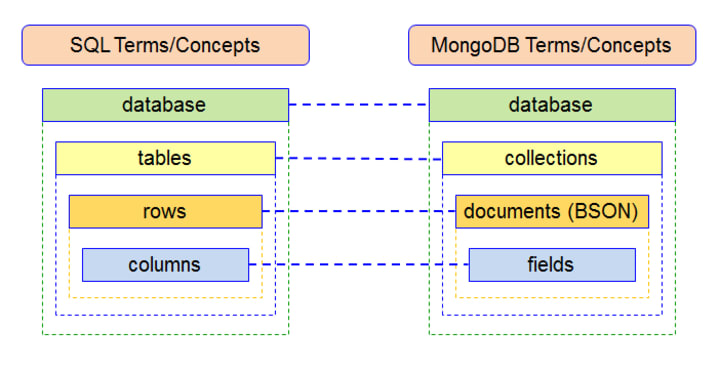
MongoDB is a NoSQL database, which means it doesn’t rely on the traditional table-based structure you might associate with databases like MySQL or PostgreSQL. Instead of rows and columns, MongoDB uses a flexible document model to store data in JSON-like objects. These objects are called documents & they are grouped together into collections. This structure allows MongoDB to handle large amounts of diverse data more efficiently than traditional databases.
For example, while a SQL database requires you to define a rigid schema (e.g., a table where every entry has a specified set of fields), MongoDB doesn’t impose any such restrictions. You can have one document with 10 fields and another document with 5 fields in the same collection without causing any issues.
Why MongoDB?
You might be wondering, "What makes MongoDB special?" Well, it is not just one thing. There are several reasons developers and companies choose MongoDB over other databases:
1. Flexibility
In a fast-paced development environment, the last thing you want is to be limited by the database. MongoDB is schema-less structure allows you to easily adjust and modify the data model as your application evolves, making it great for startups and projects where requirements are constantly changing.
2. Scalability
One of the biggest challenges with traditional databases is scaling them. As your app grows and starts handling more users or larger datasets, scaling can become a real headache. MongoDB is designed to scale out horizontally. This means you can spread data across multiple servers, which is particularly useful when dealing with huge volumes of data.
3. Document-Oriented
Instead of breaking down data into tables and rows, MongoDB stores data as JSON-like documents. This makes it easier to store and work with complex data structures. For instance, if you are building a social media app, a user is profile data might include their name, posts, friends, photos & more all stored together in one document rather than spread across multiple tables.
4. Speed
MongoDB is designed to handle large datasets quickly. It is particularly well-suited for applications that require high-speed data access, such as real-time analytics, content management systems & IoT applications. Because it doesn't need to perform complex joins or follow rigid schemas, MongoDB can process requests faster in many cases.
Key Concepts in MongoDB
Before you get started with MongoDB, it is essential to understand some of the core concepts. These might feel a little different if you are used to working with relational databases but don’t worry they are pretty straightforward!
1. Document
A document in MongoDB is the basic unit of data. It is a JSON-like object that can contain fields and values. Each document is a self-contained record & fields can be simple values (like strings, numbers or booleans) or more complex structures (such as arrays or nested documents).
Here, we have got a document that represents a user. The hobbies field is an array & you could also have nested documents (like an address field containing multiple subfields such as street, city & zip code).
2. Collection
A collection is essentially a group of documents. Think of it like a table in a traditional database but without the fixed schema. A collection might store documents about users, products or any other type of data you need for your app.
3. Database
A database in MongoDB is a container for collections. You can have multiple databases on the same MongoDB server & each database can have multiple collections. It is a simple hierarchy: a database contains collections & collections contain documents.
4. Replica Set
MongoDB supports replication, which means you can keep copies of your data on multiple servers to ensure it is always available. A replica set is a group of MongoDB servers that maintain the same data. If the primary server goes down, one of the secondaries can take over, ensuring minimal downtime.
5. Sharding
When your data becomes too large for a single server to handle efficiently, MongoDB allows you to split your data across multiple servers using a process called sharding. This helps maintain performance even as the amount of data grows exponentially.
Installing and Using MongoDB
Now that you have an idea of what MongoDB is and what it does, let’s talk about getting started. Thankfully, setting up MongoDB is pretty straightforward.
1. Installation
MongoDB can be installed on most operating systems, including Windows, macOS & Linux. Simply head over to the official MongoDB website and download the appropriate package for your system.
2. Basic Commands
Once MongoDB is up and running, you can interact with it using the mongo shell or any number of programming languages (like Python, JavaScript or Java) using one of MongoDB is drivers.
Here are some basic commands you’ll want to know:
Insert Data: To insert a new document into a collection, you would use the insert command:
db.users.insert({ name: "Jane Doe", age: 25 })
Find Data: To query data, you can use the find command:
db.users.find({ age: { $gt: 20 } })
Update Data: If you need to update a document, use the update command:
db.users.update({ name: "Jane Doe" }, { $set: { age: 26 } })
Delete Data: To remove a document from a collection, use the remove command:
db.users.remove({ name: "Jane Doe" })
Conclusion
MongoDB is an incredibly powerful and flexible tool that can handle a wide range of data storage needs. Its document-based model makes it easy to work with complex and evolving data & its scalability makes it a great choice for applications of all sizes. Whether you are just starting a small project or building a large-scale application, MongoDB Training is definitely worth exploring.
About the Creator
Keep reading
More stories from Steve Diaz and writers in Education and other communities.
What is Salesforce Marketing Cloud? Key Components & Benefits
In todays digital age, businesses are constantly searching for ways to enhance their marketing efforts & connect with their customers on a more personalized level; One powerful tool that has emerged to address these needs is Salesforce Marketing Cloud; But what is Salesforce Marketing Cloud? & how can it benefit your business? Lets delve into the key components & benefits of this robust marketing platform;
By Steve Diazabout a year ago in Education
Why Network Automation Is Transforming the Way Businesses Manage IT?
Businesses are operating in an increasingly connected world, where managing complex networks is highly challenging, due to the growth of connected devices, applications and data traffic. One of the most important technological advances of recent years is the increased adoption of network automation to address these growing challenges. Once viewed as a specialized function only for bigger IT departments and technologists, network automation is now seen by organizations of all sizes as a way to increase efficiency, reduce errors and increase performance.
By Akshay Kumar7 days ago in Education
Is the Universe Deterministic or Free? Exploring Fate, Free Will, and the Laws of Physics
What Is Determinism? Determinism is the idea that every event is the inevitable result of preceding causes. If you knew the exact state of the universe at one moment — including the position and momentum of every particle — you could, in principle, predict the entire future.
By shahkar jalal2 days ago in Education
Blessed 33
So I woke up on the morning of February 5, 2026 and guess what and you know what I realized? It’s my 33rd birthday. Do you know what that means? Yes, technically I’m getting old, but what I couldn’t have guessed was this would be one of the best days of my life.
By Joe Patterson5 days ago in Confessions




Comments
There are no comments for this story
Be the first to respond and start the conversation.