
Gap Analysis and Career Development Plan
Management

Part A
1. Gap Analysis and Career Development Plan
Introduction
As employees’ career progression depends on a number of personal and professional qualities known as employability skills. It is essential to realize the paramount role this set of elements plays in establishing a successful career. Furthermore, professional development is the place which will assist to improve these skills so that people remain sufficient and relevant in their chosen field. In a rapidly changing professional environment, career goals should be strategically planned and any identifiable gaps closed with an eye to consistent achievements of long-term objectives in one’s profession. Thus, the purpose of this assignment is to overview one vital connection between employability skills, career advancement and personal goals.
Organisation of Interest
Microsoft Corporation is a multinational technological empire that cultivates an atmosphere of inclusivity, collaboration and growth mind set to realize the benefits diversity can have for initiating innovation.

Microsoft is a global provider of solutions in different fields including Productivity and Business Processes, Intelligent Cloud, More Personal Computing. As a Team Leader at work, I am responsible for leading teams in achieving their goals and project objectives while promoting teamwork that reflects the company’s commitment to innovation and customer satisfaction.
Future Aspirations
In the next five to ten years, my plan is to secure a position in a company like Microsoft Corporation and achieve a major leadership role such as higher management roles or Director. My goal is to contribute towards making the organization more innovative by leveraging my experience as a Team Leader in order to advance influential projects, encourages an environment of collaboration and align team efforts with company’s commitment of empowering people and organisations everywhere. I hope to become phenomenal in shaping the company’s future endeavors and raising its profile within the technology industry.
Current Status and CV
Curriculum Vitae
Name:
Contact Details:
Professional Summary
Skilled and results-oriented Team Leader with a proven record of developing team successes, reaching organisational goals. Highly skilled in fostering relationships and creativity, having strong capabilities to lead, communicate effectively and solve problems.
Education
Bachelor Degree – The University of Law, BSc (Hons) Business Management with Marketing.
[2023 - Present]
Level 3 Creative Media Studies
[2021 - 2023]
Level 2 Business BTEC First Extended Certificate
[2020 – 2021]
Ruskin Community High School,
[2018 - 2020]
Cheshire College South and West
Work Experience
Actively seeking employment
Skills
• Decision-making and Problem-solving
• Leadership and Team Management
• Communication and Collaboration
• Strategic Planning
• Project Management
Language
English
Reference
Will be furnished upon request
Gap Analysis
Skills Required for Desired Role
A strategic leadership role within Microsoft calls for various competencies, personal characteristics and career skills. Crucial competencies include strategic planning, team leadership and effective communication to lead teams toward organizational targets. It is important to have an excellent command of the latest technological developments and a deep understanding of the industry in order to make educated decisions. Adaptability, resilience and growth mentality are attributes in synch with innovation culture of Microsoft being always improved. Furthermore, necessary professional qualities are the track record of effective project results achieved, ability to build partnerships and strategic thinking.
Comparison with the Current Skill Set
Comparing these requirements with my current abilities as a Team Leader, I have good knowledge in managing teams and project delivery along with the ability to effectively communicate. However, identified shortfalls in my strategic planning proficiency and the ability to better understand emerging technology trends. To tackle this issue, I intend to take specialized professional development courses and qualifications in strategic leadership as well as new technologies. Finally, I understand the value of enhancing my adaptability and resilience to cope with unpredictable changes in a strategic leadership role. Continuous learning and networking within companies like Microsoft will help to address these gaps in my skills and qualities, aligning them with the requirements of the desired position.
Career Development Plan
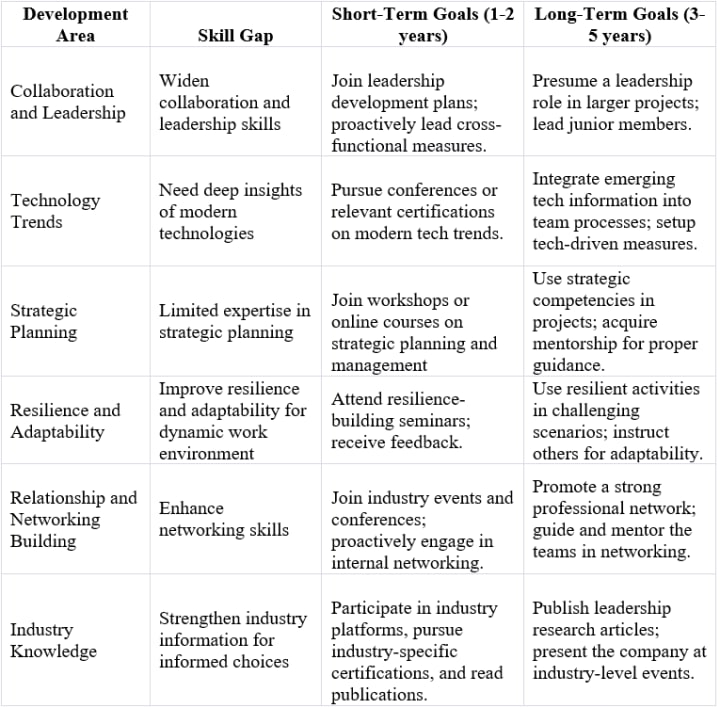
Conclusion
In conclusion, this research considers visualizing a leadership role gap analysis and professional growth strategy. The plan focuses on linking individual skills to organisational demands. It details current and future objectives of learning, as well as adaptability. Constant professional development is necessary for surviving the changing technology market and maintaining ongoing success. It aids people in achieving their career targets and assists the company to achieve success.
2. Leadership Skill
Introduction
This essay is based on contemplating and analysing the quote by Alexandre Ledru-Rollin, which implies that I am propelled by my followers with no other possibility but to guide them because they are following me. The essay aims to evaluate personal leadership in the light of this quotation, examining its influence and relevance on personal leadership philosophy.
Discussion
The Revolution in 1848 February was a period of social and political turmoil in France when the Alexander Ledru-Rollin played an important role. A strong leadership principle is “I must follow them for I am their leader”. This statement illustrates the dynamic and flexible nature of historical leadership, especially in a period when revolutionary aspirations are driven by public determination. Examining Ledru-Rollin’s remark, it can be said that a leader is to perceive and share the interests of people as true leadership consists in mutual advantage. “Let leaders be humble to meet needs of people.” This world view emphasizes empathy and adaptability as we challenge hierarchy-based leadership.
Ledru-Rollin’s suggestion that effective leadership indeed requires a real bond with followers would touch my heart. A servant leadership ideology places team needs first and fosters collaboration to reach objectives. This method highlights team inputs and direction to develop synergy and a shared vision. The phrase, I would say a good leader is one who understands and cater to the changing needs of his team. Flexible leadership fosters collaboration and inclusion, leveraging group strengths and ideas. By making leadership objectives unite with team goals, this method encourages innovation and a sense of ownership.
Own Leadership Style Assessment
My leadership style can be described as participative and transformational. Teamwork is something I value and will promote feedback to develop a sense of ownership. In the past, success was achieved due to positive team culture. My leadership style is characterized by setting the team accountable and inspiring them. Creative problem-solving and high team morale in difficult projects have been achieved through collaboration. Team feedback encourages the notion that environments promoting diversity improve both individual performance and collective success. The essence of my leadership style is adaptability, as I communicate, assist and modify techniques. Flexibility allows me to adapt my leadership style according to the team dynamics and project demands.
There are similarities with my leadership style and Ledru-Rollin’s focus on collective approach. It means both discuss about aligning leadership with team objectives. This corresponds to my collaborative, responsive attitude as a leader. There have been challenges due to diversity which had to be overcome with caution. I have managed to overcome leadership issues through my skill of adaptability, which enabled me to alter the approach while maintaining the unity within a team.
Conclusion
The project focused on professional development, leadership philosophy and their own personal growth. Discussions centered on the importance of aligning skills with organisational demands. It included a career strategy, leadership evaluation and one of Ledru-Rollin. The quotation very strongly appeals to me personally. My personal road in leadership helps me focus on the principles of cooperation, changeability, and a constant improvement towards winning for both teams.
Part B: Reflective Essay
Learning Journal
This journal documents my key learnings from the Academic and Employability Skills module. Each week I reflect on topics taught and how new skills impact my personal and professional development. Continual self-improvement is my goal through documenting experiences gained.


Self – Reflection
Topic 1: Personal and Time Management
The most inspiring topic I learned about was personal and time management. This resonated strongly as I previously struggled with prioritisation and focusing on what mattered most. Workshop 2 taught critical strategies like the Eisenhower Matrix and time blocking. Categorising tasks by importance and urgency revolutionised how I approached my to-do list (Briones and Romero, 2020). I realised most of my stress came from trying to do everything at once, instead of sequencing key deadlines. Blocking dedicated time for important tasks, communication and deep work prevented constant distractions from derailing my progress (Griffin, 2022). Keeping a time log also greatly improved my self-awareness. I was astonished by time wasted on unimportant tasks like social media versus productive work (Perreault and Power, 2023). Simply tracking my hours revealed areas for optimisation. With a clearer picture of where time leaks occurred, I could make wiser trade-offs.
This newfound understanding profoundly impacted my mindset. Previously believing I was “always busy”, I now felt empowered versus overwhelmed. Strategic prioritisation freed up capacity rather than adding pressure. I also developed a stronger internal locus of control, prioritising outcomes versus activities. Going forward, I will continue refining my system. Daily and weekly planning with estimated task durations keeps me accountable. Regular breaks recharge my focus so I do not burn out (Vveinhardt and Sroka, 2022). Multitasking is also being replaced with single-tasking to optimise flow. Incorporating time management into my workflow has noticeably boosted my productivity and work satisfaction. I am accomplishing more goals while enjoying an improved work-life harmony. The strategies will undoubtedly support my studies and career endeavors by maximising output within set time constraints. Overall, gaining perspective on personal effectiveness has been extremely inspiring and impactful.
Topic 2: Decision-Making
The second most inspiring topic I learned about was decision-making. Before Workshop 9, I would often struggle with important choices due to feelings of anxiety or uncertainty. However, being taught practical frameworks really boosted my confidence in this area. We covered techniques like decision trees, opportunity cost analysis and the pros-cons list, all of which helped systematically assess various options against key criteria (Zhu et al., 2020). This structured approach calmed my nerves by focusing solely on facts rather than gut feelings. I also gained appreciation for how small decisions accumulate into significant consequences, both positive and negative. The case study exercises were particularly impactful as they allowed real-world application (Fahmi and Ali, 2022). Deconstructing complex scenarios into step-by-step problems to be solved switched my mindset from one of panic to one of strategy. I found peace in knowing a logical process existed, rather than leaving decisions to chance.
Workshop discussions highlighted common pitfalls like loss aversion bias, status quo bias and short-term thinking. Mindfully recognising these fallacies ahead of time now helps prevent skewed analysis. Overall, decision-making felt less arbitrary and more like a tangible skill I could develop. Going forward, I plan to regularly apply techniques I learned. Maintaining decision logs and reviewing past choices will further enhance my judgement abilities over time. Learning to rapidly assess pros, cons and risks before committing to a certain path empowers me with necessary flexibility (Black, 2023). While some uncertainty is inevitable, being equipped with evidence-based strategies significantly boosts my confidence. I am excited to apply strategic decision-making across both my studies and future career, where calculated risks and pivots will likely be routine. The workshop opened my eyes to decision-making as a key professional competency worth mastering.
Topic 3: Leadership and Team Building
The third most inspiring topic was leadership and team building skills covered in Workshop 3. As someone who prefers working independently, I found this area quite challenging initially. However, the interactive activities really widened my perspective. We discussed theories like Tuckman's forming-storming-norming-performing model of group development (Stroud Stasel, 2019). This helped me understand why conflicts naturally arise as a team comes together, instead of taking issues personally. We also analysed different team roles using Belbin's role taxonomy (Pfutzenreuter et al., 2020). Performing Belbin's self-perception inventory highlighted my preferences for roles like Plant and Monitor Evaluator. Understanding my tendencies prepares me better to balance strengths with areas needing development. Group work applying core leadership concepts was most impactful. Guiding discussions highlighted soft skills like active listening, questioning to draw others out and managing diverse viewpoints (Super, 2020). I realised leadership is less about job titles and more about one’s ability to motivate others. Facilitating productive team dynamics will serve me well in any industry requiring cooperation. Going forward, I aim to proactively develop “people skills” further. Assuming more responsibility on group projects will refine my emotional intelligence and ability to delegate tasks strategically. I will also keep an open mindset, seeking to understand different viewpoints versus stubbornly insisting on my way. While collaboration remains an ongoing challenge, these learned frameworks for success make the skills far less intimidating to strengthen long-term.
References
Black, K., 2023. Business statistics: for contemporary decision making. John Wiley & Sons.
Briones, M.A. and Romero, V.A., 2020. Examining the Personal Factors Affecting Licensure Examination Preparation. Journal of English Education and Linguistics, 1(2), pp.72-83.
Fahmi, I. and Ali, H., 2022. Determination of Career Planning and Decision Making: Analysis of Communication Skills, Motivation and Experience (Literature Review Human Resource Management). Dinasti International Journal of Management Science, 3(5), pp.823-835.
Griffin, R.W., 2022. Fundamentals of management. Cengage Learning, Inc..
Perreault, M. and Power, N., 2023. Work-life balance as a personal responsibility: The impact on strategies for coping with interrole conflict. Journal of Occupational Science, 30(2), pp.160-174.
Pfutzenreuter, T.C., de Lima, E.P. and Frega, J.R., 2020, December. Building high performance teams. In International Conference of Production Research–Americas (pp. 251-264). Cham: Springer International Publishing.
Stroud Stasel, R., 2019. Forming, Storming, Norming, Performing and Adjourning: Leadership Lessons from some Youth Thespians.
Super, J.F., 2020. Building innovative teams: Leadership strategies across the various stages of team development. Business Horizons, 63(4), pp.553-563.
Vveinhardt, J. and Sroka, W., 2022. What determines employee procrastination and multitasking in the workplace: personal qualities or mismanagement?. Journal of Business Economics and Management, 23(3), pp.532-550.
Zhu, Y., Tian, D. and Yan, F., 2020. Effectiveness of entropy weight method in decision-making. Mathematical Problems in Engineering, 2020, pp.1-5.
Important Notes:
The purpose of this assignment is to overview one vital connection between employability skills, career advancement and personal goals. It focused on professional development, leadership philosophy and their own personal growth.
Management is the process of completing a task to accomplish an organisation’s goals and objectives. It is the main focus of every organisation which aims at the smooth working of the corporate and its employees. Students who find difficulty in writing their management assignment can seek help from online assignment help UK services to get the expert’s management assignment help.
Are you looking for help with management dissertation to get good grades? Avail online management dissertation help from reliable online writing services to get flawless management dissertation that helps to score the best grades.
About the Creator
Keep reading
More stories from Lucy Rowell and writers in Education and other communities.
Why Creative Thinking is the Catalyst for Higher Productivity
In many professional settings, creativity and productivity are often seen as separate, even conflicting, concepts. Productivity is typically associated with structure, deadlines, and measurable output, while creativity is considered unstructured, unpredictable, and harder to quantify. But this outdated thinking overlooks a critical truth: a creative mindset is a powerful driver of productivity.
By Norman Badger6 days ago in Education
📢 Raise Your Voice Thread: 01/22/2026
Our “Raise Your Voice Threads” are hosted most alternating Thursdays at 12PM ET to offer creators more avenues to uncover exceptional stories on Vocal. As we are continuously searching for fresh creators and inspiring stories, this thread provides an opportunity to exchange and discuss the stories that have moved and motivated us on Vocal.
By Raise Your Voice by Vocal5 days ago in Resources



Comments
There are no comments for this story
Be the first to respond and start the conversation.