
"From the Classroom to the Stars: Newton’s Groundbreaking Achievements"
. "The Extraordinary Mind of Isaac Newton: A Legacy That Shaped Modern Science"

Bio graphy
Isaac Newton's work in physics, particularly his groundbreaking discoveries in gravity and optics, forever changed our understanding of the natural world. His contributions were not just revolutionary in the 17th century; they laid the very foundations for modern science, shaping the way we view the universe today. This story unravels how Newton’s work unveiled the secrets of the universe, altered scientific thought, and left an indelible mark on history.
The Beginning: A Quiet Genius
Born in 1642: Newton was born on January 4, 1643, in Woolsthorpe, England. His early life was marked by tragedy, as his father died before he was born, and his mother remarried, leaving him to be raised by his grandmother.
Cambridge and Early Studies: Newton enrolled at Cambridge University in 1661, where he immersed himself in mathematics, physics, and philosophy. It was here that he began to develop his groundbreaking theories.
The Great Plague of 1665-1666: A pivotal moment in Newton's life came when the plague forced Cambridge to close. This isolation allowed him to focus entirely on his work. During this period, Newton made several of his most significant discoveries, including his work on gravity and the early foundations of calculus.
The Discovery of Gravity: A Stroke of Genius
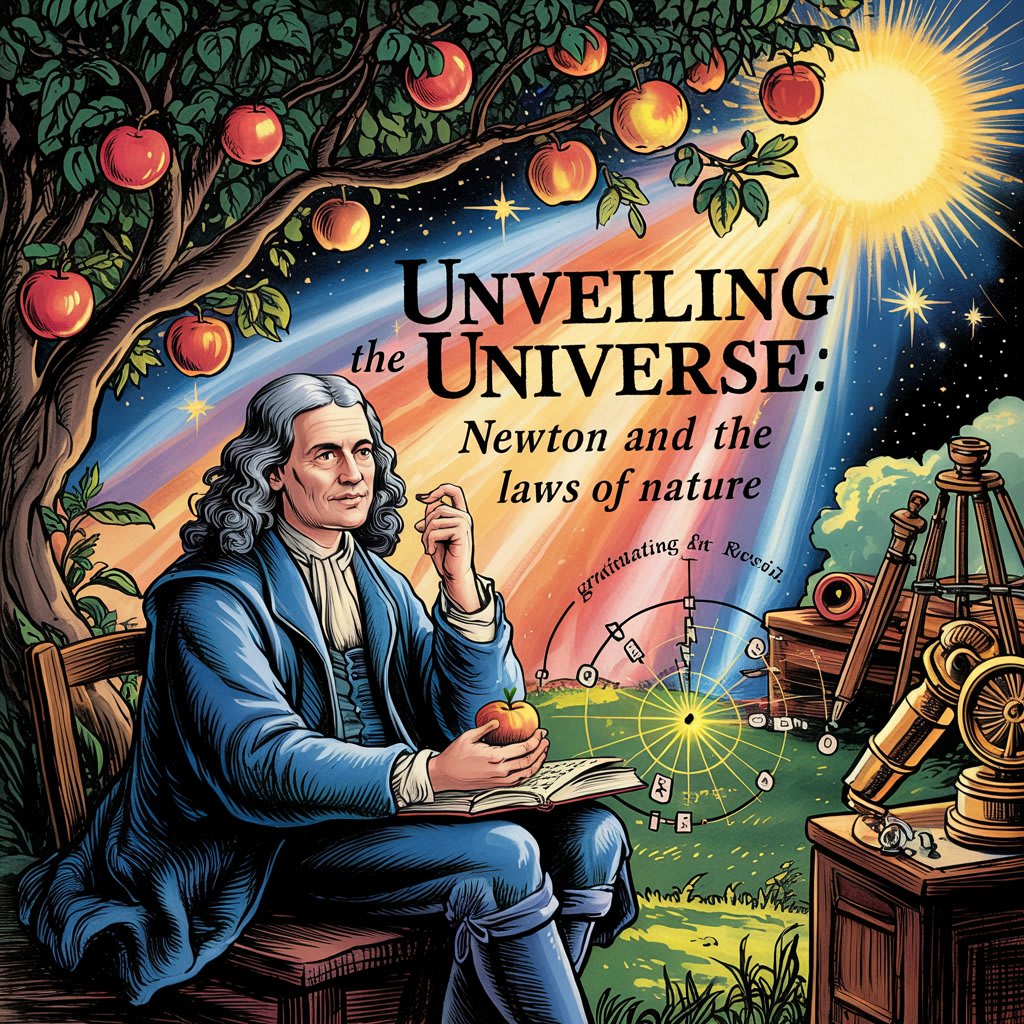
The Falling Apple: Legend tells that Newton was sitting under an apple tree when an apple fell to the ground, sparking the question that would change science forever: "Why do objects fall straight down?" This moment of inspiration led him to explore the concept of gravity.
Universal Gravitation: Newton theorized that the same force that caused an apple to fall to the ground also governs the motion of the planets. He proposed that gravity was a universal force that acted on all objects, regardless of their size or distance. This was a radical departure from earlier ideas, which were confined to Earth’s surface.
The Mathematical Formulation: In his Principia Mathematica (1687), Newton formulated the law of universal gravitation: "Every particle of matter in the universe attracts every other particle with a force that is directly proportional to the product of their masses and inversely proportional to the square of the distance between them." This law explained not only the motion of objects on Earth but also the orbits of the planets and the moon.
The Impact: Newton’s law of gravity proved that the universe was governed by a set of universal principles, forever altering our understanding of the natural world. It unified celestial and terrestrial mechanics, which had previously been considered separate.
The Revolution in Optics: Unveiling the Secrets of Light
The Nature of Light: Newton's curiosity about the nature of light and color led him to conduct experiments using prisms. He discovered that white light was not pure, but a mixture of all the colors of the spectrum.
The Prism Experiment: In 1666, Newton passed a beam of sunlight through a prism, and to his astonishment, it separated into a spectrum of colors—red, orange, yellow, green, blue, indigo, and violet. This experiment demonstrated that light is composed of different colors, which could be separated and recombined.
The Theory of Color: Newton concluded that color was not a property inherent in objects but rather a result of the interaction between light and the objects it illuminated. His work laid the foundation for the study of optics and color theory.
Reflecting Telescope: In addition to his work on light, Newton also invented the reflecting telescope in 1668. Unlike previous telescopes, which used lenses, Newton’s design used mirrors, eliminating the problem of chromatic aberration (color distortion) caused by lenses. This invention greatly improved the power of telescopes and contributed to advancements in astronomy.
The Principia and the Birth of Modern Physics
The Magnum Opus: In 1687, Newton published his Mathematical Principles of Natural Philosophy (Principia), a work that revolutionized physics and astronomy. The Principia contained the laws of motion and the law of universal gravitation, which became the foundation for classical mechanics.
The Three Laws of Motion: Newton's three laws of motion described the relationship between a body and the forces acting upon it. These laws laid the groundwork for the entire field of classical mechanics:
1. Inertia: An object in motion stays in motion unless acted upon by an external force.
2. Force and Acceleration: The force acting on an object is equal to its mass times its acceleration (F = ma).
3. Action and Reaction: For every action, there is an equal and opposite reaction.
Impact on Astronomy: With the law of gravitation, Newton was able to explain why planets move in elliptical orbits, why the moon orbits the Earth, and why the tides rise and fall. His work in astronomy and physics helped confirm the heliocentric model of the solar system, with the Sun at the center, and it inspired future astronomers like Johann Kepler and Albert Einstein.
The Lasting Legacy
A New Scientific Era: Newton’s discoveries in gravity and optics paved the way for the Age of Enlightenment and the scientific revolution. His laws of motion and universal gravitation remained the dominant scientific paradigm until the early 20th century when Albert Einstein’s theory of relativity provided new insights.
Influence on Modern Science: Newton's work continues to influence fields as diverse as engineering, space exploration, and quantum physics. His contributions to optics, particularly his study of light and color, are still taught in schools today.
A Timeless Genius: Newton died in 1727, but his legacy lives on. He was not just a great scientist; he was a visionary who, through observation, experimentation, and mathematical formulation, unveiled the hidden forces that govern the universe. Newton showed that the natural world operated according to universal laws, a concept that continues to shape how we understand the cosmos.
In conclusion, Isaac Newton’s groundbreaking achievements in physics, especially in gravity and optics, revolutionized the way we perceive the universe. His scientific insights not only transformed the scientific world of his time but also provided the tools for future generations to continue exploring the mysteries of nature. Through his work, Newton didn’t just unveil the universe; he gave us the language to understand it.
About the Creator
AMK_AQIB
Passionate storyteller and creative thinker, I use words to spark emotion, inspire thought, and connect with readers around the world. Whether it's fiction, personal essays, poetry, or thought-provoking articles,
Innovation and Adaptability in Action: How to Thrive in a Fast-Changing World
The modern world changes fast. New tools, new ideas, and new challenges appear every day. People and organizations must respond with speed and purpose. This is why innovation and adaptability matter more than ever. These skills help individuals, teams, and businesses stay strong during change. They support growth, learning, and long-term success. When change feels constant, the right mindset can turn risk into opportunity. Innovation and adaptability are not abstract ideas. They are daily actions. They guide how we solve problems, learn new skills, and adjust plans. They help us move forward when old ways no longer work. In a world shaped by technology, climate issues, and social shifts, these qualities are essential.
By Brian Ferdinand5 days ago in Education



Comments
There are no comments for this story
Be the first to respond and start the conversation.