
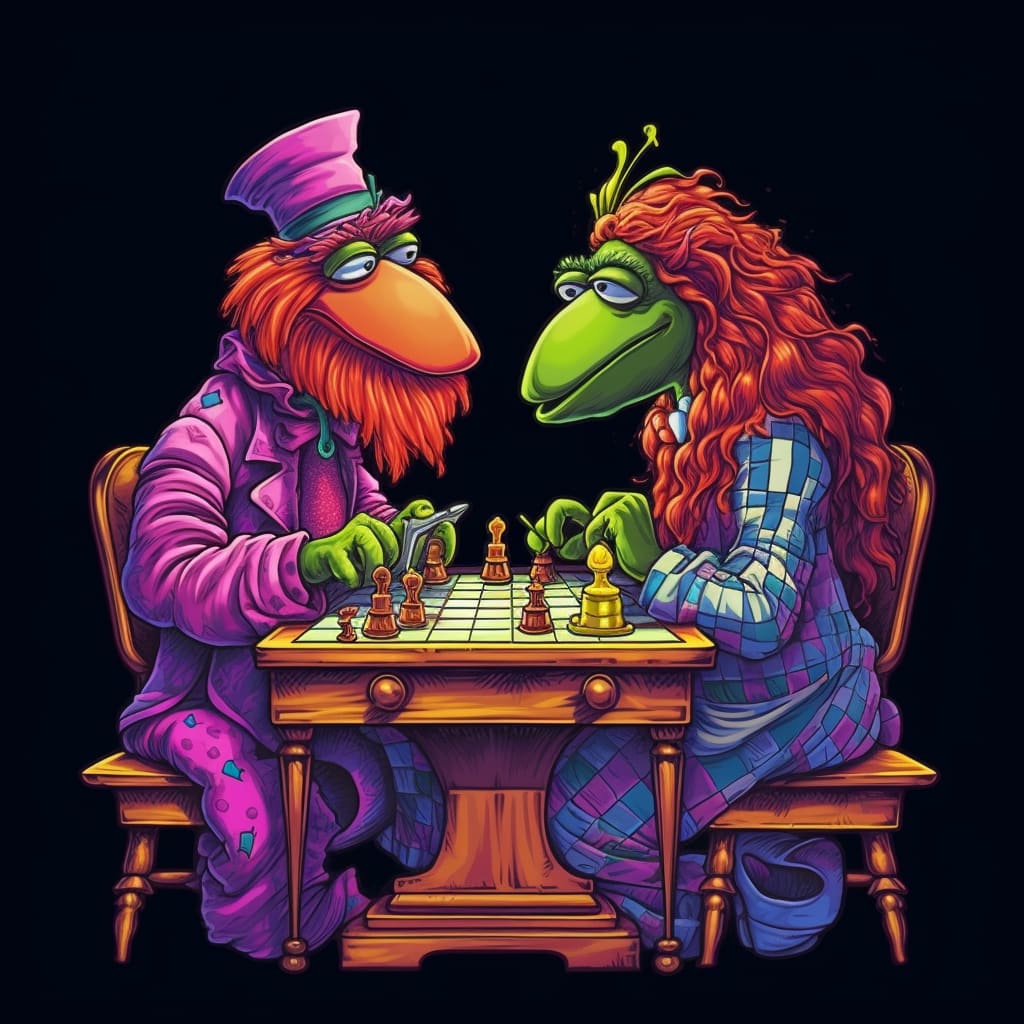
This variant of chess was created by the former World champion Bobby Fischer in 1996, with the aim of challenging players to be more creative and rely less on memorization.Despite his psychiatrical behavior later on,he is still regarded as maybe the greatest Chess Player of all time.
In Chess 960, the starting position of the pieces on the back rank is randomized, with the following restrictions: the king must be placed between the two rooks, and the bishops must be placed on opposite color squares. This creates 960 different possible starting positions, hence the name.
As a result of the randomized starting position, players are forced to think on their feet from the very beginning of the game. Memorized opening lines and traps become less important, while creativity and understanding of the game's basic principles become more valuable.
The Chess 960 variant is a problem to those who want to excel in this variant of chess. Since there are so many possible starting positions, players must be able to adapt and adjust their strategies on the fly. This requires a deep understanding of chess principles such as control of the center, piece coordination, and pawn structure.
The "Rochade", more commonly known in English as "castling", is a special chess move that involves the king and one of the rooks. This move is unique in that it allows a player to move two pieces in the same turn, which is otherwise not allowed in the game of chess. The purpose of castling is to quickly move the king to a safer position and to bring the rook into play. Here's how the castling move is typically executed:
1. **King-side Castling (Short Castling)**: The king moves two squares towards the king-side rook (from e1 to g1 for white, or from e8 to g8 for black), and then the rook jumps over the king and lands on the square the king just crossed (from h1 to f1 for white, or from h8 to f8 for black).
2. **Queen-side Castling (Long Castling)**: The king moves two squares towards the queen-side rook (from e1 to c1 for white, or from e8 to c8 for black), and then the rook jumps over the king and lands on the square the king just crossed (from a1 to d1 for white, or from a8 to d4 for black).
In Chess 960, the castling rules are slightly modified to accommodate the randomized starting positions. The king and rook always end up on the same squares they would in traditional chess, regardless of their starting positions. The king may pass over a square that is under attack in the process of castling, unlike in traditional chess.
Bobby Fischer, the creator of Chess 960, was known for his creativity and ability to think outside the box. He was a fierce competitor who wasn't afraid to challenge the status quo, which is reflected in his creation of Chess 960. His games often showcased his deep understanding of chess principles and his adaptability to varying positions.
In summary, the Chess 960 variant illustrates the ongoing evolution of chess as a game. It emphasizes the importance of adaptability, creativity, and an understanding of core chess principles. It challenges players to step away from the comfort of familiar starting positions and pre-memorized sequences, and instead engage with the game in a more dynamic and innovative way. As such, Chess 960 represents a vibrant and challenging frontier for competitive chess, which was respected by the Fide by creating the first Fischer World Championships in 2019,which was won by GM Wesley SO.Then came Corona and the world stood still.
About the Creator
Keep reading
More stories from Reinhold Lautner and writers in Education and other communities.
Unleashe your creativity with Creative Fabrica
Creative Fabrica is a fantastic tool for everyone who wants to build stunning designs and let their creativity run wild, making it such a valuable resource for designers of all levels. With over 6 million fonts, images, craft, and embroidery files, Creative Fabrica has something to offer every type of designer, from those who design for a living to those who design as a hobby or for a small business. Their enormous collection is continually updated with new and fashionable stuff, making it an excellent place to find the latest trends and styles.
By Reinhold Lautner3 years ago in Education
Natural Ways to Clear Blackheads and Whiteheads
Blackheads and whiteheads are very common skin problems that affect people of all ages. They usually appear on the nose, chin, forehead, and sometimes on the cheeks. These small bumps form when the pores of the skin become clogged with oil, dead skin cells, and dirt. Blackheads appear dark because the clogged material inside the pore reacts with air and becomes oxidized, while whiteheads remain covered by skin, giving them a white or flesh-colored appearance.
By DigitalAddi6 days ago in Education
Peter Ayolov’s Publications
Peter Ayolov is a media theorist and lecturer at Sofia University 'St. Kliment Ohridski', Faculty of Journalism and Mass Communication. His research focuses on the political economy of communication, propaganda models, digital media, narrative structures, and the transformation of language in contemporary technological environments. His work examines how digital communication systems organise dissent, amplify outrage, and reshape the relationship between media, public opinion, and political power.
By Peter Ayolova day ago in Education




Comments
There are no comments for this story
Be the first to respond and start the conversation.