

Introduction
The major emphasis of this financial analysis report will be to determine whether ABC Office Solutions should move from a partnership firm into Limited by Guarantee Company followed with an investment appraisal of a manufacturing facility and aspects relating equity finance. Calculations and recommendations are offered to help strategic decisions in the dynamic business environment.
Part 1: Meeting with the Partners
a. Explanation of Inability to Recover £10,000
In the case of ABC Office Solutions, Ali, Brenda, and Clive are unable to recover the amount of £10,000 from the shareholders of the bankrupt firm as a result of the laws that control these kinds of organizations. In this sense, an incorporated company that functions as a separate legal entity is separated from its shareholders (Dine and Koutsias, 2020). That is why shareholders benefit from limited liability whereby the extent of their financial responsibility extends to only value that they own in shares of a company. In the case of bankrupt companies, its assets are liquidated to pay off existing debts but shareholders remain protected from personal liability beyond whatever they have invested in the company.
The principle of limited liability lies in the core idea behind company law protecting shareholders against bearing debts and obligations owing to business (Douglas, 2023). When it comes to the £10,00 borrowed by a collapsed limited company before ceasing operations, this liability falls onto the corporate entity itself, and recovery proceedings are primarily aimed at the assets of such an entity. In the unsuccessful condition of insolvency, the process of liquidation means selling off items that belonged to members for repaying creditors and this is above compensating individual shareholders which is necessary to notice that the legal separation between shareholders and the company itself represents an important feature for differentiating limited companies from other forms of business organizations.
While this acts as a form of protection in regards to the individual shareholders, it also implies that when financial trouble strikes creditors such as trade partners mentioned above Ali, Brenda, and Clive may have problems receiving their outstanding debts from personal assets belonging to these individuals. Moreover, insolvency proceedings follow a hierarchy of priorities with secured creditors being preferred in comparison to unsecured ones (Eidenmüller, 2023). If there are insufficient assets to meet all outstanding debts, unsecured creditors such as ABC Office Solutions may see their claims partially or completely not met. This hierarchical structure creates a clear representation of the problems creditors face whenever they need to recover debts from insolvent companies and demonstrates the necessity for careful consideration while extending credit.
Overall, the lack of ability to get back £10,000 from shareholders at the failed company is directly connected with a principle applicable in law called limited liability which applies here to Ali, Brenda, and Clive. The separate legal nature of the limited company protects shareholders against personal responsibility, and in cases when there are insolvency creditors face complications on their travels through liquidation procedures with priority payments for debts that often mean lower chances of finding back lost sums (François and Naqvi, 2023). This makes it important for businesses to take a profound note in evaluating and addressing credit risks carefully considering the legislation that governs corporate entities.
b. Conditions for a Private Limited Company
When considering the shift from a partnership to a private limited company, Ali, Brenda, and Clive are faced with the requirement of conforming to certain conditions that characterize this kind of corporate format. A private limited company is a separate legal system governed by laws and corporate law, which impose requirements that must be met for its creation and continued existence (Laptev, 2021).
Compliance with The Regulatory Framework
Firstly, establishing a private limited company requires adherence to legislation instituted by the jurisdiction in which it is active. Some of these common elements include the filing of necessary documentation with appropriate regulatory bodies such as the memorandum and articles of association for approval (Shakhatreh and Jadallah, 2023). Besides, a specific company name must be chosen and registered to differentiate the entity from other companies in the market.
Capitalization
The second important aspect that Ali, Brenda, and Clive should pay attention to is capitalization. A private limited company is required to have a minimum authorized and issued share capital, although in many cases this figure was prescribed by the relevant jurisdictional laws. This capitalization requirement acts as a financial protection, offering some space for creditors and in line with the company’s operations.
Proper Corporate Structure
Further, a private limited company should have the proper corporate framework consisting of shareholders, directors, and firm officers each having rights obligations defined. Shareholders are the shareowners of this firm, and they have certain rights as well as responsibilities outlined in the articles’ agreement (THAKOLWIROJ and Sithipolvanichgul, 2021) thus enhancing transparency and accountability in the governance of a company.
Financial Transparency
Financial transparency is a basic condition for private limited companies where the company needs to keep an accurate financial record and prepare their annual financial statements following accounting standards (Said, 2021). This set of financial statements is usually audited by outside entities to guarantee their credibility, and reliability for shareholders some of which would include investors, creditors, and regulatory bodies.
Compliance with Tax Obligations
Another important aspect is compliance with tax obligations. Private limited companies will have to go through the complications of tax legislation and fulfill their fiscal obligations by submitting accurate on-time tax returns (Gangl and Torgler, 2020). Furthermore, compliance with employment laws is also necessary which covers fair labor practices work contracts, and other legal stipulations regarding employees.
Restriction On the Transferability of Shares
First, to operate a private limited liability company, it has been suggested that there is no capacity for share trading freely (Li et al., 2022). Different from publicly traded corporations, private limited companies have limitations in relation to how they can transfer the shares. This restriction is created to assist in maintaining control over possession and works well as such entities are close.
As such, the ultimate conclusion is that Ali Brenda and Clives decision of establishing a private limited company requires much understanding as well as adherence to many conditions among them. These include legal and regulatory requirements, financial needs, corporate governance frameworks as well share transfer restrictions. Both the success of establishment and maintenance of financial viability, as well as legal righteousness within Corporate Governance depend on due diligence to these conditions.
c) Advice on Partnership vs. Private Limited Company
As per the conditions and after outlining them, it can only be furthered through careful study as to whether Ali, Brenda, and Clive should continue running their partnership or convert into a private limited company which is tagged by accelerating this change. Each form of business structure has its unique benefits and drawbacks, and the suitability of one over another varies depending on such factors as goals, risk levels, or an operation’s dynamics at ABC Office Solutions. Being still a partnership ensures some advantages, mainly so far as simplicity and flexibility are oblivious. Usually, partnerships are less legally charged and administrative requirements compared to private limited companies (Hasan et al., 2020). Decision-making is made easier and allows for quick reactions to changes in the market or changing things internally. Partnerships have greater degrees of operational flexibility as well, making them appropriate for businesses that are built on mutable structures or change in their business models over time (Ebert and Griffin, 2020).
However, the latest financial disappointment caused by the insolvency of a client and witnessing that shareholders at the collapsed company would hardly return means increased threats in using a partnership structure (Bhattacharya, 2021). By their very nature, partnerships leave each of the individual partners exposed to unlimited liability that would also put at risk his or her assets in case business debts arise as well as legal claims. The £10,00 loss is a palpable illustration of how material each partnership’s financial vulnerability may be to the personal asset base that Ali, Brenda, and Clive possess. Thus, taking into account all these aspects the variant of switching to a private limited company appears quite reasonable. The idea of limited liability is one of the primary benefits of a private limited company. Ali, Brenda, and Clive also benefit if they incorporate because their assets remain safe from business liabilities up to the extent of them holding shares in the company. This protects their wealth, which is the most important shield against unexpected financial problems as was seen with recent insolvency (Boisjoly et al., 2020).
Furthermore, the private limited company structure strengthens the reputation and credibility of the firm for stakeholders like customers, suppliers as well as potential investors (Ross et al., 2022). As ABC Office Solutions seeks to broaden or diversify its operations, the legal separation of the company from its owners promotes an environment that is favorable for receiving capital investment. In addition, the perception of stability and corporate governance that is seen in private limited companies can also help to improve relationships with creditors as well as suppliers (Sakawa and Watanabel, 2020). Private limited companies also often provide more solid frameworks for succession planning and continuity. Share transfers promote a smooth transfer of ownership, thus promoting sustainability over the long term. Moreover, the company’s life does not depend on its owners’ lives achieving longer-term survivability compared to a partnership format.
The formation and maintenance of a private limited company entails expenses and administrative obligations, but they are frequently outweighed by the advantages, which include reduced liability, increased credibility, and the possibility of future expansion and investment (Gawer, 2021). Thus, the recent financial loss and potential of challenging economic conditions for their customers make transitioning to a private company appear like an effective strategy in the case of Ali, Brenda, and Clive. A more secure foundation for the further success and resilience of ABC Office Solutions is given by this corporate structure’s limited liability protection, as well as numerous other benefits associated with it.
Part 2: Investment Alternatives
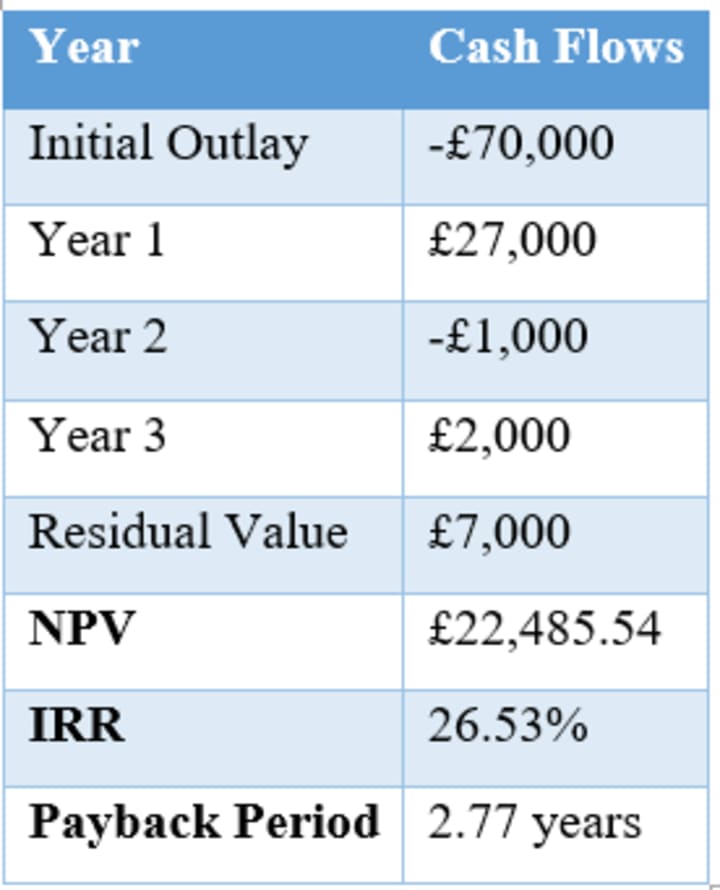
Option 1
Option 2
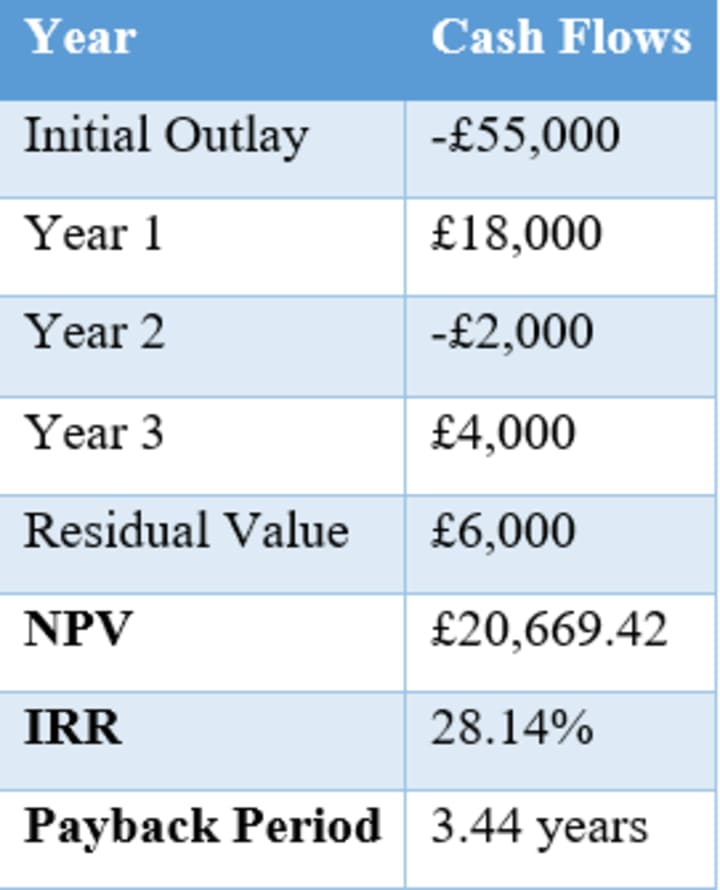
Considering the capital investment techniques, both options exhibit positive NPV and IRR, indicating potential profitability. Option 1, however, demonstrates a slightly higher NPV and a shorter payback period. Therefore, based on the provided analysis, ABC Office Solutions may find Option 1 more financially favorable. Nevertheless, the final decision should also consider qualitative factors, risk tolerance, and strategic alignment with the company's objectives.
Part 3: Equity Finance
a. Explanation of a rights issue
A rights issue is a secondary raising finance technique by corporations through selling another piece of shares at an initial fixed fee to their shareholders (Ofer, 2023). Through this method, the company can come up with cheap funds through a new issue of shares without seeking loans from outside. The preemptive right allows existing shareholders to contribute and buy new shares issued by the company in proportion to their current holdings, thereby ensuring that they remain holding proportional stakes (Wynant et al., 2023). A rights issue is normally issued at a discount to the market price and drives up shareholder participation. To address the issue of upcoming maturity for its £6 million 7% debenture, ABC Plc was evaluating a rights issue to raise equity finance from existing shareholders so that it could fund repayments and enhance financial stability.
b) Conditions that support a rights issue
Under certain circumstances, a rights issue might be the preferable method of raising long-term capital when such an option lines up with a company’s strategic objectives and financial standing. An additional feature of a rights issue as an advantageous method is the fact that it does not depend on new investors but involves existing ones which makes it attractive when a company wants to preserve or improve relationships with its group of current shareholders (Ross et al., 2022). First, a rights issue is particularly useful when the purpose of raising capital for a company does not involve taking on additional debt. In line with the above, issuing new shares to current shareholders of a company connects with internal alternatives for fundraising without having to endure some financial burden regarding interest payments on loans. This is particularly useful in cases where the company already manages a large debt burden or wishes to reduce its financial leverage (Vernimmen et al., 2022).
Second, it may be an astute decision for a company to raise revenues through a rights issue when the market situation appears favorable and thinks that its share price is undervalued (Garayli et al., 2023). A discounted offer of shares to the market price prevailing encourages current shareholders to share their rights, a capital gain at reduced cost of capital is achieved through this process. Moreover, a rights issue gives the company flexibility in terms of timing and control. The company could strategically decide at which time to exercise the rights issue, timing it with favorable market conditions or a particular milestone in the growth strategy of their business (Khanuja and Jain, 2023). The control element is seen by the fact that current shareholders continue to enjoy proportional ownership, resulting in a diminished risk of dilution and potential shifts in control witnessed with other forms of equity issuance.
Furthermore, when a company is attempting to create loyalty and dedication among the current investors rights issues achieve such an objective. It shows trust in the future performance of the company and gives a chance for stakeholders to become more involved with it helping strengthen its relationship with investors (Hasan et al., 2020). In conclusion, a rights issue is more desirable than borrowing when the company wants to avoid taking on additional debt and observes its shares are trading at an undervalued price value timing and control of funding prefers investment from current shareholders. From the above, it can be concluded that the choice of financing is dependent upon particular circumstances and strategic objectives within a company.
Benefits to shareholders of a rights issue
When a company accepts the rights issue, it may have several advantages that emerge to benefit its shareholders. First, it enables them to buy more shares at discounted prices so that they increase the overall value of their investment in this particular company (Belot et al., 2023). By exercising their rights shareholders will be able to reap the benefits of profitable pricing and expect capital gains once the market value of shares can recover. Second, engaging in a rights issue enables shareholders to retain their percentage of ownership. This protects them from dilution of their relative influence and voting rights because shares will not be issued to external investors. Additionally, contributing to rights issues signals the shareholders’ trust in their company through active participation in its fundraising activity by growing its capital sources (Chen and Bellavitis, 2020). On the whole, by accepting a rights issue shareholders can strengthen their financial leverage, gain from favorable pricing of shares, and increase confidence in delivering performance in the future.
b. Rights issue calculations
i. Number of New Shares
Result: 6 million new shares would be issued.
ii. Issue Price per Share
Result: The issue price per share would be £1.00.
iii. New Earnings per Share (EPS) and Dilution per Share
Result: The new EPS would be £0.1667, and the dilution per share would be £0.0833.
iv. Theoretical Ex-Rights Price and P/E Ratio
Result: The theoretical ex-rights price would be £1.3125, and the corresponding P/E ratio would be 7.
v. Value of Rights on New Shares
The value of rights on the new shares would be -£1.875 million.
vi. Value of Rights on Existing Shares
Result: As a result, the rights on the current shares would be worth £70.875 million.
In conclusion, figures show that, at an issue price of £1.00 per share, 6 million additional shares would be issued as part of ABC Plc's 1 for 3 rights issue. A reduction of £0.0833 would result in the new EPS of £0.1667. With a projected ex-rights price of £1.3125, the P/E ratio would be 7. The rights attached to the new shares are valued at -£1.875 million, whereas the rights attached to the existing shares are valued at £70.875 million.
Part 4: Working Capital Management
a. Explanation of cash discounts
Businesses quite often give cash discounts to encourage customers’ timely payments. First of all, fastening the cash flow is a strategic use for implementing discounts based on payments made in immediately; it will be able to incentivize clients’ son paying their invoices within an agreed time duration. This practice improves liquidity, reduces the dependence of a company on credit, and decreases reliance upon external financing. Furthermore, cash discounts improve customer relations which creates a favorable view of the business (Boisjoly et al., 2020). Business can solve their financial problems in a much better way by structuring their incentives prospects for customers to be aligned with the company’s cash management targets.
b. Keys to reduce credit costs
Other than cash discounts, businesses can use several ways to reduce credit costs as a result of delayed payments by debtors. Some proactive steps include the implementation of strict credit policies, in-depth credit assessments before providing loans, and regular monitoring of credibility to determine customer ability (Alvarez et al., 2021). In addition, the use of factoring or invoice financing can help gain faster inflows reach by transforming accounts receivable into available cash. Efficient credit management involves streamlining invoicing processes, providing for partial payments, and setting out clear credit terms as well as costs (Bhattacharya, 2021).
Conclusion
In summary, the report recommended that ABC Office Solutions enter into private limited liability in accordance with strong financial analysis. The investment appraisal indicates that Option 1 is far better in terms of viability, whereas equity finance issues focus on the benefits associated with a rights issue. These insights give a solid base to make sound decision in business.
References
Alvarez, T., Sensini, L. and Vazquez, M., 2021. Working capital management and profitability: Evidence from an emergent economy. International Journal of Advances in Management and Economics, 11(1), pp.32-39.
Belot, F., Ginglinger, E. and Starks, L.T., 2023. Encouraging long-term shareholders: The effects of loyalty shares with double voting rights. Finance, 44(4), pp.3-61.
Bhattacharya, H., 2021. Working capital management: Strategies and techniques. PHI Learning Pvt. Ltd..
Boisjoly, R.P., Conine Jr, T.E. and McDonald IV, M.B., 2020. Working capital management: Financial and valuation impacts. Journal of Business Research, 108, pp.1-8.
Chen, Y. and Bellavitis, C., 2020. Blockchain disruption and decentralized finance: The rise of decentralized business models. Journal of Business Venturing Insights, 13, p.e00151.
Dine, J. and Koutsias, M., 2020. Company law. Bloomsbury Publishing.
Douglas, K., 2023. Business Organizations as Natural Objects of Ownership. Tex. A&M J. Prop. L., 9, p.525.
Ebert, R.J. and Griffin, R.W., 2020. Business essentials. Pearson.
Eidenmüller, H., 2023. Comparative corporate insolvency law.
François, P. and Naqvi, H., 2023. Secured and unsecured debt in creditor-friendly bankruptcy. Journal of Corporate Finance, 80, p.102413.
Gangl, K. and Torgler, B., 2020. How to achieve tax compliance by the wealthy: A review of the literature and agenda for policy. Social Issues and Policy Review, 14(1), pp.108-151.
Garayli, S., Zeynallı, A. and Piriyev, N., 2023. Evolution of stock prices of digital conglomerates and impacts on the share values. Scientific Collection «InterConf», (140), pp.12-25.
Gawer, A., 2021. Digital platforms’ boundaries: The interplay of firm scope, platform sides, and digital interfaces. Long Range Planning, 54(5), p.102045.
Hasan, M.M., Popp, J. and Oláh, J., 2020. Current landscape and influence of big data on finance. Journal of Big Data, 7(1), pp.1-17.
Hazen, G. and Magni, C.A., 2021. Average internal rate of return for risky projects. The Engineering Economist, 66(2), pp.90-120.
Khanuja, A. and Jain, R.K., 2023. The conceptual framework on integrated flexibility: an evolution to data-driven supply chain management. The TQM Journal, 35(1), pp.131-152.
Laptev, V.A., 2021. Corporate Law: Legal Organization of Corporate Systems. Monograph. " Издательство"" Проспект""".
Li, W., Huang, R., Li, J., Liao, Y., Chen, Z., He, G., Yan, R. and Gryllias, K., 2022. A perspective survey on deep transfer learning for fault diagnosis in industrial scenarios: Theories, applications and challenges. Mechanical Systems and Signal Processing, 167, p.108487.
Ofer, L., 2023. Control Expropriation via Rights Offers. Forthcoming, American Business Law Journal, 60.
Ross, S.A., Westerfield, R.W. and Jordan, B.D., 2022. Fundamentals of corporate finance.
Said, S., 2021. The Influence of Transparency Accountability and Value For Money Concepts on Financial Management in the Public Sector. Point of View Research Accounting and Auditing, 2(3), pp.244-251.
Sakawa, H. and Watanabel, N., 2020. Institutional ownership and firm performance under stakeholder-oriented corporate governance. Sustainability, 12(3), p.1021.
Shakhatreh, M. and Jadallah, H., 2023. DEVELOPMENT OF E-COMMERCE WITHIN THE FRAMEWORK OF COMPLIANCE WITH FINANCIAL LAW. Financial & Credit Activity: Problems of Theory & Practice, 4(51).
THAKOLWIROJ, C. and Sithipolvanichgul, J., 2021. Board characteristics and capital structure: Evidence from Thai listed companies. The Journal of Asian Finance, Economics and Business, 8(2), pp.861-872.
Vernimmen, P., Quiry, P. and Le Fur, Y., 2022. Corporate finance: theory and practice. John Wiley & Sons.
Wynant, L., Manigart, S. and Collewaert, V., 2023. How private equity-backed buyout contracts shape corporate governance. Venture Capital, 25(2), pp.135-160.
Important Notes:
The major emphasis of this financial analysis report will be to determine whether ABC Office Solutions should move from a partnership firm to a Limited by Guarantee Company, followed by an investment appraisal of a manufacturing facility and aspects relating to equity finance.
Finance is a field of money management. Students who are enrolled in a finance course often face issues while working on their finance assignments. If you are also one of those finance students who find difficulty in writing finance assignments, you can hire an expert from assignment writing services UK to get the best finance assignment help.
Writing a finance dissertation is not a simple task. It is one of the most complex and lengthy tasks that can be perfectly written by those who have extensive knowledge of complex finance concepts. Are you looking for finance dissertation help? Don’t hesitate to seek help from various online services that offer high-quality work within deadlines.
About the Creator
Keep reading
More stories from Lucy Rowell and writers in Education and other communities.
Individual Reflective Report: The Dairy, Popular PR and Creative Design Company for Marketing
1. Introduction The Consultancy Experience Project is a major journey taken by graduate students from Nottingham Trent University. It is an important part of our learning program. This project is about The Dairy, a popular PR and creative design company for marketing, which is in West Bridgfort area of Nottingham city. The group intended to grow its business in new places. In 20 years, The Dairy has earned a positive reputation. They are best known for working with small businesses and family-run companies. People really like what they do there. The goal of this Reflective Report is to critically study and evaluate the real-world knowledge gained while leading the Consultancy Experience Project. The research examines two crucial aspects: Project Management and Team Working/Leadership. In Project Management, the key goal is to check if theories and methods learned in the module can be used when working on a project. The study concentrates on how teams work together and are led, with special focus given to international groups. It focuses on methods for getting good teamwork and different ways of leading. This report allows to look closely at the problems, successes and important points learned from this real-world project. It helps guide future progress in our personal and job concerns.
By Lucy Rowell7 months ago in Education
Benefits of Study Abroad Scholarships
Benefits of Study Abroad Scholarships Millions of students around the world long to study abroad. It's very exciting to have the chance to study at a foreign university, learn about a new culture, and build a career that spans the globe.
By Farida Kabirabout 21 hours ago in Education
Understanding Ductwork Airflow Distribution for Modern Homes
Ductwork airflow distribution is the system that moves heated or cooled air through a building. Many homeowners hear the word ductwork but do not fully understand what it does or why it matters. This guide explains the basics in a clear and simple way. By the end, you will know how air moves, why design matters, and how small issues can affect comfort and energy use.
By Lickety Split6 days ago in Education




Comments
There are no comments for this story
Be the first to respond and start the conversation.