
Individual Reflective Report: The Dairy, Popular PR and Creative Design Company for Marketing
Individual Reflective Report

1. Introduction
The Consultancy Experience Project is a major journey taken by graduate students from Nottingham Trent University. It is an important part of our learning program. This project is about The Dairy, a popular PR and creative design company for marketing, which is in West Bridgfort area of Nottingham city. The group intended to grow its business in new places. In 20 years, The Dairy has earned a positive reputation. They are best known for working with small businesses and family-run companies. People really like what they do there. The goal of this Reflective Report is to critically study and evaluate the real-world knowledge gained while leading the Consultancy Experience Project. The research examines two crucial aspects: Project Management and Team Working/Leadership. In Project Management, the key goal is to check if theories and methods learned in the module can be used when working on a project. The study concentrates on how teams work together and are led, with special focus given to international groups. It focuses on methods for getting good teamwork and different ways of leading. This report allows to look closely at the problems, successes and important points learned from this real-world project. It helps guide future progress in our personal and job concerns.
2. Project Management Reflection
2.1 Time Estimation and Effective Management
During my time as a consultant for The Dairy, I played an important role in managing how much time was needed and guessing how long projects would take. First, I tried to carefully work out how much time each task in a project would take. I used ideas and plans from my studies about managing projects that helped me do this well. However, the project had some problems because certain parts failed. After analysing it, I saw some events where my first ideas of how long something would take were too positive. This made me late to finish tasks on time. In many cases, not having enough time was a cause. It showed why we need better plans and ways to back up our schedules more often. The lessons have shown how important it is to use time wisely, guess right and quickly spot any slow-downs. In the future, I want to use these ideas for better planning. This will help me guess how long a project will take and make plans that can fix any unexpected problems rapidly (Ong et al., 2023). This experience has really helped me understand how to manage projects in the real world.
2.2 Team Structure and Planning
In the Dairy project, I carefully examined how well our planning methods work for organizing projects and teams. The first plan for the job acted like a help, but I found areas where change was needed because the project kept changing. Team's structure was imrpoved because everyone knew their job and duty, making them work well together in harmony. As part of the group, I was important for organizing and setting up work. This included helping communicate between people, coordinating jobs and promoting teamwork. Each person on the team did their own part for organizing the project, using their special skills with specific duties. This experience showed the key deal of changing plans, strong team setup and different contributions from people in teams. It helped me understand effective project management and how to work well with others better. In the future, I want to use these ideas in new projects. This will help improve planning and working as a team more than before (Kozlowski, 2018).
2.3 Communication: Navigating Client and Team Relationships
Selecting right ways to initiate communication and ongoing discussions was highly important for managing team working and connecting with clients well during the help job from The Dairy. Using tools like Slack, Zoom and Trello let people in real-time manner about jobs. These answers made the views clearer, making sure everyone knew what was happening with the project and when it would be finished. These tools are effective because they come in many types and anyone can use them. They make it easy to communicate in real-time, have videoconferences and share documents together. However, there were some issues seen mostly when not everyone was online at the same time. This was because some team members found it hard to stay up-to-date with their speedy messages and responses (Anselmann and Mulder, 2020). However, weekly online meetings were set up to deal with issues and keep a sense of being connected.
2.4 Challenges and Approaches in Dealing with Geographical Distance
The location of team members and clients caused problems. This needed new ways to work well together. The key problems were the differences in hours and changing work shifts. To tackle these issues, we started a schedule for meetings that fits everyone. This helped include all members and make them want to join in fully. A key challenge was making a link in an online space. This affected how the team worked together as one unit (Waizenegger et al., 2020). To deal with this problem, they started having easy online meetings and team-building activities. They also made sure everyone could communication freely. These projects encouraged a sense of belongingness and helping each other, making up for not being able to meet face-to-face (Belbin and Brown, 2022). It was important to communicate well in order to handle relationships with customers across far distances. Frequent changes, key event checks and online showings are now highly important (Koeslag-Kreunen, 2018). However, the absence of direct communication made it difficult to gauge customer responses (Salas et al., 2018). To handle this problem, we added extra activities to online communications. This makes customers share their thoughts right away and stay engaged fully.
2.5 Comparative Analysis of Face-to-Face vs. Online Management
Managing teams and customers online instead of face to face creates new ways of working. It changes how we communicate, help with tasks or come together as a group.
In the era of a digitalized world, online communications and messaging services take place instead of face-to-face meetings. Even though digital communicationing lets us share info fast, it could cause clues that we do not seem to be lost, this might make understanding challenging. Face-to-face communications give more complete communication because they include body language and quick answers (Offermann et al., 2021). Managing well online needs more attention on orderly teamwork. Managing jobs and time in online situations can be challenging. Effective project management software should be used for this. Having direct one-on-one communications lets the group members’ work together in an effective away, making it easier to bend (Jordan and Troth, 2021). Online teamwork mostly uses digital tools. This might limit the personal bonds that come with working together in person (Belbin and Brown, 2022).
Making a positive link and feeling sure might be harder when online, this can change how well a team works together. Gantt charts are very important in both situations. In face-to-face meetings, real maps give solid reference points. On the internet, digital Gantt charts give us updates in real time. They help with planning and tracking projects better. The value of Gantt charts comes from its ability to change for different ways we share thoughts, making sure clear understanding can be given either if it is in person or not (Jordan and Troth, 2021). Basically, internet management gives flexibility and speed while face-to-face communications provide depth and quickness. We should choose these ways based on what the project needs. It is important to use tools that can change and practices for managing projects that adapt too (Noguera et al., 2018).
3. Reflection on Team Working and Leadership
3.1 Developing Team Roles and Rules: A Collaborative Approach
To start our job with The Dairy, we had to make rules for the team and choose who would do what. This was very important. First, we all communicated together and each team member shared their ideas on the best ways to work. They also discussed how they like communicating with others and what skills they are good at using. This communication laid the groundwork for making clear team rules. These include how to communicate well, set up meetings and share out tasks properly (Sanyal and Hisam, 2018).
3.2 Reflecting on Project Effectiveness
As the project went on, it became clear how well the rules of our team were working. Sticking to fixed ways of communication and close watching kept people one major team. It stopped many chances for misunderstandings. Following the plan in the guidelines helped everyone work together for a project schedule. This made sure tasks were done on time. But, random changes showed the need for continuous checking and adjusting to better match project actions (Belbin and Brown, 2022). Clearly defined jobs and duties were important to make the team work better. Every team member got tasks that fit their abilities, which evenly split the work. Regular checkups helped team members to change easily as project needs changed. The ability to change made sure that jobs stayed important and had a key effect during the whole time of work.
Our team rules and duties were working well, shown by the successful completion of our project. However, the act of reflection found sections that could be made better. A key understanding that we developed was how important it is to check team rules and role changes often, especially when project deadlines or situations change. We learned that it is helpful to change rules if new problems come up. This shows how project management is always changing and flexible (Noguera et al., 2018).
3.3 Motivation, Idea Generation, and Harmony
The group encouraged desire in different ways. Often, people were praised for their hard work and success. This made them feel important. Encouraging open communicationing let workers share their concerns and ideas, creating a team-like setting. Adding special events and praises to show achievement greatly helped improve team spirit. This made people want more rewards, creating a positive cycle of motivation. To help grow ideas, we used brainstorming communications and places where people share thoughts. Using many different ideas, each team member helped. This made everyone more creative and inventive by sharing their thoughts. Creating a place without criticism helped people freely share their thoughts. This made sure many good ideas could be found for fixing project problems (Sanyal and Hisam, 2018).
Attempts were made to create agreement by putting in place effective ways of communicationing, setting hopes for polite teamwork and solving issues quickly. Activities that help a team work together, if done on the computer or in person, were really important to make everyone friends. Checking on the team's well-being often made a caring environment. This helped with general unity and working together better (Salas et al., 2018).
3.4 Cultural Intelligence: Exploring Key Perspectives
When I worked with a group of people from different cultures, I found many kinds of ideas, habits and ways to communication. Understanding different cultures changed into a valuable learning experience. This experience did not only make me see tasks differently, but also improved our group's way of solving problems. In this part, I spent time thinking about the ways my own culture can be unfair. Then, on purpose I tried hard to understand and use each person's special skills in our team better.
To make everyone on the team work better, I always pushed for all members to be included. Regular team meetings helped open discussions about small differences in culture and different ways of working. Considering myself was important because I kept checking my own ways of communicationing and leading the team, to make sure they worked with all kinds of people. I encouraged teamwork where members shared their different cultures as a way to create new ideas instead of seeing it like way that could affect the process.
Working in a group include several challenges as well. Our group needed flexible leadership and a focus on making everyone feel welcome, because some people had trouble with language barriers and different ways of doing tasks. Self-evaluation helped me find ways to grow in working with people from other cultures during hard times. I wanted to get feedback from my team about if I was good at making sure everyone felt heard and valued. This helped me improve how I lead others.
3.5 Leadership Roles
In our team, people naturally took on leadership roles. A person in charge of the project helped to arrange everything and made sure they stuck with their deadlines. People who know a lot about certain subjects gave help in their special areas. This encouraged them to work together nicely. Plus, informal leaders naturally appeared. They helped in making ideas, encouraging others and solving issues. There were different ways of leading, such as involving everyone and making decisions based on what the situation needs. The leader showed a powerful way of leading, getting team members to do better than expected results. The leaders of the Democratic Party made sure everyone felt welcome and listened to when making decisions (Noguera et al., 2018). Using a leadership style that changes with the situation, we adapt our approach to different project stages. This makes sure we give best help tailored for special problems.
The way leaders lead affects how the team works and what results they get from their projects. Transformational leadership led to everyone being committed to reach high standards, which made individuals and teams perform better. The Democratic leadership style made people feel like they owned the process. This encouraged creativity and new ideas to grow (Hao et al., 2018). The use of adaptable leadership, which changes with different situations, makes sure we can change and stay strong when problems come up. Using many ways together made the team work better and faster.
3.6 Individual Reflection on Leadership Roles
In my own thoughts, I realised that I am like a transformative leader. This means helping to make new ideas and creating an environment where all can work well together as a team effectively. Understanding that the team has many ways of leading made me look at my own style. I checked if it matches what we want to achieve together. This perception made me understand leadership flexibility better and its effect on a team's actions. The main key to remember was how important it is to match leadership styles with different project stages. When making up new ideas, a plan was used to get lots of thoughts from many people. But when putting those plans into action, it worked better to use strong leadership and control.
4. Lessons Learned and Recommendations
4.1 Lessons Learned
We learned extensively by watching people and groups closely. A vital finding was about the importance of using time well and properly calculating tasks. A study was done to find out why project delays happened. The waits happen because there is not enough time planning and it is challenging to forecast the time duration of tasks. Figuring out these parts gave important details for future tasks. A study by Hao et al. (2018) showed how important it is to be flexible when using different ways of talking. This helps overcome problems caused by distance apart. Working together online using websites on the internet has good and bad parts. It's important to remember that using different tools and methods can help manage distance successfully. The action showed how important it is to start quick and regular talks for a unified online space.
4.2 Recommendations: Directing Future Success
Using what we have learned before, it is best to carefully plan for our next group works in project management. This means carefully looking at the planning stage, checking for possible problems related to time use and guessing how long tasks will take. Checking and changing project plans, using what was learned before can help lower the chances of being delayed. To make teamwork better, it is highly important for new projects to first set up strong teams. Making clear team rules and tasks, while always checking how well they work improves the speed of performing tasks in a group. Using different styles of leading and matching them with the stages of a project makes it easier to adapt. This helps in dealing with problems more quickly. Stressing the importance of making team members satisfied, sharing new ideas and communicating them help in creating a positive group culture (Sanyal and Hisam, 2018).
5. Conclusion
In conclusion, considering that I have learned during this project, it would be effective to plan strategically for future project management tasks. This means doing a careful study at the planning phase, considering possible problems with time control and guessing job lengths. Checking and changing project plans often, using what we learned before, can help stop delays from happening. Also, to make teams work better together we should focus on developing them in a smart way first. This is important for future projects. Setting clear team rules and work roles, then always checking if they are working well makes the job go faster. Using different types of leadership styles with different parts of a project makes me better at adapting to the given situations. So, focusing on making the team happy and working well together helps build a good group culture. This makes them better at what they do.
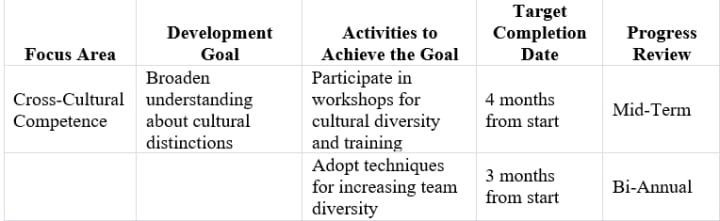
6. Personal Development Plan

References
Anselmann, V., and Mulder, R. H. 2020. Transformational leadership, knowledge sharing and reflection, and work teams’ performance: A structural equation modelling analysis. Journal of Nursing Management, 28(7), 1627-1634.
Belbin, R.M. and Brown, V., 2022. Team roles at work. Routledge.
Hao, P., He, W. and Long, L.R., 2018. Why and when empowering leadership has different effects on employee work performance: The pivotal roles of passion for work and role breadth self-efficacy. Journal of Leadership & Organizational Studies, 25(1), pp.85-100.
Jordan, P.J. and Troth, A.C., 2021. Managing emotions during team problem solving: Emotional intelligence and conflict resolution. In Emotion and Performance (pp. 195-218). CRC Press.
Koeslag-Kreunen, M., Van den Bossche, P., Hoven, M., Van der Klink, M. and Gijselaers, W., 2018. When leadership powers team learning: A meta-analysis. Small group research, 49(4), pp.475-513.
Kozlowski, S. W. 2018. Enhancing the effectiveness of work groups and teams: A reflection. Perspectives on Psychological Science, 13(2), 205-212.
Noguera, I., Guerrero-Roldán, A.E. and Masó, R., 2018. Collaborative agile learning in online environments: Strategies for improving team regulation and project management. Computers & Education, 116, pp.110-129.
Offermann, L.R., Bailey, J.R., Vasilopoulos, N.L., Seal, C. and Sass, M., 2021. The relative contribution of emotional competence and cognitive ability to individual and team performance. In Emotion and Performance (pp. 219-244). CRC Press.
Ong, M., Ashford, S.J. and Bindl, U.K., 2023. The power of reflection for would‐be leaders: Investigating individual work reflection and its impact on leadership in teams. Journal of Organizational Behavior, 44(1), pp.19-41.
Salas, E., Reyes, D.L. and McDaniel, S.H., 2018. The science of teamwork: Progress, reflections, and the road ahead. American Psychologist, 73(4), p.593. Salas, E., Reyes, D.L. and McDaniel, S.H., 2018. The science of teamwork: Progress, reflections, and the road ahead. American Psychologist, 73(4), p.593.
Sanyal, S. and Hisam, M.W., 2018. The impact of teamwork on work performance of employees: A study of faculty members in Dhofar University. IOSR Journal of Business and Management, 20(3), pp.15-22.
Waizenegger, L., McKenna, B., Cai, W. and Bendz, T., 2020. An affordance perspective of team collaboration and enforced working from home during COVID-19. European Journal of Information Systems, 29(4), pp.429-442.
Important Notes:
The goal of this Reflective Report is to critically study and evaluate the real-world knowledge gained while leading the Consultancy Experience Project. The study concentrates on how teams work together and are led, with special focus given to international groups. It focuses on methods for getting good teamwork and different ways of leading.
Many university students in the UK feel stressed due to their extreme workload. However, academic success should not come at the cost of their mental peace, which is why assignment help UK is here to make things easier for them. Seeking an online university assignment writing service reduces your stress level by offering support to meet your academic needs.
Do you struggle with writing a dissertation as a major part of your academic journey? Don’t worry! Many university students feel the same as you. To help those students, dissertation writing services UK are here to ease the dissertation burden on their shoulders.
About the Creator
Keep reading
More stories from Lucy Rowell and writers in Education and other communities.
Managing International Trade: Iran Khodro Co.
Executive Summary As a leading car manufacturer from Iran, Iran Khodro attempts to effectively manage its entry into the UK market. The report critically evaluates the political, economic-matters and society with lens of UK environment. This gives the ideas upon which appropriate strategies and alternatives for entering in the new market can be formulated. The plans involve gradually putting its products in the market, making eco-friendly product offerings, strictly following rules and changing to suit local customs. The action plan draws up a clear timetable, key stages and tasks involved in allocating resources. The report shows how important it is to know about market changes, understanding the connections between countries and trade offers while focusing on economic and other risks. Finally, this analysis gives useful recommendations for Iran Khodro to make a strong place in the challenging UK automobile business.
By Lucy Rowell7 months ago in Education
Dr. Richard Kannwischer on Christian Community in a Digital Age: Koinonia and the Ethics of Belonging
Dr. Richard Kannwischer is Senior Pastor of Peachtree Presbyterian Church and has served more than 25 years in pastoral ministry. He earned a Master of Divinity from Princeton Theological Seminary and a Doctor of Ministry from Fuller Theological Seminary. A gifted communicator, he is passionate about helping people see how the story of God speaks with clarity, depth, and relevance to everyday life. His preaching and writing blend theological rigor with storytelling, making complex truths accessible and engaging. Whether in the pulpit, on the page, or in conversation, he invites audiences into practical, life-giving Christian faith for seekers and believers.
By Scott Douglas Jacobsen6 days ago in Education
Where Wisdom Meets Action: The Deep Connection Between Culture, Education, and Service
In any thriving society, specific values act as the foundation for growth, unity, and identity. Among these, culture, higher education, and service stand out as essential pillars. While they may operate in different spheres, they are deeply connected by a shared purpose — to empower individuals and strengthen communities through knowledge, empathy, and tradition.
By Carmen Reid7 days ago in Education
Living in a hemp house
Hemp, a multi-purpose crop that delivers fibres, shivs, seeds, and pharmaceuticals is currently used in insulation materials and bio-composites for a more sustainable construction industry. Russ Martin and his wife Karon Korp tell their story as owners of the first hemp house in the U.S.
By Susan Fourtané about 19 hours ago in Interview


Comments
There are no comments for this story
Be the first to respond and start the conversation.