
Faraday’s Laws of Electromagnetic Induction
Faraday's Laws of Electromagnetic Induction: Understanding the Principles of Electromagnetic Interaction
Introduction
When I first started learning about Faraday’s work, I was fascinated by how his laws explain the relationship between electricity and magnetism. The first law clearly describes how an electric current is produced when a changing magnetic field interacts with a conductor. The second law goes further and quantifies the amount of emf generated based on the rate of change of flux. These principles are the foundation of electromagnetic induction, which plays a vital role in electrical machines and power generation.
As we move through the sections ahead, we will learn more about these concepts in detail and how they shape modern electrical applications. The next time you see a transformer or a generator, remember that these devices operate because of these two fundamental induction principles.
Faraday’s Laws of Electromagnetic Induction
In the year 1831, Michael Faraday changed the way we understand electromagnetism by conducting experiments that led to the observation of a fascinating phenomenon. His work helped predict how a magnetic field could interact with an electric circuit to produce an electromotive force (EMF), a process now known as induction. Through three main trials, he performed careful studies and discovered the fundamental laws of electromagnetic induction. He later proposed a basic law that explains how a changing magnetic field induces current. These results were groundbreaking and have been widely recognized in modern electrical applications, making his findings one of the most important contributions to science.
Faraday’s First Law of Electromagnetic Induction
When a conductor is placed in a varying magnetic field, Faraday concluded that an electromotive force (emf) is induced across it. This happens because the magnetic flux through the coil changes over time. If the circuit is closed, a current is induced, known as induced current. This was one of the key experimental observations that led to the discovery of electromagnetic induction. Faraday's first law describes how force is applied to generate this current and how the process of induction depends on the rate of flux changes. Henry also contributed to this field, helping shape our understanding of how electromagnetic induction works in a series of experiments.
Changing the magnetic field intensity in a closed loop
There are different ways to change the magnetic field intensity in a closed loop. For instance, rotating the coil relative to the magnet or moving the coil in or out of the magnetic field can cause variations. Additionally, adjusting the area of the coil placed in the field or moving a magnet toward or away from the coil also impacts the intensity of the field. These actions, when done correctly, help in understanding how electromagnetic induction occurs.
Second Law of Electromagnetic Induction
Faraday’s second law of electromagnetic induction explains that the induced emf (ε) in a coil is related to the rate of change of the flux linkage. The flux linkage is the product of the number of turns (N) in the coil and the magnetic flux (Φ) associated with it. According to Faraday’s law, this relationship helps calculate how changes in magnetic fields affect the induced force or emf in the coil. The formula captures this connection, making it easier to predict and understand the behavior of coils when exposed to varying magnetic fields.
Lenz’s Law
Lenz’s law explains the polarity of the induced emf and how it relates to the magnetic fields. It states that the induced current creates a flux that opposes the change in the original magnetic field. This is why the direction of the induced emf tends to be opposite to the direction of the change in flux. The negative sign in the formula represents this effect and shows that the direction of the induced emf and the change in the magnetic field have opposite signs.
Faraday's Law Derivation
To understand Faraday's Law of electromagnetic induction, let's consider a coil and a magnet moving relative to each other. As the magnetic flux changes, the flux linkage in the coil also changes. At any given time, we can calculate the flux linkage using the equation NΦ, where N represents the number of turns in the coil and Φ is the magnetic flux. The rate of change of this flux linkage is crucial for understanding the induced emf, which is calculated as NΦ/t or N dΦ/dt, where t is the time taken for the change in flux. The derivative of the flux gives the rate of change, which, according to Faraday's law, results in an induced emf in the coil.
Now, using Lenz’s law, we know that the induced emf always works in a direction to oppose the change in the magnetic field, which produces an opposite polarity. The effect of this opposition can be seen in the flux linkage equation, NΦ, where the increase in flux or number of turns directly increases the induced emf. Similarly, increasing the strength of the magnetic field or the speed of the relative motion between the coil and magnet leads to a larger induced emf. This fundamental principle connects the magnetic fields, motion, and flux changes to the generation of electrical power.
Faraday's Experiment: Relationship Between Induced EMF and Flux
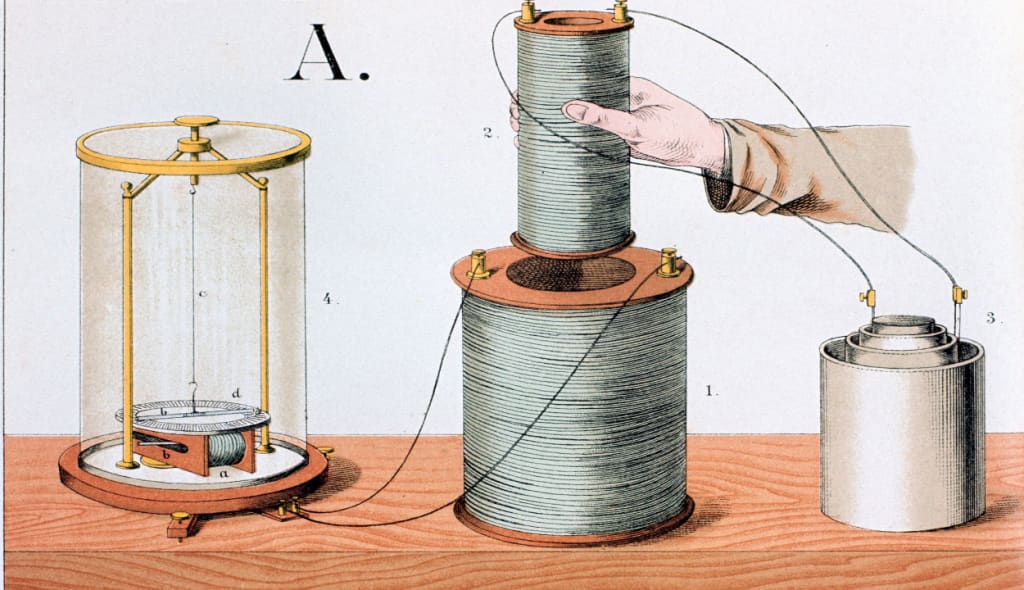
In Faraday's first experiment, he demonstrated that a magnetic field must vary to induce a current. When a magnet was moved towards a wire, the ammeter deflected, showing the induced current. However, in his second experiment, he found that when a current passed through an iron rod, it became electromagnetic, and the relative motion between the magnet and the coil caused an induced electromotive force.
If the magnet was stationary, no electromotive force was produced, but rotating the magnet induced a force, and the ammeter deflected. His third experiment showed that when the coil was kept in a stationary magnetic field, there was no deflection or induced current. But when the magnet was moved, an induced electromotive force was observed. This proved the importance of motion and varying magnetic fields in generating induced EMF.
Conclusion
In the study of Faraday’s Laws of Electromagnetic Induction, Michael Faraday showed that when there is relative motion between a conductor and a magnetic field, a change in flux occurs. This change in flux leads to the production of electromotive force (EMF) or voltage across the coil. Faraday’s law essentially states that any change in the magnetic flux over time causes an electromotive force to be produced. Flux linkage plays a key role in this, with the two laws he formulated explaining how these changes in the magnetic field result in an induced current. Faraday’s experiments laid the foundation for the understanding of electromagnetic induction.
About the Creator
Muhammad Ikram
A cultural anthropologist
Keep reading
More stories from Muhammad Ikram and writers in Education and other communities.
What is an inductor?
Introduction I remember the first time I encountered inductors in a circuit. At first glance, they looked like simple coil-like components, but their role in electronic devices is far more significant. These structures consist of a wire that is looped around a central core and is often insulated to prevent interference. Their primary functions include controlling electric surges and handling sudden spikes in current flow. By storing energy in an electromagnetic field, inductors can manage power fluctuations efficiently. When the current flow changes, they gradually release the energy back into the circuit, helping to decrease sudden variations. Unlike resistors and conductors, which primarily influence current and voltage, inductors react dynamically, making them essential in power regulation and signal processing.
By Muhammad Ikram11 months ago in Education
The Lesions of Devotion
Every day I set myself down on the freshly cut lawn and strip myself bare. I take my guitar and finger the frets and pick at the strings, listening for dissonance. My life is dissonance. I twist the tuning pegs until each string sounds bright. Then I kneel, calves pointing behind me, kneecaps facing forward. All exposed to the breeze. I close my eyes and play the melody.
By Paul Stewart2 days ago in Fiction



Comments
There are no comments for this story
Be the first to respond and start the conversation.