
Exploring the Impact of Procedural Generation in Indie Games
How Procedural Generation Transforms Indie Game Development with Infinite Replayability, Dynamic Worlds, and Scalable Content Creation

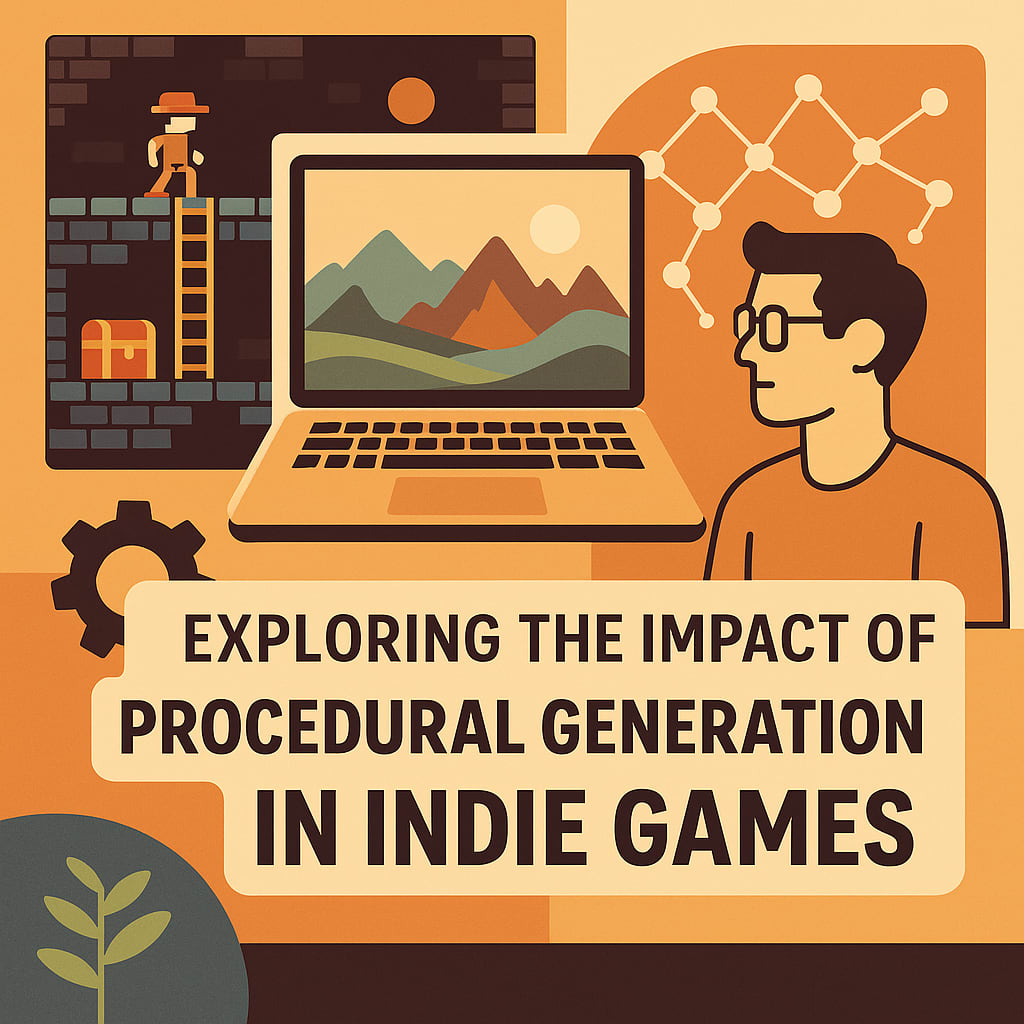
In the ever-evolving world of indie game development, procedural generation has emerged as a powerful tool that enables small teams and solo developers to create expansive, dynamic worlds without the need for massive resources. From roguelike dungeon crawlers to open-world survival games, procedural content generation (PCG) has revolutionized how content is produced, experienced, and replayed.
This article delves into the impact of procedural generation in indie games, examining how it contributes to unique gameplay experiences, the technical and creative challenges it poses, and the new opportunities it unlocks for independent developers.
What is Procedural Generation?
Procedural generation refers to the use of algorithms to automatically create content such as levels, maps, quests, enemies, items, and even entire game worlds. Unlike hand-crafted assets, procedural content is often generated on-the-fly or semi-randomly within a set of predefined rules and parameters.
In the context of indie games, PCG is a way to maximize content variety while minimizing the need for manual asset creation. Some well-known examples of procedural generation in indie games include:
- Spelunky: Randomly generated levels for high replayability.
- No Man’s Sky: Vast, algorithmically-generated planets and ecosystems.
- Enter the Gungeon: Dynamic dungeons with varied enemy placement and loot.
- Dead Cells: Procedural level layouts combined with curated design.
Benefits of Procedural Generation for Indie Developers
1. Expanded Content with Limited Resources
One of the most attractive advantages for indie developers is the ability to generate vast amounts of content with limited manpower. A single developer can create a level generator that provides hours of gameplay without individually designing each level.
This is crucial in a space where time, budget, and workforce are often constrained. By leveraging procedural systems, devs can simulate the scope of a much larger game.
2. Enhanced Replayability
Replayability is a core pillar of many successful indie games. Procedural generation ensures that each playthrough feels fresh and unpredictable, encouraging players to return repeatedly.
Games like Rogue Legacy and Slay the Spire exemplify this by offering players new challenges, layouts, and strategies in each session—an enticing prospect in the age of endless gaming choices.
3. Player-Driven Discovery
Procedural content fuels a sense of exploration and discovery. Since environments or challenges are different each time, players are often more engaged in uncovering what the game world has in store.
This emergent gameplay can lead to unexpected, delightful moments that feel uniquely personal—a hallmark of memorable indie titles.
Challenges of Procedural Generation
Despite its benefits, procedural generation comes with a unique set of hurdles that can make or break a game.
1. Lack of Narrative Cohesion
Procedural systems can lead to fragmented or shallow storytelling. Unlike hand-crafted levels with specific pacing and emotional beats, procedurally generated worlds can struggle to maintain a coherent narrative arc.
Indie developers often need to find creative ways to blend procedural systems with authored content—for instance, combining random environments with hand-written lore snippets or characters.
2. Balancing Randomness and Design Intent
Too much randomness can result in unplayable or unenjoyable experiences, while too much structure undermines the spontaneity PCG aims to achieve. Striking the right balance is a complex design challenge that requires iterative testing and refinement.
Good procedural generation doesn’t feel random; it feels intentional. This illusion of design is what separates successful PCG games from chaotic, confusing ones.
3. Debugging and QA Complexity
Testing a procedural game is inherently harder because every run can be different. This variability makes it difficult to identify bugs or balance issues consistently.
Indie teams must build robust tools to visualize and analyze generated content, and sometimes even design systems that can self-test or self-correct.
Techniques and Tools Used in Procedural Generation
Procedural generation isn’t a one-size-fits-all solution. Here are some common techniques used by indie developers:
- Noise Functions (e.g., Perlin, Simplex): Used to create natural-looking terrain and landscapes.
- L-systems and Grammars: Ideal for generating structured content like architecture, dungeons, or flora.
- Cellular Automata: Common in roguelikes for generating caves and organic spaces.
- Markov Chains: Used for generating dialogue, names, or item descriptions with statistical variation.
- Blueprints and Modular Design: Combining hand-crafted assets with procedural assembly for hybrid results.
Many modern engines like Unity and Godot offer frameworks or plugins to assist with procedural content generation, reducing the technical barrier for indie developers.
Best Practices for Implementing Procedural Systems
- Set Clear Design Goals: Know what kind of experience you want your procedural content to provide—exploration, challenge, variety, etc.
- Layer Procedural and Handcrafted Content: Combine the efficiency of procedural generation with the emotional impact of crafted experiences.
- Test with Real Players: Human feedback is crucial for balancing unpredictability with playability.
- Use Constraints Thoughtfully: Procedural systems should be bounded by rules that reflect your design vision.
- Visualize the Output: Build tools to debug and iterate on the generated content effectively.
Future of Procedural Generation in Indie Games
As AI, machine learning, and neural networks advance, we are seeing the next evolution of procedural generation: procedural creativity. AI-driven systems can generate not only levels and maps, but also music, art styles, and dialogue, offering new frontiers for indie creativity.
Moreover, community-driven content tools, like those in Minecraft or Terraria, allow players to become co-creators, extending procedural systems beyond the developer’s control and into the hands of the audience.
Procedural generation has profoundly shaped the landscape of indie game development, providing a toolkit for ambitious, content-rich experiences without the need for massive resources. While not without its challenges, PCG allows indie developers to punch above their weight—delivering replayability, surprise, and scope that rival larger studios.
When implemented thoughtfully, procedural generation becomes more than a technique—it becomes part of a game’s identity, offering infinite possibilities for creativity and expression.
Suggested Readings & Tools
- Procedural Generation in Game Design (book by Tanya X. Short & Tarn Adams)
- Unity Asset Store: Procedural Toolkit, Dungeon Architect
- Godot Engine Procedural Generation Tutorials
- Reddit: r/proceduralgeneration for inspiration and community advice
About the Creator
Richard Bailey
I am currently working on expanding my writing topics and exploring different areas and topics of writing. I have a personal history with a very severe form of treatment-resistant major depressive disorder.
Keep reading
More stories from Richard Bailey and writers in Education and other communities.
Designing Engaging Non-Player Characters (NPCs) with Limited Resources
Non-Player Characters (NPCs) are essential for creating immersive and dynamic game worlds. They provide storytelling depth, enrich the gameplay experience, and help players feel connected to the game’s universe.
By Richard Bailey12 months ago in Education
How to Start a Home Remodeling Business
Starting a home remodeling business can be a good opportunity for people who enjoy construction, repairs, and improving homes. Many homeowners want to update their kitchens, bathrooms, roofs, and living spaces, but they often need skilled professionals to handle the work.
By supun fernando2 days ago in Education
International Footballer Joins Forces With StoryZoo
An international footballer has joined forces with one of the UK’s main education platforms to launch a brand-new nationwide initiative. Levi Colwill who has played for both Chelsea and England aims to reverse the decline in children’s reading engagement by teaming up with StoryZoo to launch a brand-new scheme which will look at increasing the rate at which children gain the valuable skills they need to read.
By Ashish Prabhuabout 21 hours ago in Education


Comments
There are no comments for this story
Be the first to respond and start the conversation.