
Emperor Nero: Flames of Ambition, Shadows of Legacy
The Captivating True Life Journey of Rome’s Most Controversial Emperor
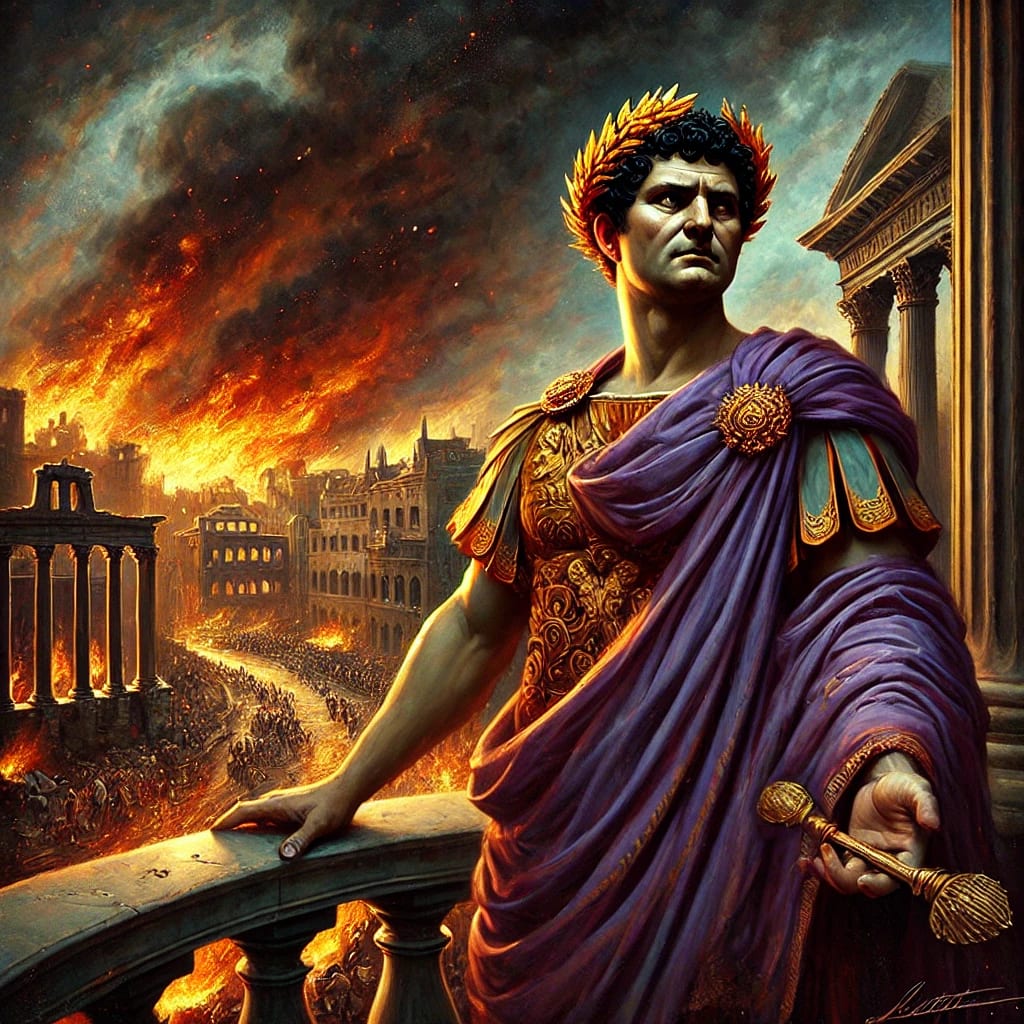
In the storied annals of ancient Rome, one name continues to spark both fascination and dread—Nero. Born into a world rife with political intrigue and volatile power struggles, Nero’s life unfolds like a dramatic epic, interweaving brilliance with brutality, artistry with autocracy. His existence was a high-stakes performance on the grand stage of history, one that still resonates with modern readers, offering lessons about the complexities of ambition and the perils of unchecked power.
Nero’s journey began under circumstances as intricate as they were fateful. Born Lucius Domitius Ahenobarbus in 37 AD, he was destined from infancy for a life intertwined with Rome’s upper echelons. His mother, Agrippina the Younger, was a woman of formidable intellect and ambition—a force determined to mold her son into a leader who would command not only the empire but also the hearts of its people. Agrippina’s relentless political maneuvering culminated in the adoption of Nero by the then-emperor Claudius, a bold act that elevated Nero from the obscure ranks of nobility to the immediate circle of imperial power. With his new name came a new destiny, setting him on a course toward ruling an empire as vast and unpredictable as the Mediterranean itself.
Ascending to the throne at just 16, Nero’s early years as emperor were filled with promise and youthful idealism. The Roman people, weary of old traditions and embattled by constant strife, looked to this young ruler with a mix of hope and trepidation. Nero’s early reign was marked by an earnest desire to merge governance with art. Unlike his forebears, he saw the role of emperor not only as the supreme arbiter of state but also as a patron of the arts—a performer in his own right. Taking to the stage, Nero recited poetry, composed music, and staged theatrical productions that delighted commoners even as they scandalized Rome’s conservative elite. This blending of political authority with creative expression made Nero an anomaly in Roman history—a ruler whose artistic passions were as celebrated as they were controversial.
Yet, the exuberance of his early rule soon gave way to a darker, more turbulent narrative. As the responsibilities of power weighed on him, Nero’s inner conflicts began to manifest in increasingly ruthless actions. His reign, while initially promising reform and cultural enrichment, gradually turned toward paranoia and cruelty. Historical accounts record a series of purges aimed at eliminating those deemed a threat to his authority—from political adversaries within the Senate to members of his own family. Critics argue that his violent measures were not solely born from the necessities of securing power in a fractious empire but also from an inner turmoil and a penchant for dramatic self-assertion. In a world where loyalty was as fleeting as the shifting sands of the empire’s borders, Nero’s harsh methods carved out a legacy defined by both genius and terror.
Perhaps no event encapsulates the duality of Nero’s character more than the Great Fire of Rome in 64 AD. As flames ravaged the city, reducing entire neighborhoods to smoldering ruins, rumors began to circulate about the emperor’s role in the catastrophe. Some whispered that Nero, with a flair for the theatrical, had orchestrated the fire to pave the way for grandiose urban renewal projects—a claim that would forever mar his reputation. Although modern scholarship continues to debate his direct involvement, the image of an emperor serenading the burning city with his lyre endures as a powerful symbol of decadence and detachment. In the wake of the disaster, Nero set about an ambitious reconstruction program, envisioning a transformed Rome that blended classical grandeur with his own innovative aesthetic. Despite these efforts, the memory of the conflagration persisted, a stark reminder that even the most visionary plans can be overshadowed by moments of catastrophic failure.
Beyond the political and military challenges of his reign, Nero’s personal life was a rich tapestry of passion, betrayal, and introspection. His relationships—whether forged in love or in political expediency—revealed the complexities of a ruler constantly torn between his public duties and private desires. The emperor’s infamous liaison with Poppaea Sabina, for example, is recounted as a union driven as much by ambition as by passion. This turbulent relationship, along with his multiple marriages and shifting alliances, underscored the inseparable link between personal indulgence and imperial policy in his life. Behind the veneer of splendor and theatricality, Nero struggled with profound isolation. His relentless pursuit of artistic expression and personal validation often clashed with the brutal demands of political leadership, leaving him to navigate a labyrinth of contradictions that defined both his public persona and his innermost self.
The later years of Nero’s rule were marked by growing unrest and disillusionment among his subjects. Economic instability, military setbacks, and a pervasive sense of injustice gradually eroded the emperor’s support base. The once-adoring crowds turned into dissenters, and the legions, which had long been the backbone of his power, began to waver in their loyalty. As conspiracies swirled and the empire teetered on the brink of revolt, Nero found himself increasingly isolated—a ruler surrounded by sycophants, yet abandoned by those who had once celebrated his youthful promise. In the face of mounting rebellion, Nero’s responses grew more desperate and erratic. His attempts to placate the populace and consolidate power only deepened the chasm between him and the very people he was meant to lead.
In a final act of defiance that was as dramatic as it was tragic, Nero chose to end his own life rather than face the ignominy of capture by his enemies. His suicide in 68 AD marked not only the end of a tumultuous reign but also the closing of a volatile chapter in Roman history. The news of his death rippled through the empire, leaving behind a legacy that was as fiercely debated as it was enduring. In the aftermath, Nero became a symbol—a personification of the eternal struggle between creative genius and destructive ambition. His life story, replete with moments of sublime artistry and unspeakable cruelty, continues to serve as a powerful allegory for the complexities of human nature and the burdens of power.
Today, the name Nero evokes images of both awe and admonition. For some, he remains a misunderstood patron of the arts whose visionary pursuits were stifled by the ruthless necessities of autocratic rule. For others, he is the archetypal tyrant, whose legacy is forever stained by blood and fire. What makes Nero’s story so compelling is precisely this tension—the interplay between light and shadow, beauty and brutality. His life challenges modern readers to confront the paradoxes inherent in the exercise of power and to question the cost of greatness when ambition is allowed to run unchecked.
As historians continue to pore over ancient texts and reinterpret the fragmentary records of his reign, the true essence of Nero’s character remains as elusive as ever. His reign, which oscillated between moments of inspired creativity and episodes of relentless cruelty, offers a nuanced portrait of a man caught between two worlds. On one side lay the allure of artistic expression and the desire to leave an indelible cultural legacy; on the other, the harsh realities of political survival in a time of constant peril and upheaval. This duality is what makes Nero’s life a subject of enduring fascination—a reminder that even the most notorious figures in history can be seen through multiple lenses, each reflecting a different facet of the human experience.
In the final analysis, the true life story of Emperor Nero is not a simple tale of villainy or virtue but a complex narrative that encapsulates the volatile interplay between ambition and downfall. It is a story that transcends the boundaries of time, inviting readers to explore the timeless themes of power, creativity, and the human capacity for both destruction and renewal. For those who seek to understand the intricacies of leadership and the enduring impact of historical legacy, Nero’s life offers a profound meditation on the cost of unchecked ambition and the fragile balance between genius and madness.
This is the story of an emperor who dared to redefine what it meant to rule—a man whose life burned as brightly as it ultimately collapsed into ashes. It is a story that continues to captivate, inspire, and caution, urging each new generation to reflect on the eternal questions of identity, legacy, and the price of greatness. In the echoes of his reign, we hear not just the lament of a fallen ruler, but the resounding call of history itself—a call to remember, to learn, and to strive for a future where power is tempered by wisdom and compassion.
About the Creator
OWOYELE JEREMIAH
I am passionate about writing stories and information that will enhance vast enlightenment and literal entertainment. Please subscribe to my page. GOD BLESS YOU AND I LOVE YOU ALL
Keep reading
More stories from OWOYELE JEREMIAH and writers in Education and other communities.
Shadows and Light
Ethan always thought that life was a series of choices, some small and insignificant, others life-altering. Growing up in a Christian household, he was taught early on about the importance of purity, not just as a moral guideline but as a path to spiritual and physical well-being. Yet, as he entered his teenage years, the allure of rebellion and the curiosity of forbidden desires began to tug at him, promising freedom and pleasure that his conservative upbringing seemed to deny.
By OWOYELE JEREMIAH10 months ago in Education
How to Become a Super Tutor on Preply
Teaching online is now accessible to almost anyone. Creating a profile, offering lessons, and waiting for students is easy. What is much harder is becoming a tutor who is trusted, visible, and stable over time. On Preply, the Super Tutor status is not a cosmetic label. It is a strong signal sent to students, to the platform, and to the tutor themselves. It reflects seriousness, consistency, and a deep understanding of what makes online learning work.
By Bubble Chill Media 5 days ago in Education


Comments (1)
Power should always be tempered! Great work