
"Echoes of a Thinking Soul"
Meditations on Love, Life, and Meaning

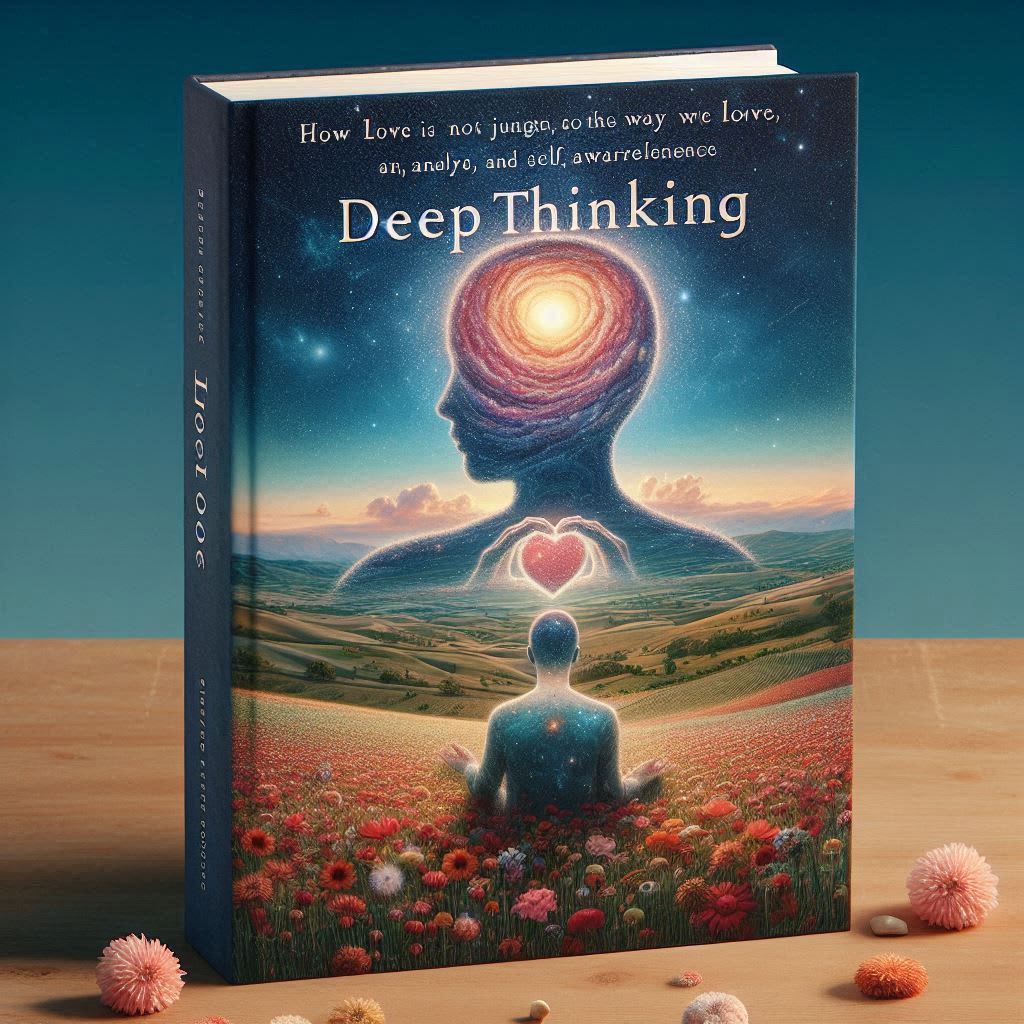
Anaya had always felt things deeply—but she never showed it. She was one of those people who looked calm even when her world was on fire. Some called her thoughtful; others, distant. She called herself a thinker. Not because she wanted to be above emotion, but because her emotions ran so deep that only thought could give them structure.
She loved solitude the way some people love the sound of applause. Her favorite nights were those spent curled under a dim lamp with a book in her hand and silence in the room. There was something sacred about reflection. It wasn't loneliness—it was intimacy with her own mind.
But everything changed the day she met Rihan.
He was the opposite of her in almost every way. Loud, expressive, full of fire and spontaneity. He wore his heart on his sleeve and laughed like he meant it. Where Anaya questioned everything before speaking, Rihan spoke first and unraveled his thoughts out loud. He was emotional, impulsive, passionate—and for reasons she couldn’t explain, Anaya was drawn to him.
They met at a philosophy seminar at the university—ironically, in a discussion about the conflict between emotion and reason. Rihan had argued, quite loudly, that emotion was the truest form of intelligence.
“If you don’t feel it, do you really understand it?” he said, eyes scanning the room, landing briefly on Anaya.
She had raised an eyebrow, amused. “Understanding isn’t always a matter of feeling. Sometimes, it’s the distance from emotion that lets you see the shape of truth.”
Their debate turned into a conversation. The conversation turned into a series of meetings. And those meetings slowly became something like love—though neither of them dared to name it at first.
He teased her about her mind.
“You think too much,” he would say, sipping coffee beside her on a cold bench in the university courtyard.
“And you think too little,” she’d counter, smiling, eyes soft behind her glasses.
But somewhere in those silences between their banter, they grew close. Rihan began to admire the way Anaya’s mind worked. The way she could see beauty in quiet things—an old poem, a falling leaf, a sentence well-constructed. He started asking her questions—not to challenge her, but to learn how she saw the world.
Anaya, in turn, began to appreciate Rihan’s honesty. His willingness to feel deeply, speak vulnerably, love openly. He didn’t hide behind thought like she did. He lived in the fire of the moment. And slowly, he taught her how to step into that fire without fear.
But it wasn’t always easy.
There were arguments—especially when their worlds clashed. Rihan accused her once of “intellectualizing everything.”
“You never just feel things, Anaya. You dissect them like they’re theories. Like people are experiments.”
That night, she didn’t sleep. She sat by her window, writing in her journal, asking herself the question she had always avoided: Was she using thought to protect herself from emotion?
She remembered her childhood—how, after her father left, she stopped crying and started reading. How she built a fortress of books and analysis to avoid the sharp edge of loss. Rihan wasn’t wrong. Thought had become her armor.
But wasn’t it also her language? Her way of loving?
She recalled how she would write Rihan long letters she never gave him—pages of reflection on what he’d said, what he meant, how he made her feel. Not because she didn’t care, but because she cared too much. Her mind was a river, and every emotion was a stone tossed into it—she needed time to watch the ripples, to understand.
The next day, she handed Rihan a letter.
It wasn’t dramatic. It wasn’t poetic. It was honest.
“I think deeply not because I don’t feel, but because I feel so deeply that I have to think. Loving you is the most alive I’ve ever felt—and the most terrifying. You challenge me to feel out loud. I hope I challenge you to reflect inward. Maybe love doesn’t live only in fire or in silence—but in the space where they meet.”
He read the letter in silence, then folded it and put it in his coat pocket.
“I don’t always get you,” he said, “but I trust what we’re building.”
From then on, their love became a balance. Anaya brought depth, reflection, and quiet meaning. Rihan brought passion, presence, and emotional clarity. Together, they learned that love wasn’t a war between thought and feeling—but a dialogue. A dance.
Years later, when they moved in together, Anaya found the letter still tucked in Rihan’s coat. Faded, but treasured.
She smiled and whispered, “Still thinking about you.”
And in the next room, Rihan called out, “Still feeling for you.”
In that moment, she realized: she was never just in love with thought—she was in love with the understanding that thought made possible. And in Rihan, she had found not just emotion, but the courage to live between reflection and fire.
About the Creator
Love of mom
A mother’s love is one of the purest and most unconditional forms of love in the world. It is a bond that begins before birth and lasts a lifetime, rooted in selflessness, care, and sacrifice. A mother's love nurtures, protects, and guides
Keep reading
More stories from Love of mom and writers in Education and other communities.
"My Journey with Nature"
I never planned to leave the city. The rush, the noise, the crowded streets—it was all I had ever known. But one evening, as the sun dipped behind skyscrapers I barely noticed anymore, I felt an emptiness I couldn’t explain. Life was moving fast, but I was standing still.
By Love of mom10 months ago in 01
Foreclosure vs. Short Sale: 7 Key Differences Every Real Estate Pro MUST Know
You are driving through a target neighborhood and spot a classic "diamond in the rough." The lawn is overgrown, mail is spilling out of the box, and the shutters are hanging by a thread. To the untrained eye, it is just a neglected house. To a seasoned real estate professional, it is a potential high-margin opportunity.
By REI Data Solutions3 days ago in Education
Olena Kalaitan on Mariupol, Journalism, Language, and War in Ukraine
Olena Kalaitan is a Ukrainian journalist and editor best known for leading Mariupol’s Pryazovskyi Robochyi newspaper and heading the Donetsk regional organization of the National Union of Journalists of Ukraine. During Russia’s 2022 siege of Mariupol, she stayed in the city for 23 days, survived the destruction of her home, and escaped on foot with her son. She later became a prominent voice for displaced journalists, media freedom, and the revival of independent Ukrainian journalism in occupied and war-affected regions. Kalaitan has also warned publicly against Russian propaganda issued under the stolen name of her newspaper during wartime occupation there.
By Scott Douglas Jacobsen5 days ago in Education


Comments
There are no comments for this story
Be the first to respond and start the conversation.