
Discipline and Punish: The Birth of the Prison – A Detailed Summary and Analysis
A Comprehensive Summary and Analysis of Michel Foucault’s Landmark Work on Discipline and Social Control
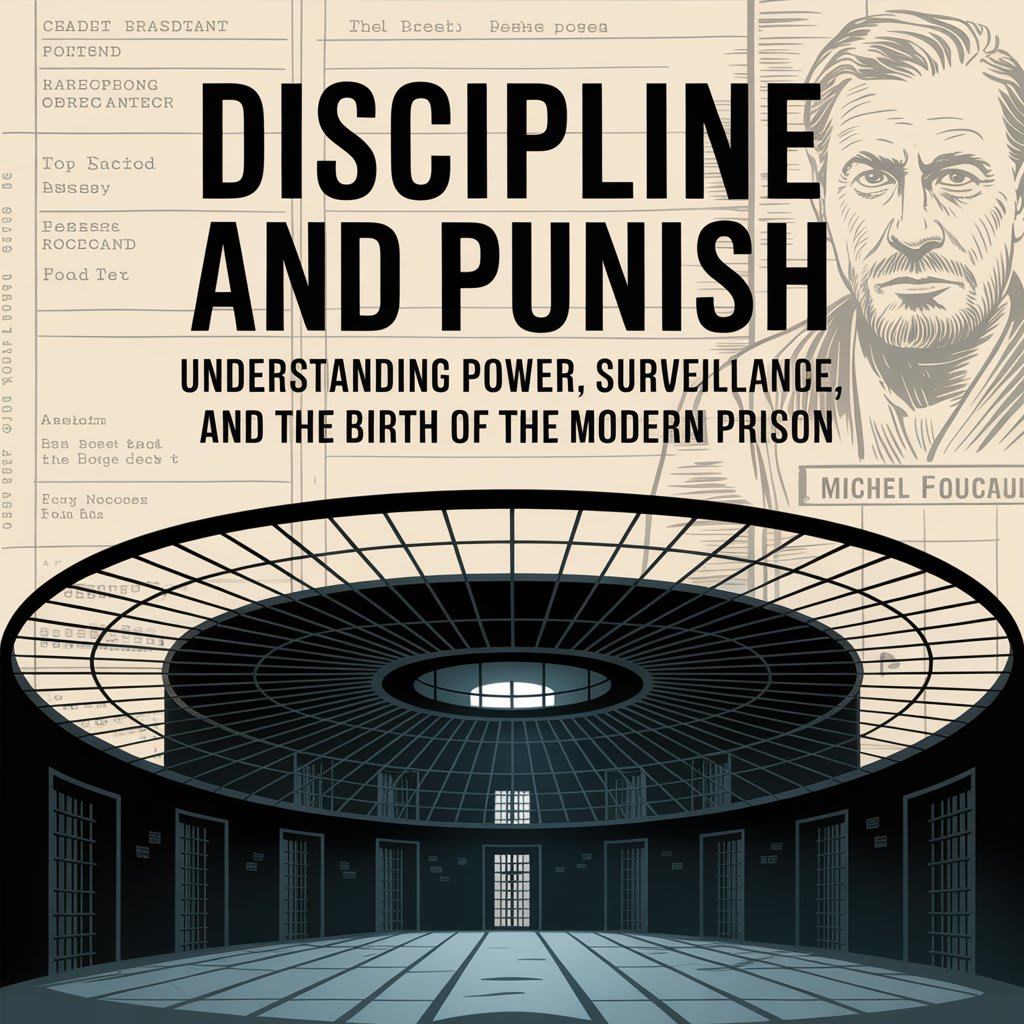
Michel Foucault’s Discipline and Punish is a seminal work in modern philosophy and critical theory, examining the transformation of Western penal systems from public, violent spectacles to more subtle, institutional forms of discipline. Foucault traces this shift from the brutal execution of regicide Damien's in 1757 to the structured surveillance of 19th-century prisons, revealing how power operates not only through law and coercion but through internalized norms and invisible systems of control.
Historical Context
Foucault wrote Discipline and Punish in the context of the post-1968 political upheavals in France, when trust in institutional power was being widely questioned. He was part of a broader intellectual movement that critiqued modern systems of control—not just governments, but schools, prisons, hospitals, and even language.
His work falls within what’s often called post-structuralism, and in this book, he introduces key ideas that have become foundational in critical legal studies, sociology, criminology, and surveillance theory.
Structure of the Book
The book is divided into four parts:
Torture
Punishment
Discipline
Prison
Each section tracks a historical and philosophical transformation in how societies punish and control.
Key Concepts and Ideas
1. From Public Torture to Institutional Discipline
Foucault begins with a vivid description of the execution of Damien's—a gruesome public spectacle designed to demonstrate the absolute power of the sovereign. He contrasts this with a 19th-century prison timetable, which represents a new kind of power: subtle, normalized, and deeply embedded in institutions.
Old power: Brutal, theatrical, based on inflicting pain to assert control.
Modern power: Quiet, systematic, internalized through institutions and routines.
Foucault argues that power has not diminished, but has become more effective by becoming less visible and more pervasive.
2. Disciplinary Power
One of Foucault’s most influential contributions is his analysis of disciplinary power—a form of power that is productive rather than simply repressive. Rather than punishing the body, modern power shapes behavior, thought, and identity.
Discipline operates through:
Observation and surveillance
Normalization (defining and enforcing norms)
Examination (tests, records, documentation)
This power is diffused through institutions like:
Schools – where timetables, exams, and rankings discipline minds.
Military barracks – where drill and routine discipline bodies.
Hospitals – where records and diagnosis control health.
Prisons – which synthesize all of the above into a total institution.
3. The Panopticon
One of the most famous sections of the book is Foucault’s discussion of Jeremy Bentham’s Panopticon—a theoretical prison design where a single guard can observe all inmates without them knowing if they’re being watched.
"The Panopticon is a marvelous machine which, whatever use one may wish to put it to, produces homogeneous effects of power."
The Panopticon becomes a metaphor for modern surveillance society:
Individuals internalize the gaze of authority.
Control becomes self-regulated, not externally imposed.
It applies not only to prisons but to schools, workplaces, and society at large.
4. Power and Knowledge
Foucault famously argues that power and knowledge are inseparable. What we consider “truth” is shaped by institutions with power to define it.
For example:
Psychiatry defines what is “sane.”
Criminology defines what is “criminal.”
Education defines what is “intelligent.”
Power doesn’t just repress; it produces—it creates categories, norms, and identities.
5. The Prison as a Model for Society
In the final section, Foucault discusses how the modern prison system is not a failure (as critics claim), but a success—in the sense that it perfectly fulfills the goals of modern power.
Prisons:
Reinforce hierarchies.
Produce a class of labeled “delinquents.”
Justify broader forms of surveillance and control.
He argues that the prison model has spread to the rest of society—what he calls the “carceral archipelago.”
Major Themes
Surveillance and the Internalization of Authority
People are no longer punished for breaking laws publicly, but are watched and molded continuously in all areas of life.
Normalization
By defining what is normal, institutions make people self-correct, producing conformity and passivity.
Invisibility of Power
Modern power is more efficient because it hides in plain sight—within procedures, norms, and technologies.
Resistance
Though Foucault describes deeply entrenched systems, he also implies that wherever there is power, there is resistance—a key idea in his later work.
Impact and Legacy
Discipline and Punish transformed how we understand:
Prisons and criminal justice
Education systems
Medical institutions
Surveillance (especially in the digital age)
It laid the groundwork for fields like:
Surveillance Studies
Critical Criminology
Postmodern Legal Theory
Political Philosophy of the Body
Criticisms
Some argue that Foucault underemphasizes the agency of individuals.
Others say he offers no concrete solutions or positive vision.
Yet, his work is valued for opening critical questions, not giving final answers.
Conclusion
Discipline and Punish is a profound exploration of how societies control bodies and minds. Foucault challenges us to question systems we take for granted—from prisons to schools—and to see how discipline operates not just in laws, but in our everyday routines, thoughts, and identities.
About the Creator
Keep reading
More stories from Muhammad Huzaifa and writers in Education and other communities.
Letting Go of Judgment
If you pause for even a few moments and pay attention to your thoughts, you’ll likely notice something surprising: you're constantly making judgments. About yourself, about others, about what’s happening, what should be happening, what shouldn’t have happened. It’s automatic. Often, it’s harsh.
By Muhammad Huzaifa9 months ago in Education
Invisible Radiation in Everyday Life
We live in a world powered by invisible signals. From the moment you wake up and check your phone, to working on a laptop, connecting to WiFi, using Bluetooth earbuds, or scrolling before bed—your body is constantly surrounded by electromagnetic fields (EMFs). They’re an unavoidable part of modern life, yet most people rarely stop to think about how continuous exposure may affect their energy, sleep, focus, and overall well-being.
By Inamullah Momand 4 days ago in Education
Core Skills Every Finance Professional Needs Today
Financial analysis is one of the most critical abilities for anyone working in finance today. Companies rely on clear and accurate financial information to make smart business decisions. Finance professionals must understand how to read numbers, study trends, and guide action based on facts. These must-have financial analysis skills help workers become stronger, more confident, and more valuable in their roles. When used well, these skills support better planning, lower risk, and long-term success. Because of this, developing strong financial analysis skills is essential for finance professionals at every level.
By Andrew Lake3 days ago in Education
Wild Card Weekend Recap: What Happens Now?
I think I figured out why I love Wild Card Weekend so much. It's because it's the first playoff anything of the calendar year. The NFL season starts in the fall, and once upon a time, the champion was crowned either on or slightly before New Year's. The evolution of the NFL schedule has resulted in the playoffs starting just into the New Year, and currently, the final week of the season falls on the first weekend of the New Year, with Wild Card Weekend coming a week after that. So yes, chronologically, the NFL's Wild Card Weekend serves as the first playoff anything of the calendar year.
By Clyde E. Dawkins5 days ago in Unbalanced



Comments
There are no comments for this story
Be the first to respond and start the conversation.