
Disaster Management Approach and Phases
Disasters are dangerous events that cause harm to humans and their source of living. Disasters are unpredictable. They come suddenly and destroy the whole area. Disasters need to be handled effectively to reduce losses and damage. This is done using a disaster management system or a disaster recovery plan. Business organizations, educational institutes, hospitals, and other firms need to have a disaster recovery plan that protects their business and assets to continue business operations after the disasters. The article includes details of disasters, the causes, and the importance of disaster management.
Introduction
The growth of technology has affected the environment in many ways. Manufacturing industries are releasing harmful chemicals in the air that disturb the environment due to which disasters occur. Changes in weather and climate will lead to natural disasters. Natural disasters are dangerous as they lead humans to death and destroy lands. The technology also increases unintentional events, like attacks and others disrupting business operations.
Disaster management is a process of avoiding and reducing the risks created by natural and manmade disasters. Business organizations are creating disaster recovery plans or business continuity plans to protect their business from these threats. Every country has disaster management plans to protect the nation and its people. Disaster management includes planning, responding to disasters, mitigating the risks, and recovering the business operations.
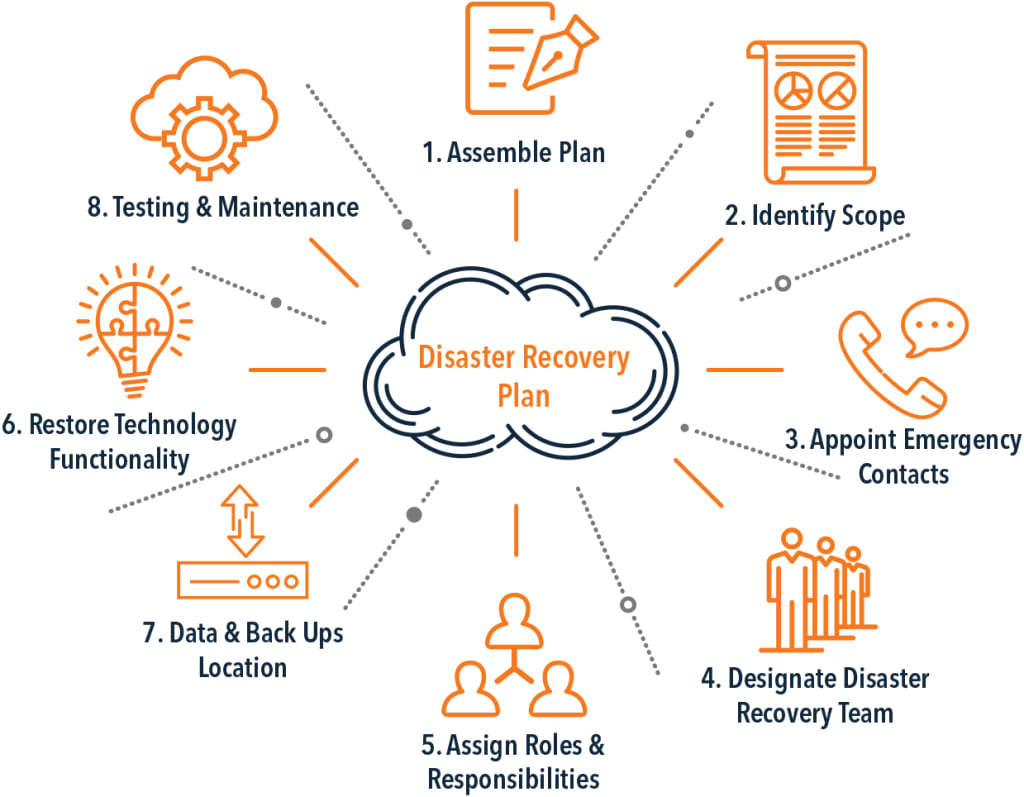
The disaster recovery plan helps either prevent the disaster from occurring or take appropriate action to reduce the risks and losses due to the disaster. The disaster manager or the team needs to identify the possible risks and threats from the external and internal factors and create a plan to reduce losses from those threats and vulnerabilities. The disaster recovery team is responsible for assuring the continuity of business operations after a disaster and protecting business assets.
The disaster recovery plan needs to include the identification of threats, creating a plan, training employees on the procedure, and maintaining the strategy for future use by updating it as and when required. A plan must be tested to ensure effectiveness so that no employee panics while using the plan during the disaster.
Types of disasters
- Natural disasters occur because of changes in the environment and climates, such as floods, earthquakes, hurricanes, and others.
- A technological disaster occurs when the computer system and automatic machines used in organizations and hospitals fail to respond correctly. All the data will be lost, and patients' lives will be at risk. The other technological disasters are cyber-attacks that target a company’s data and lead them to discontinue business operations.
- Malevolence disasters are the disasters made by humans, such as terrorist attacks in which groups of people are hijacked to demand something from the government.
Phases of disaster management
Prevention: in this phase, the organization and the employees are protected from the threats of human disasters and natural disasters using preventive measures such as a disaster recovery plan, evacuation plan, designing the organization so that the building does not harm employees doing the natural disasters, and other emergency precautions.
Mitigation: in this phase, employees and other people must be trained and aware of the disaster and risk to their health and property. They need the training to protect themselves from the disaster effects, such as creating health insurance, going to a safe place during the disaster, and using the techniques to protect themselves and other persons near to them. Preventive and mitigation measures are different from each other. Mitigation is to reduce the risks, whereas preventive measures to protect from the disasters like floods by building houses on poles, using earth earthquake valves to shut down the supply of natural gas and protecting household items, and so on.
Preparedness: preparedness will reduce the effects of disasters by creating a plan and procedure to reduce the losses and protect their assets. Some of the planning and preparedness include:
Implementation of disaster communication systems to communicate with the emergency service providers and with the family,
To install the notification and alert system in the workplace.
To create a backup of confidential assets of the organization,
To practice the developed recovery plan,
To decide about the languages to be used and the communication means to use during the disaster.
To keep emergency things and food for the employees in the workplace as they cannot go out in disaster.
Response: the organization needs to create a team that can respond quickly to the disaster situation and rescues the people near the disaster place. They need to use the plan and help the organization reduce the consequences.
Recovery: it is the final stage of disaster recovery management in which the place of disaster is recovered to normal. The data in business is restored to start business operations. The entire emergency contact list is contacted as they restore the business operations, give treatment to the employees, and ensure safety.
Disaster Management Approach
The management is responsible for assuring the safety of the organization from every crisis. They need to create different crisis management teams and plans to respond to the emergency apart from business strategies and objectives. Small organizations can keep their data backup as they cannot invest in creating disaster recovery plans. Organizations with a large volume of data need to create an effective disaster recovery plan to protect their business from every threat. The following are the steps to building a disaster recovery planning team:
The disaster management team should consist of senior managers, disaster committee members, incident handlers, technical officers, public relationship officers, legal officers, and other experts. They need to have a broad range of skills and expertise through which they need to gather relevant business information and make the right decisions. There should be one or more disaster recovery teams that can handle disasters in an emergency.
A disaster management communication center must be created so that all the communication between the disaster management team happens without disturbance.
A spokesperson with desired communication skills must be selected to communicate continuously with the team and spread the information among them to reduce conflicts and confusion. He should handle the media and new channels by speaking confidently, as they are the sources through which consumers and markets get the news of how the organization is regulating the disaster and its effectiveness.
The disaster recovery plan must contain the communication objectives, the persons to be informed about the disaster, such as employees, customers, family members of employees, stakeholders, shareholders, top managers, union representatives, crisis committee, and others to respond effectively. They should use adequate communication tools to communicate with the emergency service providers like fire engine officers, health centers, networks, data backup providers, dealers, vendors, police officers, and others to start the recovery process and save the employees from the crisis.
Public interest groups and government officers must be informed about the disaster and the recovery process continuously. The team needs to take help from the media to inform about the safety of employees and others to reduce panic in public. Rumors are spread by the media when they are not involved in the recovery process, which harms the reputation of the business in the market, even when they become successful in restoring business operations. Therefore, media must be handled effectively by the public relations officer.
Conclusion
Disaster recovery management and the communication process are essential to reduce the consequences of disasters in the organization and other areas. Organizations should have a plan to reduce the effects of disasters. Disaster recovery planning must be included in the business strategic planning process to ensure business continuity. Organizations need to create policies and procedures to handle the business data effectively by the employees to reduce the technological disasters and train them about the threats and vulnerabilities that occur while using technology. Technologically both communication and data storage applications must be used effectively to reduce disasters and protect the company from natural and human-created disasters.
About the Creator
From Job to Prison: Revenge, Sacrifice, and Ending
The story begins by showing a bald and strong man named Bradley, who is a car mechanic by profession. As usual, Bradley reaches the garage with a broken car, but after arriving there, he sees that the garage owner is anxiously waiting only for him, which makes him a little surprised. Then the garage owner calls him into his office. Hearing this, Bradley understands that he is about to be fired from his job, and exactly that happens. The owner tells him that these days the garage is going through a financial crisis, and that is why he is being forced to fire some workers. But this is only an excuse, because Bradley is a hard-tempered man, and the owner wants to remove him and hire someone who flatters him. Now since Bradley is a tough man, he does not argue with the owner. He goes to the locker room, takes out his belongings, takes his car, and silently leaves for home. And yes, friends, this is where the downfall of Bradley’s life begins, which continues straight until the end of the story and ends there. Anyway, Bradley stops his car in front of his house, and at the same time he sees that his wife Lauren is sitting in her car, talking to someone on the phone. Bradley becomes suspicious of her. To know the truth, he keeps watching her carefully for some time. When he becomes sure, he immediately goes to Lauren and tells her to open the car door. His wife says, “You came back from work very early today.” At the same moment, Bradley notices marks of someone else’s lips on her neck and says to Lauren, “Give me your phone.” But Lauren refuses to give the phone, because of which Bradley forcefully snatches the phone from her, and his suspicion turns out to be correct. She is talking on the phone with another man. In anger, Bradley tells Lauren to go inside the house. Lauren says, “At least listen to me.” Bradley says, “I said go inside the house.” Then Lauren silently goes inside the house. Now, he had already been fired from his job a little while ago, and now his wife’s affair, because of which he had become even more disturbed, so he starts taking out all his anger on Lauren’s car. How? You can see that yourself. Yes, he is so angry that he does not even realize that his hands have been badly injured. After that, he calms himself down and goes inside the house and questions Lauren about how many days she has been with the other man. Lauren tells him everything, that for the past three months she had been having an affair with someone else. Actually, Bradley’s wife had an abortion a few days earlier, because of which she used to remain sad, and Bradley often stayed busy with his work. Because of this, Lauren felt lonely and very depressed at home, and to fill this emptiness, she had to take support from another man. Hearing these things, Bradley realizes that he should have given time to Lauren. He apologizes to Lauren for this and says that from today, from right now, they will both start a new life. Lauren agrees. After that, Bradley tells Lauren that he has been fired from his job and now he will work for a man named Gil, who is a drug lord. As soon as she hears Gil’s name, Lauren clearly refuses and says, “You yourself said that you would never work with Gil.” Bradley says, “Yes, but in such circumstances, we cannot live like a prosperous family. To run a family, money is needed, and at this time I have no other option.” He also assures Lauren that he will do this work very carefully.
By Filmon Ke Raaz | Movie Mysteries Explained5 days ago in Education
Beyond Speed: How High-Performance Computing Is Shaping Tomorrow’s Discoveries
High-Performance Computing is changing how people explore ideas, test theories, and solve complex problems. It allows machines to work together at great speed. These systems can handle tasks that are far too large for standard computers. As a result, High-Performance Computing and the future of discovery are closely linked.
By Jason Pruet5 days ago in Education
Autonomy Is The Real Privilege
Good morning, freedom-seekers! Today we’re gonna be looking at autonomy. A strange word, I know; one many would probably look at blankly and run away from on sight. We’re gonna figure out what it actually means, consider how it’s achieved, and decipher just how deeply most of us are tangled up in dependence without realising it.
By That ‘Freedom’ Guy3 days ago in Humans



Comments
There are no comments for this story
Be the first to respond and start the conversation.