
Difference Between Persistent and Non-Persistent Connection
Understanding the Impact on Web Performance and Resource Management

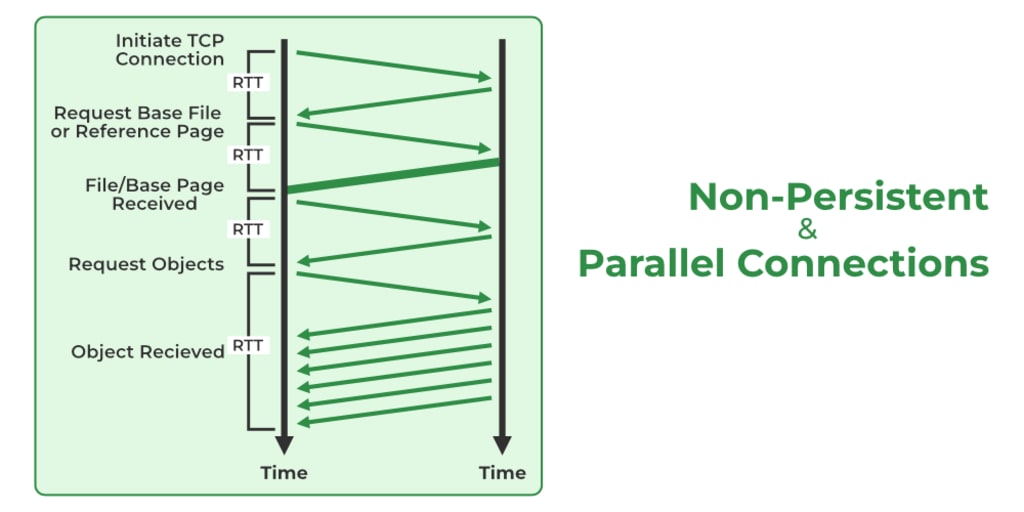
In the realm of computer networking, particularly within the Hypertext Transfer Protocol (HTTP), understanding the differences between persistent and non-persistent connections is crucial for optimizing web performance and resource management. These two types of connections define how data is transferred between a client and a server, influencing the efficiency, speed, and overhead involved in web communication.
1. Definition
- Persistent Connection:
Also known as HTTP keep-alive or HTTP connection reuse, a persistent connection allows multiple requests and responses to be sent over a single TCP (Transmission Control Protocol) connection. Once the connection is established, it remains open for multiple transactions between the client and the server.
- Non-Persistent Connection:
In a non-persistent connection, each request/response pair uses a separate TCP connection. After the server sends the requested data to the client, the connection is closed. For each subsequent request, a new connection must be established.
2. Operation Mechanism
- Persistent Connection:
Establishment: A TCP connection is established between the client and the server.
Data Transfer: Multiple HTTP requests and responses are exchanged over this single connection.
Termination: The connection remains open until it is explicitly closed by either the client or the server, or it times out due to inactivity.
- Non-Persistent Connection:
Establishment: A new TCP connection is established for each HTTP request.
Data Transfer: The server processes the request and sends back the response over this connection.
Termination: Once the response is sent, the connection is immediately closed.
Often used in older HTTP/1.0 implementations or simple web services.
3. Advantages and Disadvantages
- Persistent Connection:
Advantages:
Reduced Latency:
By reusing the same connection, the overhead of establishing new connections is eliminated, reducing latency for subsequent requests.
Lower Resource Utilization:
Fewer TCP connections mean reduced CPU and memory usage on both client and server, leading to better overall resource management.
Improved Performance:
Enhanced performance, especially for web pages that require multiple resources (e.g., images, CSS files, JavaScript files).
Disadvantages:
Resource Holding:
Keeping connections open for longer periods can consume server resources, potentially limiting the number of clients the server can handle simultaneously.
Complexity in Management:
Managing timeouts and ensuring connections are properly closed when no longer needed can add complexity to server configuration.
- Non-Persistent Connection:
Advantages:
Simplicity:
Each request is handled independently, simplifying the management of connections.
Resource Release:
Connections are immediately released after the transaction, freeing up resources promptly.
Disadvantages:
Increased Latency:
The overhead of establishing and closing a TCP connection for each request increases latency.
Higher Resource Usage:
More CPU and memory resources are used due to the repeated setup and teardown of connections.
4. Use Cases
- Persistent Connection:
Ideal for web applications and websites with multiple resources that require multiple HTTP requests.
Beneficial for APIs where multiple requests are expected in a short period.
- Non-Persistent Connection:
Suitable for simple, single-resource requests where the overhead of maintaining a connection outweighs the benefits.
- HTTP/1.0:
- HTTP/1.1:
5. HTTP Versions and Connection Types
By default, uses non-persistent connections.
Persistent connections can be used if explicitly specified using the Connection: keep-alive header.
Persistent connections are the default behavior.
Non-persistent connections can be requested using the Connection: close header.
6. Impact on Performance
Persistent connections generally offer better performance for modern web applications due to reduced connection overhead, leading to faster page load times and better user experience. However, non-persistent connections can be simpler to implement and may be more appropriate in scenarios where maintaining a connection would be inefficient or unnecessary.
7. Security Considerations
Both connection types must ensure secure data transfer through encryption protocols like TLS (Transport Layer Security). Persistent connections may require additional attention to ensure that long-lived connections do not become vectors for prolonged attacks, while non-persistent connections, by frequently opening and closing, may provide slightly better isolation per transaction.
Conclusion
The choice between Persistent and Non-persistent Connections hinges on the specific requirements and constraints of the application or service being deployed. Persistent connections generally provide superior performance for most web applications, reducing latency and resource consumption. However, non-persistent connections can be advantageous in simpler scenarios or where the overhead of maintaining a long-term connection is not justified. Understanding these differences and their implications helps in designing efficient, responsive, and scalable networked systems.
About the Creator
Pushpendra Sharma
I am currently working as Digital Marketing Executive in Tutorials and Examples.
Keep reading
More stories from Pushpendra Sharma and writers in Education and other communities.
ER Diagram for University Database in DBMS
In the realm of Database Management Systems (DBMS), Entity-Relationship (ER) diagrams play a crucial role in modeling the structure and relationships of data within an organization. For a university, an ER diagram serves as a blueprint for the database, capturing essential entities such as students, courses, and faculty, and the relationships between them. This article will explore the components and construction of an ER diagram for a university database.
By Pushpendra Sharma2 years ago in Education
Karen Solie’s Wellwater Wins the TS Eliot Poetry Prize: A Quiet Triumph of Modern Verse
In a literary world often dominated by loud headlines and fast-moving trends, poetry still finds ways to stop time. That pause arrived powerfully with the announcement that Karen Solie’s poetry collection Wellwater has won the TS Eliot Poetry Prize, one of the most prestigious honors in contemporary poetry. The award is not only a personal milestone for Solie but also a reminder of poetry’s enduring ability to explore the human condition with depth, restraint, and emotional clarity. A Prize That Shapes the Poetry World The TS Eliot Poetry Prize, awarded annually in the United Kingdom, is considered one of the highest accolades a poet can receive. It recognizes the best new poetry collection published in the UK or Ireland, often setting the tone for literary discussions in the year ahead. Past winners have included some of the most influential poetic voices of modern times, making Solie’s victory a significant cultural moment. What sets this prize apart is its emphasis on craft, originality, and emotional intelligence—qualities that Wellwater embodies fully. Who Is Karen Solie? Karen Solie is a Canadian poet known for her sharp intellect, grounded observations, and emotionally resonant language. Over the years, she has earned respect for writing poetry that feels both deeply personal and socially aware. Her work often navigates themes such as place, memory, climate anxiety, labor, aging, and quiet resilience, avoiding grand statements in favor of carefully observed truths. Solie’s poetry does not shout; it listens. That listening quality is precisely what makes Wellwater stand out. Inside Wellwater: Poetry of Depth and Reflection Wellwater is a collection that moves deliberately, inviting readers to slow down and pay attention. The title itself suggests hidden depths—water drawn from below the surface, shaped by time and pressure. This metaphor runs throughout the collection, as Solie explores lives shaped by unseen forces: economic uncertainty, environmental change, personal history, and emotional endurance. The poems are rooted in everyday experiences, yet they carry philosophical weight. Solie writes about landscapes both natural and human-made, finding meaning in small moments: a shift in weather, a conversation overheard, a memory resurfacing unexpectedly. Her language is precise but never cold, intellectual without being inaccessible. Why Wellwater Resonated With Judges The TS Eliot Prize judges praised Wellwater for its quiet authority and emotional honesty. In a time when many works aim for immediacy or spectacle, Solie’s collection was recognized for its patience and depth. The poems do not rush toward conclusions; instead, they allow complexity to remain unresolved, mirroring real life. This approach reflects a broader shift in contemporary poetry, where subtlety and reflection are gaining renewed appreciation. Solie’s work demonstrates that poetry can be powerful without being performative, political without being loud, and personal without being confessional. Poetry in a Restless World The success of Wellwater also speaks to the role of poetry in today’s fast-paced, digitally saturated culture. As attention spans shrink, poetry offers a counterbalance—a space where readers can slow down, sit with uncertainty, and engage with language thoughtfully. Solie’s poems address modern anxieties without sensationalism. Climate change, economic instability, and emotional fatigue are present, but they are woven into lived experience rather than treated as abstract concepts. This grounding makes Wellwater especially relevant to contemporary readers seeking meaning rather than noise. What This Win Means for Contemporary Poetry Karen Solie’s TS Eliot Prize win reinforces the idea that poetry still matters, even—perhaps especially—in uncertain times. It highlights the value of work that prioritizes depth over trendiness and reflection over reaction. For emerging poets, Solie’s success is encouraging. It suggests that careful craftsmanship, intellectual honesty, and emotional restraint can still find recognition in a competitive literary landscape. For readers, Wellwater offers an invitation: to read slowly, to think deeply, and to reconnect with the quieter aspects of being human. A Lasting Literary Moment Karen Solie’s Wellwater winning the TS Eliot Poetry Prize is more than an award announcement—it is a celebration of poetry’s ability to endure, adapt, and illuminate. In drawing from the deep wells of observation and experience, Solie has created a collection that will likely be read and discussed for years to come. In an age hungry for instant answers, Wellwater reminds us that some truths are best discovered slowly.
By Fiaz Ahmed Brohi3 days ago in Education



Comments
There are no comments for this story
Be the first to respond and start the conversation.