


Democracy is defined typically as, government by the people. That government is implemented and exercised directly by the people or by their elected representatives. With the peaceful transfer of power and checks and balances implemented into the American constitution, the ideals of democracy were to be what made the United States the beacon of freedom it so desired to be. The democracy concept, theoretically, was implemented by individuals as far back as the hunter-gatherer age. However, the initiation of the concept into statehood came about during the 6th century in Athens, Greece. In Greek, the term democracy derives from the term dēmokratia which literally translates to “rule by the people”. This was enacted in the Greek city-states to denounce the previous political system derived in the 5th century BCE that blanketed society at the time. This new style of governmental reform was to be used by individual city-states or tribes at the time because the concept was simple enough to implement into what would be called “direct-democracy”.
Over time as communities grew and population expanded, “direct-democracy” would soon mold itself into what we now know today as “representative-democracy”. The implementation of representative-democracy would come at a cost. The cost being, that in order for representative-democracy to be upheld, numerous political institutions would need to be created that would be vastly contradictory to the democratic concept. Representative-democracy would eventually migrate towards the other world power at the time, the Roman Empire, off the Italian peninsula. This is where the clear perversion of democracy would begin. The Romans would adopt the democratic concepts at the same time as Greece, but they would go on to title their governance as a rēspūblica or a Republic. Essentially, a Republic that belongs to the people, or the populus romanus. Just like Athens, Rome also began as a city-state where the true concepts of democracy fit in comfortably. It is when the Romans began to expand their empire, we began to understand that the democratic concept was never meant to exceed those city-states. It became very simple and very clear. The larger the populous, the harder it becomes for governance to be performed “by the people”. Which brings us back to the new form of democracy that we still believe we implement to this day, Representative-democracy.
Representative-democracy is as it sounds. The people elect political representatives through the democratic voting process. Sounds simple. “The people” know they cannot actually bring governance and order themselves, so they elect the best representative they see fit to do the job. It’s a straightforward concept on paper. Unfortunately paper can get crumbled and thrown away. That crumbling force is universally recognized as corruption. Corporate or political; corruption has become the catalyst for the demise of Democracy throughout centuries. It is arguable that there has never been an individual or institution in a position of power that hasn’t been corrupted, directly or indirectly, that affected the outcome or development of their populace. Provided are a few core examples that clearly outline and display the deterioration and manipulation of democracy as a governing concept.
The United States is the clearest example of democratic deterioration. This is emphasized by the convoluted thought process behind its supposed democratic voting system. A representative democracy voting style is clouded by the vail of the Republic's deceptive loophole in its election process. That loophole being the Electoral College. The Electoral College’s very existence disqualifies the United State’s claim to being a governing democracy. The Electoral College is a group of electors who are selected to “elect” a candidate to a certain office. However, these groups can be of differing political parties, factions, organizations, or entities. Each is represented by a particular number of electors with votes that are scaled in their own way. There is a constant redundancy in American politics with the idea that “your vote doesn’t count”. With the founding of the Electoral College, that idea becomes plausible.
It’s alarmingly clear how inept the United States populace has become to the reality of their political hierarchy. With the implementation of the Electoral College, the democracy that once was anticipated, never truly found the light of day. The United States of America, has never, not once, been dubbed a Democracy. Ever. It’s clearly stated in our pledge of allegiance.; “To the Republic, for which it stands”. The United States is a Constitutional Republic. Not a Democracy. Broadly speaking, a Constitutional Republic is a form of government in which officials are elected by citizens to lead them as directed by their country’s constitution. A Constitutional Republic implements the representative democracy voting style as it is in its very definition; A state in which political power rests with the public through their representatives. Representation in a republic may or may not be freely elected by the general citizenry. I want to emphasize “may or may not be freely elected”. This is self explanatory, yet there are still political shills that will try and convince you otherwise.
The Constitutional Republic implemented in the United States initiated multiple loopholes when it comes to political decision making. The most prevalent of those loopholes is the creation of Lobbyists or the act of Lobbying. Lobbying, or “advocacy”, is the process of lawfully attempting to influence the actions, policies, or decisions of government officials, more often legislators or members of regulatory agencies, but also judges of the judiciary. Legal extortion essentially. This practice in Washington taints the very fabric the idea of democracy was sewn into. For example; lobbyist will spend an exuberant amount of cash to pedal influence in political decision making. One of, if not the most powerful lobbying groups in Washington is Wall Street. The lobbying of Wall Street was arguably responsible for the market crash of 2008. From 1998 to 2008, Wall Street and other financial interest groups lobbied the U.S. Politicians nearly $5 billion in campaign contributions to deregulate Wall Street and lower the Federal Funds rate. This in turn caused a snowball of regulatory issues that plummeted the U.S. economy.
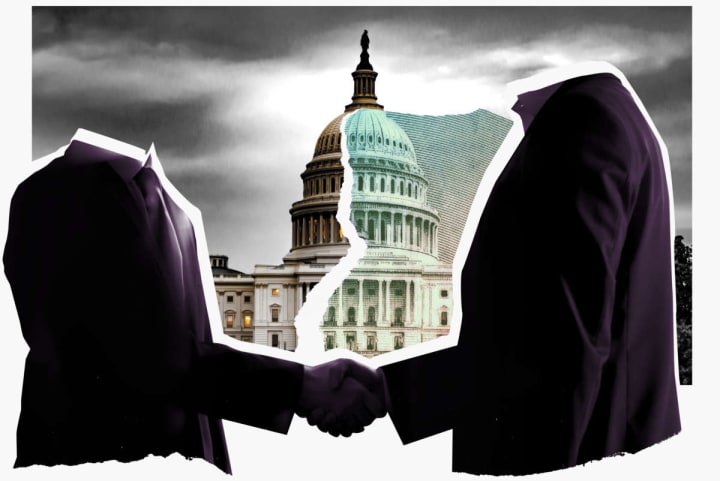
Another lingering debate that has caused strain on the democratic process is the idea that American elections are “rigged” or “stolen”. While it is virtually impossible to prove that an election was physically or rhetorically stolen, it is possible to point out clear manipulation that takes place before, during, and after we take to the polls. We can run through examples at nauseam in regards to manipulative tactics used by the Federal and State governments to force an outcome of an election. Whether it be redistricting, mail in ballots, or the distribution of disinformation, the democratic voting process has never seen the light of clarity. The most recent example being the 2020 Primary election between current President Joe Biden and former President Donald Trump. The 2020 election, still to this day, is scrutinized for its inconsistencies. It is often repeated by those who align themselves with the GOP that “the 2020 election was stolen”. No. I was not stolen. It was, however, manipulated, as all elections are, and have been, since the turn of the twentieth century. For example; during the 2020 election, damning evidence arose regarding the current President, Joe Biden’s, involvement in a bribery scheme with his son Hunter Biden via a laptop that was left in the hands of a Delaware computer shop. This was evidence that clearly would have swayed public opinion during the campaign. To cover tracks, 51 Federal intelligence agents would denounce the story as Russian disinformation or Russian interference, claiming an attempt to disrupt our democracy. Two years later, that claim was refuted and the laptop story was proven to be true. This was clear manipulation by the Federal government to sway the public opinion during an election.
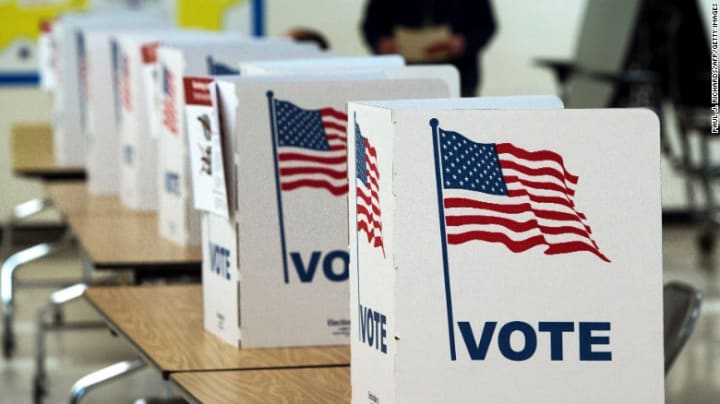
A physical example of democratic manipulation is the actual process of voting. For the first 50 years of the United States existence, voice voting was the method used to cast ballots. At the time the right was only reserved to white men. That alone is not a true democratic process as it obviously excludes a large majority of the populous. During the 19th century, paper ballots were introduced. However, they were not formally regulated by any state or federal body. Legitimately, people would take scraps of paper and write down who they wanted to vote for and drop them in a ballot box. Later on in the century newspapers would print blank ballot boxes with the names of the offices up for election. Political parties in the United States took it one step further by then issuing pre-printed fliers that were known as “tickets”. This creates the term we know today as the Democratic or Republican ticket. Voting machines would arrive later on towards the end of the 19th century as the lever-operated automatic booth. This in theory would weed out any mishandling of physical tickets dropped in ballot boxes. Although at the time public support was strong with the implementation of automatic booths, as time progressed, other optional forms of voting were being provided. From punch cards, to voting by Ipad, scantrons, or now, mail-in-ballots, there has never been a clear cut, singular route that all Americans can take to cast their votes. With the conglomerate of options Americans have been provided to cast their votes, on the surface it seems convenient. The only convenience it provides is the opportunity for chaos. There have been numerous instances on the local, state, and federal level where the voting process was undermined by manipulation and flat out cheating in regards to the counting of votes, typically defined as voter fraud. For example; in 2020, 475 cases were documented across the country where voter fraud was prevalent or may have taken place. Another example being that Rasmussen Reports and The Heartland Institute ran a telephonic and online survey post the 2020 election and found that 1 in 5 mail-in-ballot voters admitted to participating in at least one form of voter fraud during that election year, equating to just over 20% of the populous. With this in mind, it is easy to consider the idea that democracy has died. Or better yet, it never even had the chance to live.
As we now approach the 2024 primary election for the President of the United States, take everything into account. Understand the political parameters in which we participate. Remember, the United States is a Constitutional Republic not a Democracy. Never has been and never will be. Our elected officials are extorted, our voting system is fundamentally flawed, and the populous will continue to fall in line with no questions asked. From one of the founding fathers themselves, John Adams; “Remember, democracy never lasts long. It soon wastes, exhausts, and murders itself. There never was a democracy yet that did not commit suicide.”
About the Creator
Benjamin Reese
My degree is in Communications with a focus on Journalism and a minor in Political Science.
Keep reading
More stories from Benjamin Reese and writers in Education and other communities.
Democratic Candidates 2024
The Presidential outlook for the Democratic party in 2024 is becoming one of relative interest. While the pool is shallow and the rhetoric monotoned, the significance of this race is being drastically overlooked. While legacy media’s political pundits want you to believe that the incumbent, President Joe Biden, has no viable opposition to his campaign for reelection, there looms two other challengers who are now polling at a rate that is no longer dismissible. Here we will take a look at the three current front runners for the Democratic Primary ticket for the Presidential race in 2024, starting with our current commander and chief.
By Benjamin Reese3 years ago in Education
THE POST- ONTOLOGICAL THOUGHT AND THE ABYSS OF NOTHINGNESS — ALEXIS KARPOUZOS
The meta-ontological thought of Alexis Karpouzos is constituted at a level where the traditional distinction between ontology and nihilism collapses. The nothing, as it appears in this context, is neither the opposite of Being nor its limit, but the groundless condition of its appearance. It is a nothing that is not conceived metaphysically as lack, negation, or absence, but corresponds to the mathematical zero: neither positive nor negative, non-polar, and at the same time capable of encompassing all possible values without identifying with any of them. This nothing does not negate the world; it makes possible its indeterminate genesis.
By alexis karpouzosa day ago in Education
Switzerland Cosmetics Market Opportunities, Challenges, and Consumer Trends 2026-2034
The Switzerland cosmetics market has been on a steady growth trajectory, reaching a market size of USD 832.8 million in 2025. IMARC Group projects this market to expand to USD 1,330.1 million by 2034, representing a compound annual growth rate (CAGR) of 5.07% during 2026–2034. This growth is fueled by rising disposable incomes, the rapid expansion of e-commerce platforms, and the increasing demand for high-quality skincare, makeup, and wellness products that cater to diverse consumer preferences.
By Neeraj kumar4 days ago in Education



Comments
There are no comments for this story
Be the first to respond and start the conversation.