
Deep Learning vs Machine Learning: What’s the Difference and Why It Matters
Every time you use voice assistants, see recommendations on YouTube, or unlock your phone with your face—AI is at play. But not all AI is the same. Two key players in this field are machine learning (ML) and deep learning (DL).

What is Machine Learning?
Machine learning is a subset of artificial intelligence. It allows computers to learn from data without being explicitly programmed.
How It Works:
A programmer feeds the algorithm with data and labels (e.g., emails marked as spam or not).
- The machine learns patterns from that data.
- Then it makes predictions or decisions based on new input.
Example:
If you give a machine learning model 1,000 labeled cat and dog images, it will learn how to tell them apart.
✅ Real-World Use: Email spam filters, recommendation engines (Netflix, Amazon), stock predictions.
What is Deep Learning?
Deep learning is a more advanced part of machine learning. It mimics how the human brain works using neural networks—especially deep neural networks.
How It Works:
- It uses layers of neurons to process data.
- Each layer pulls more complex patterns from the raw data.
- It doesn’t always need labeled data (especially with enough of it).
Example:
Instead of just learning “this is a cat because it has whiskers,” a deep learning model can identify fur patterns, eye shapes, and even textures to detect cats—without needing someone to label everything.
✅ Real-World Use: Facial recognition, self-driving cars, speech recognition (like Siri), and ChatGPT.
Key Differences: Deep Learning vs Machine Learning
Here’s a simple side-by-side comparison to help you see the big picture:
Feature Machine Learning Deep Learning
Data Needs Works with small data Needs lots of data
Human Involvement Needs feature selection Learns features automatically
Processing Power Can run on regular compute Needs powerful GPUs or TPUs
Time to Train Faster Slower
Interpretability Easy to understand Often a "black box"
Example Spam filter Self-driving car vision
🔁 How Are They Related?
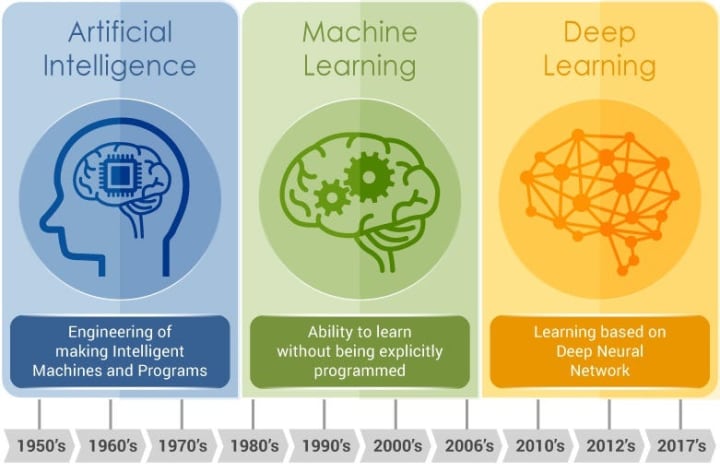
Think of it like this:
- AI is the big idea.
- Machine Learning is a branch of AI.
- Deep Learning is a branch of machine learning.
So every deep learning model is also a machine learning model—but not every machine learning model is deep learning.
📚 Real-Life Examples: Deep Learning vs Machine Learning
Machine Learning in Action:
- Credit Scoring: Banks use ML to decide if you're eligible for a loan.
- Product Suggestions: Amazon recommends based on what you’ve seen or bought.
Deep Learning in Action:
- Autonomous Vehicles: Tesla cars detect lanes, pedestrians, and traffic signs using deep learning.
- Language Translation: Google Translate uses deep neural networks to understand and translate sentences.
💡 Why This Matters Today
As AI shapes the future, understanding “deep learning vs machine learning” helps you:
- Choose the right tools for your business or startup.
- Understand tech trends (like AI-generated art or voice assistants).
- Decide on tech careers—data science, AI engineering, etc.
This knowledge isn’t just for techies anymore. Even marketers, educators, and business owners benefit from knowing the basics.
🙋 FAQs: Deep Learning vs Machine Learning
1. Is deep learning better than machine learning?
Not always. Deep learning is more powerful for tasks like image or speech recognition, but it's slower and needs more data.
2. Can I use deep learning with little data?
Technically, yes—but it’s not ideal. Deep learning needs large datasets to perform well.
3. Is ChatGPT an example of deep learning?
Yes! ChatGPT uses transformer-based deep learning models for natural language processing.
4. Which is easier to learn first?
Start with machine learning. It builds the foundation for understanding deep learning.
5. Do I need a GPU to run deep learning?
Yes, for training deep models. You can still test small models on a CPU, but it will be slow.
🧭 Conclusion: Making the Right Choice
Both machine learning and deep learning are changing the way we live, work, and think.
Choose machine learning when you want quick results, less data, and simpler problems.
Choose deep learning for complex problems like language understanding or image recognition.
They’re not in competition—they’re tools in your AI toolbox.
About the Creator
Tech Thrilled
TechThrilled is your go-to source for deeply explained, easy-to-understand articles on cutting-edge technology. From AI tools and blockchain to cybersecurity and Web3, we break down complex topics into clear insights, complete
Keep reading
More stories from Tech Thrilled and writers in Education and other communities.
Striking the Right Balance: Modern Tech and the Human Touch in Harmony
As technology continues to reshape every corner of business and daily life, the balance between innovation and personal interaction becomes increasingly important. Automation, artificial intelligence, and digital communication have allowed companies to operate faster, smarter, and more efficiently. These tools improve productivity and offer consumers greater convenience, transforming how services are delivered and experiences are shaped.
By Ian Schenkel Haliburtona day ago in Education



Comments
There are no comments for this story
Be the first to respond and start the conversation.