
Day Trading: Is it really profitable?
How to become a winning day trader in the stock markets with day trading channels


Introduction
Day trading is a form of trading that involves buying and selling securities within the same day. The objective of day trading is to make profits by taking advantage of small price movements in the market. It has become a popular form of trading due to the ease of access to trading platforms and the potential for high returns. However, the question that arises is whether day trading is really profitable or not.
What makes day traders different from investors?
Day traders differ from investors in their trading strategy and time horizon. Investors focus on long-term investments and hold onto their assets for months or years, while day traders buy and sell securities within the same day. Day traders use technical analysis and short-term price movements to make trading decisions, while investors rely on fundamental analysis to evaluate a company's long-term growth potential.
What is the earnings potential in day trading?
The earnings potential in day trading can be significant, but it also carries a high level of risk. Day traders can earn profits from small price movements in the market, and leverage can amplify these gains. However, losses can also be magnified when using leverage. The potential earnings from day trading depend on various factors such as the trader's experience, trading strategy, risk management, and market conditions.
Day Trader Salary: Example
Let's use the same trading strategy as before, where the maximum risk is 4 cents and the target is 6 cents, yielding a risk/reward ratio of 1-to-1.5. However, this time let's assume the trader makes a profit of 18 cents per share on 25 trades, and incurs a loss of 9 cents per share on 12 trades.
Assuming the trader has $30,000 in starting capital and uses 7,500 shares per trade to stay within their maximum risk of $300, the calculation would be as follows:
25 profitable trades x $0.18 profit per share x 7,500 shares = $33,750 profit
12 losing trades x $0.09 loss per share x 7,500 shares = ($10,800) loss
The gross profit is $33,750 - $10,800 = $22,950
If commissions are $30 per trade, the total commission cost would be ($30 x 37 trades) = $1,110
The net profit would be $22,950 - $1,110 = $21,840
Again, this example is theoretical and assumes that the trader is able to make consistent profits and keep their losses under control. In reality, there are several factors that can impact the profitability of day trading, including market conditions, trading strategy, risk management, and the trader's skill and experience.
How to get started
To get started with day trading, one needs to have a solid understanding of the stock market, trading strategies, and risk management. One should also have a trading plan that outlines their trading strategy, risk management, and trading goals. It is essential to start with a small trading account and gradually increase the size as one gains experience and becomes profitable.
Channel Strategy for Day Trading
The channel trading strategy is an effective approach to day trading that uses potential highs and lows for long and short entries. TradeProactive offers precisely that with its trading indicator that leverages an advanced algorithm to identify highs and lows in an equity. The TradeProactive indicator is an excellent tool for beginners who want to venture into the markets. It is seamlessly integrated with TradingView.com, a popular platform for chart analysis.
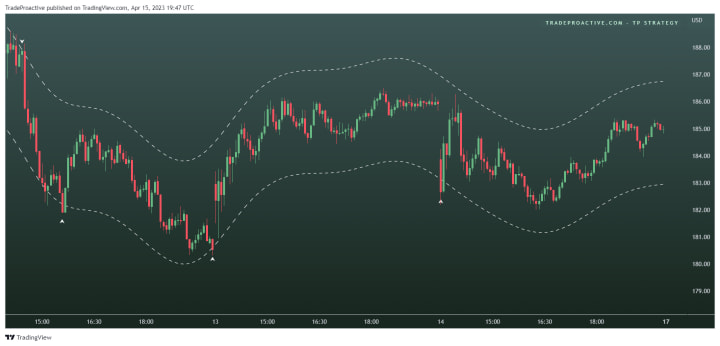
The TradeProactive indicator's proprietary algorithm analyzes market data and uses advanced mathematical models to identify patterns and trends that indicate potential buy or sell opportunities. By using this tool, traders can identify the best possible opportunities in the equities market for day or swing trades. The indicator provides real-time insights that help traders make informed decisions and increase their chances of success. Overall, the TradeProactive channel trading strategy is an effective and efficient way for traders to get started in the markets.
How many trades are possible in a day?
The number of trades a day trader can make depends on various factors such as market conditions, trading strategy, and trading platform. Some day traders may make a few trades a day, while others may make dozens of trades. It is essential to find a trading strategy that suits one's personality, risk tolerance, and market conditions.
What is the average success rate?
The success rate of day traders varies widely and depends on various factors such as their trading strategy, risk management, and market conditions. Some successful day traders have a success rate of 50% or higher, while others may struggle to make consistent profits. It is essential to have a solid trading plan, risk management, and discipline to achieve success in day trading.
Summary
In conclusion, day trading involves buying and selling securities within the same day to take advantage of small price movements in the market. Day traders differ from investors in their trading strategy and time horizon. While the earnings potential in day trading can be significant, it also carries a high level of risk. The potential earnings depend on various factors such as the trader's experience, trading strategy, risk management, and market conditions. The TradeProactive channel trading strategy is an effective approach for day traders, especially beginners. The number of trades a day trader can make depends on various factors, and the success rate of day traders varies widely depending on their trading strategy, risk management, and market conditions.
About the Creator
Keep reading
More stories from Daniel Marković and writers in Education and other communities.
6 Benefits of Creating a Company in Serbia
Introduction Serbia has become an increasingly popular destination for entrepreneurs and business owners looking to start or expand their businesses. The country offers a number of advantages that make it an attractive option, including a competitive labor market, tax reliefs, free trade agreements, a good business environment, great geographical location, and ease of starting a business. In this article, we will explore the benefits of creating a company in Serbia in more detail.
By Daniel Marković3 years ago in Education
How Toys Shape Young Minds and Inspire Lifelong Learning
Toys aid in development by providing children with the opportunity for exploration, stimulus for creativity and development of life skills. While playing with toys from infancy, children develop cognitively and emotionally. Toys have not only been used as objects of play and amusement, but also as a tool for imagination, exploration, and emotional development. The toy industry has had to adapt and grow with new educational models, innovations in design, and interactivity to meet children's modern developmental needs. By today, toys are not only for entertainment, they also carry the potential to shape how children think and interact with the world.
By Rohit Shahabout 14 hours ago in Education
Affection and Healing for Yourself
During the night of the last quarter moon, I gathered my ritual supplies. I carefully handled the chunk of black tourmaline that would protect me from your overall negative and narcissistic energy. I carefully walked the house with my stick of selenite in hand, asking the universe to cleanse our working space.
By Alisha Wilkins ✒️🦋🖋️8 days ago in Fiction




Comments
There are no comments for this story
Be the first to respond and start the conversation.