

When we gaze at the night sky, we imagine planets as bright, reflective worlds glowing with the light of their parent stars. After all, that’s how we see Venus and Jupiter in our own solar system—by the sunlight bouncing off their clouds and surfaces. But astronomers have discovered a bizarre class of planets that defy this simple logic. These worlds are so dark that they reflect less light than coal or asphalt. They are known as dark exoplanets, and they are some of the strangest objects ever observed beyond our solar system.
Worlds of Shadow Among the Stars
Dark exoplanets first came to light thanks to NASA’s Kepler Space Telescope. The telescope was designed to spot distant planets by observing the tiny dips in a star’s brightness when a planet crosses in front of it. This method, called the transit technique, doesn’t just reveal a planet’s orbit and size—it also provides clues about how much starlight the planet reflects.
That’s when astronomers stumbled upon something astonishing: some gas giants barely reflected any light at all. One of the most famous examples is TrES-2b, a planet about the size of Jupiter located in the constellation Draco. TrES-2b reflects less than 1% of the starlight that falls on it, making it darker than charcoal, darker even than black acrylic paint designed to absorb nearly all visible light. Imagine a world so dim that it is practically invisible next to the star it orbits.
Why Are They So Dark?
The mystery of these planets lies in their exotic atmospheres. Unlike Earth, where clouds and oceans reflect sunlight, dark exoplanets seem to act like cosmic sponges, swallowing nearly every photon that hits them. Scientists believe this happens for several reasons:
Lack of reflective clouds: Many exoplanets close to their stars are extremely hot, with temperatures soaring above 1,000–2,000 °C (1,800–3,600 °F). Under these conditions, clouds of water vapor or ammonia—the kind that brighten planets like Jupiter—cannot form.
Light-absorbing gases: Instead, their skies may be filled with gases such as sodium and potassium, or even exotic metallic compounds, which absorb visible light rather than reflect it.
Molecular breakdown: At extreme heat, molecules can shatter, creating chemical hazes that trap light. These hazes act like thick smog, letting almost no light escape.
The result is a planet that seems to drink in light rather than shine with it.
What Would Such a World Look Like?
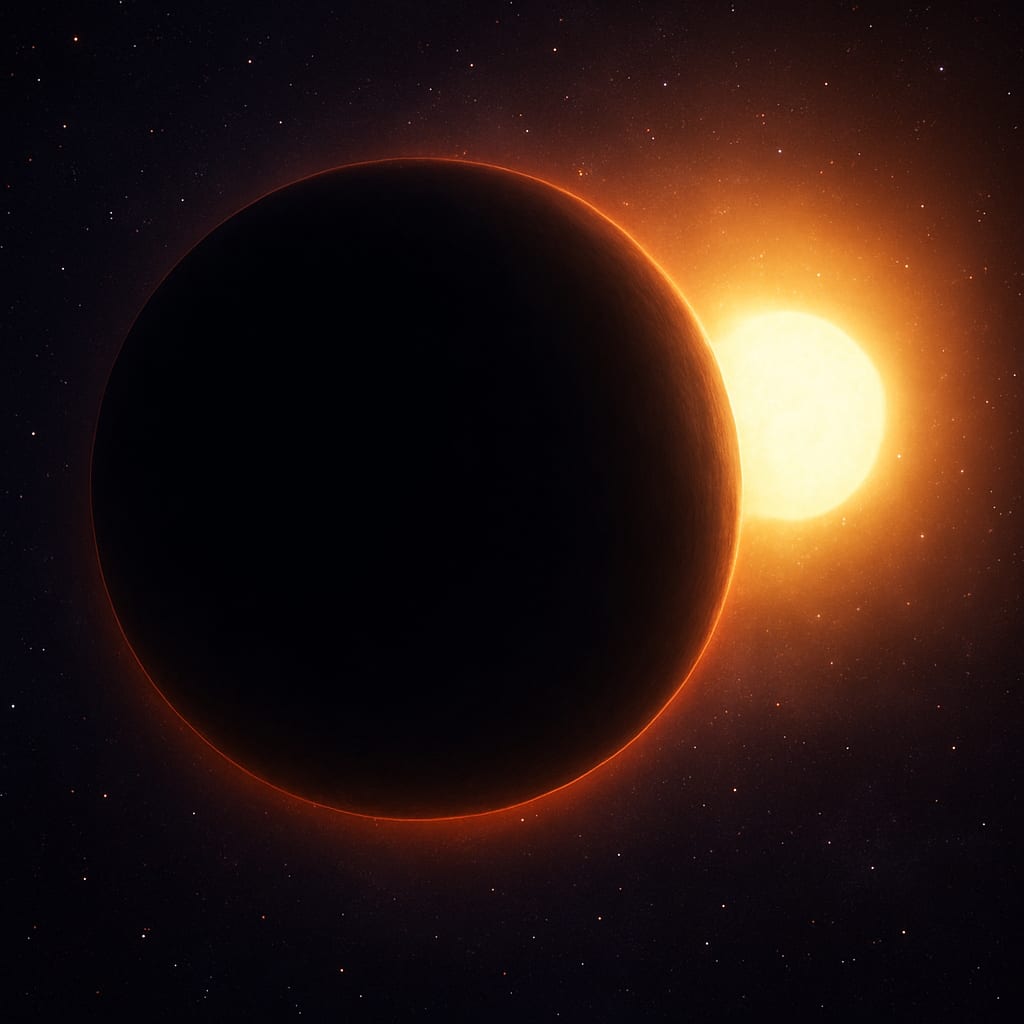
Picture a gas giant, similar in size to Jupiter, orbiting dangerously close to its parent star. The star’s brilliance floods the skies, casting fiery, red-orange light across the planet’s atmosphere. And yet the planet itself remains a dark silhouette—a cosmic shadow floating in space.
If you stood on a hypothetical platform in the atmosphere (assuming you could survive the heat), the landscape would be surreal. The star might blaze above you, but your surroundings would remain shrouded in eerie darkness. It would feel as though you were standing inside the blackest void, with light unable to illuminate the world around you.
These dark exoplanets are like cosmic paradoxes: they exist right next to some of the brightest stars, yet they themselves are nearly invisible.
Why They Matter
The study of dark exoplanets isn’t just a curiosity—it’s a valuable scientific tool. By analyzing their strange atmospheres, astronomers can refine models of how planets form and evolve. If gases like sodium or metallic vapors dominate these skies, it suggests processes very different from those in our solar system.
Even more importantly, understanding how light interacts with exotic chemicals at extreme temperatures could have applications here on Earth. Materials that mimic this kind of light absorption could one day be used for solar energy, radiation shielding, or even new kinds of stealth technology.
An Ongoing Mystery
Despite all we know, dark exoplanets remain one of astronomy’s biggest puzzles. Why do some of them absorb almost all incoming light, while others—under seemingly similar conditions—reflect much more? Are there hidden processes, unknown chemical reactions, or even magnetic influences that we haven’t yet discovered?
Every new observation deepens the mystery. Each time scientists uncover a dark world, it challenges our assumptions about what planets can be like. In a sense, these light-swallowing worlds are reminders that the universe is far stranger than we imagine.
A Universe Still Full of Surprises
Dark exoplanets are not just scientific curiosities—they’re cosmic enigmas that inspire wonder. They teach us that even something as simple as a planet reflecting starlight is not guaranteed. They invite us to expand our imaginations and consider worlds far different from our own.
Who knows—perhaps one day we’ll discover a dark planet with unique properties, maybe even a place where something more extraordinary than chemical haze hides in its eternal shadows. Until then, these planets stand as silent, invisible guardians of the universe’s deepest secrets—absorbing the light of their stars, and in the process, capturing our curiosity.
About the Creator
Keep reading
More stories from Holianyk Ihor and writers in Education and other communities.
Betelgeuse: Lesser-Known Facts About Orion’s Shoulder Star
When most people hear the name Betelgeuse, they immediately think of its dramatic future — the moment it will one day explode as a supernova. This impending cosmic firework show has captured the imagination of astronomers and stargazers alike. But focusing only on its explosive finale overlooks just how fascinating Betelgeuse already is. Long before it goes out in a blaze of glory, this red supergiant has been shaping history, science, and culture in remarkable ways.
By Holianyk Ihor5 months ago in Education
The Importance of Strong Leadership in IT and Cybersecurity Teams
In today’s rapidly evolving digital landscape, IT and cybersecurity are no longer support functions—they are central to business success and resilience. With growing threats, complex infrastructures, and constant technological change, these departments face intense pressure to perform at the highest levels. At the heart of their performance is a critical factor that often determines whether a team succeeds or struggles: strong leadership.
By Keith Brautigam2 days ago in Education


Comments
There are no comments for this story
Be the first to respond and start the conversation.