
Betelgeuse: Lesser-Known Facts About Orion’s Shoulder Star
Space

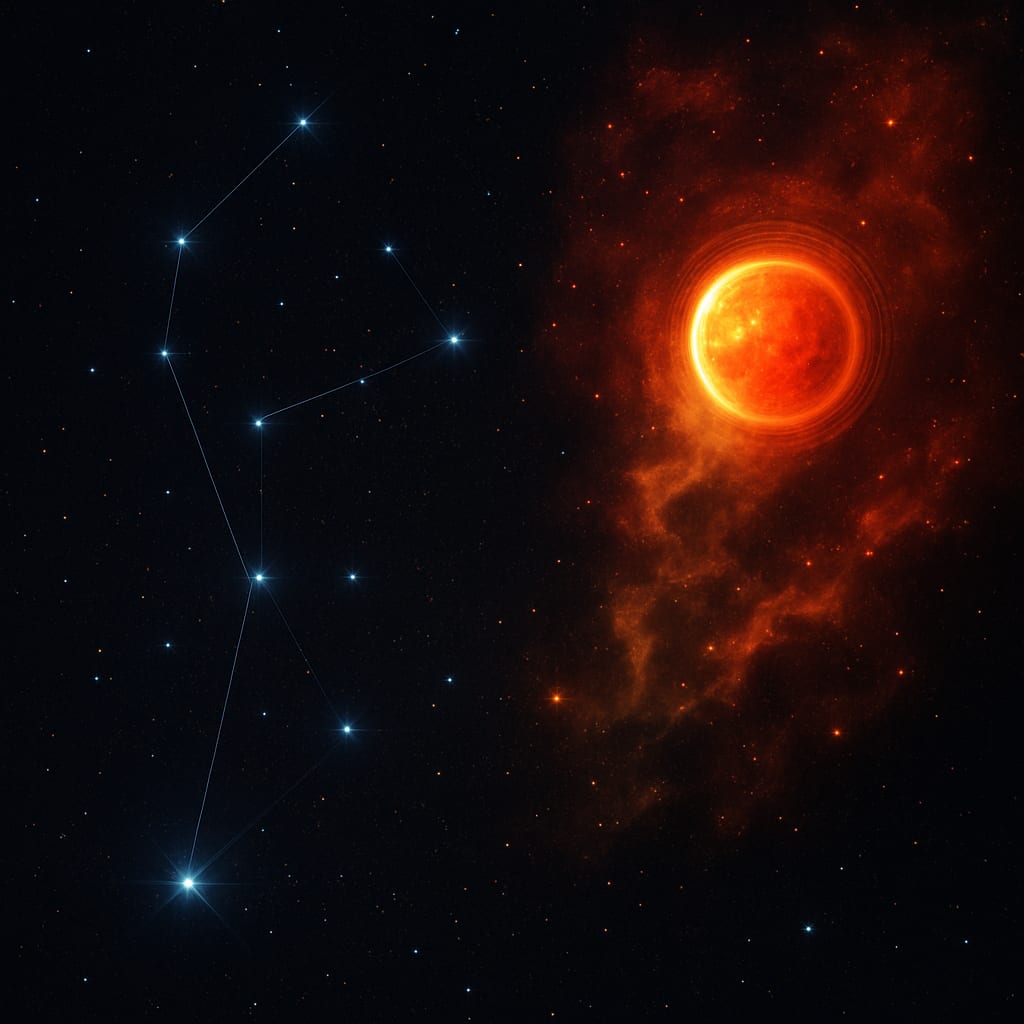
When most people hear the name Betelgeuse, they immediately think of its dramatic future — the moment it will one day explode as a supernova. This impending cosmic firework show has captured the imagination of astronomers and stargazers alike. But focusing only on its explosive finale overlooks just how fascinating Betelgeuse already is. Long before it goes out in a blaze of glory, this red supergiant has been shaping history, science, and culture in remarkable ways.
A Star with an Ancient Legacy
Betelgeuse has been known to humanity for thousands of years. Ancient civilizations carefully mapped it as one of the brightest winter stars, and its presence in Orion — one of the most recognizable constellations — made it impossible to ignore.
In the 2nd century, the Greek astronomer Ptolemy recorded Betelgeuse as a prominent celestial marker in his influential star catalog.
The name Betelgeuse itself comes from the Arabic phrase Ibt al-Jauzāʼ, which translates roughly to “the armpit of Orion,” describing its position on the hunter’s shoulder.
In Chinese astronomy, it was part of the asterism Zuǒxiàng, or “The Left General,” a symbolic military figure meant to guard the heavens.
These examples remind us that Betelgeuse was not just a point of light. For centuries, it served as a navigational guide, a seasonal marker, and a cultural symbol, woven into myths and traditions across the world.
The First Star Ever Measured
In 1920, Betelgeuse made history in an unexpected way: it became the very first star, besides the Sun, whose size was measured directly. Using the technique of interferometry, astronomers discovered that Betelgeuse was far larger than anyone had imagined.
At a time when stars were still thought of mainly as distant pinpricks of light, the revelation that Betelgeuse could extend beyond the orbit of Mars or even Jupiter if placed at the center of our solar system was mind-blowing. This discovery not only redefined our understanding of stars but also marked the beginning of modern stellar astrophysics.
A Surface We Can Actually See
Most stars in the night sky are so far away that they remain eternal dots, even in the most powerful telescopes. Betelgeuse is different. Thanks to its sheer size and relative closeness — only about 640 light-years from Earth — astronomers have been able to capture actual images of its surface.
Using the Very Large Telescope (VLT) in Chile, scientists resolved patterns of light and dark patches across Betelgeuse’s face. These are not static features but the result of enormous convective currents, essentially giant bubbles of hot plasma rising and falling through the star’s outer layers.
To put this into perspective: one of these “bubbles” can be larger than Earth’s entire orbit around the Sun. Imagine a single stellar burp capable of swallowing our whole solar system — that’s the scale we’re talking about.
The Star That Breathes
Betelgeuse is classified as a variable star, which means its brightness naturally changes over time. Over periods of months and years, its glow pulses, sometimes dimming noticeably before brightening again.
These changes occur because the star’s outer layers expand and contract, while also ejecting material into space. What’s especially fascinating is that many of these variations are visible even to amateur astronomers with backyard telescopes, making Betelgeuse a favorite target for citizen science projects. It is as if the star itself is breathing in a slow, cosmic rhythm.
A Cradle of a Future Nebula
Betelgeuse is losing mass at a tremendous rate. Its powerful stellar winds and episodic outbursts cast vast amounts of gas and dust into surrounding space. Already, astronomers can detect a kind of cocoon forming around the star — a prelude to the nebula that will eventually shine for thousands of years after the star itself is gone.
One day, this material will enrich the cosmos with heavy elements — carbon, oxygen, iron, and beyond — the building blocks of new stars and planets. In a sense, Betelgeuse is already preparing its legacy, seeding the galaxy with ingredients for future worlds.
Why Scientists Obsess Over Betelgeuse
Why does this star command so much attention from astronomers? The answer is partly proximity, partly uniqueness.
At 640 light-years away, Betelgeuse is close enough for detailed study, yet far enough that its eventual explosion won’t threaten Earth.
Its instability makes it a perfect case study for the final stages of stellar evolution. By watching Betelgeuse, scientists refine their models of how massive stars live and die.
It is also one of the rare stars large enough for us to actually see surface details, giving researchers an observational goldmine that no other star (except the Sun) can match.
In other words, Betelgeuse is like a natural laboratory — a nearby test subject that helps us better understand the entire universe of giant stars.
A Star of Records and Stories
So yes, someday Betelgeuse will light up our sky with a spectacular finale, becoming brighter than the Moon for weeks. But even without that dramatic ending, it already holds a special place in human history and science.
It was the first star ever measured, one of the very few with visible surface detail, and a celestial character that inspired myths across cultures. From serving as Orion’s glowing shoulder to shaping our modern understanding of stellar physics, Betelgeuse proves that stars don’t need to explode to be extraordinary.
Final Thought
Betelgeuse is not just a “ticking time bomb” in the sky — it is a living storybook of astronomy, blending science, history, and culture. Every observation adds another chapter, reminding us that the cosmos is not static but dynamic, unpredictable, and endlessly inspiring.
About the Creator
Keep reading
More stories from Holianyk Ihor and writers in Education and other communities.
How Scientists Measure the Age of Stars
The stars shine so steadily and so far away that it feels impossible to imagine them having a beginning or an end. Yet every star has a “date of birth” and a life cycle that eventually comes to an end. Astronomers have developed several clever methods to estimate how old stars are—even though nobody was around to watch them form.
By Holianyk Ihor5 months ago in Education
The Insurrection Act
Introduction The Insurrection Act is a law in the United States of America. It allows the President of the United States to use the military to deal with serious problems inside the country. This law is very important because it can be used when there is a rebellion, violence, or lawlessness that cannot be controlled by normal police forces. The act has been in use for many years and is sometimes a topic of debate because it gives the President significant power.
By Farhan Sayed3 days ago in Education
Top 7 Life Changing Books to Read in 2026
In 2026, readers are not just looking for entertainment—they want books that change the way they think, feel, and see the world. With endless content available online, only a few books continue to stand out, remain widely read, and influence conversations across generations. These are the books people keep recommending, searching for, and returning to year after year.
By Waqar Khan3 days ago in Education




Comments (1)
Excellent, very informative story, clearly and colorfully written!