
Cytosol: The Invisible Engine Powering Every Cell
Discover how this jelly-like fluid performs transport, metabolism, and supports cellular life—one molecule at a time.

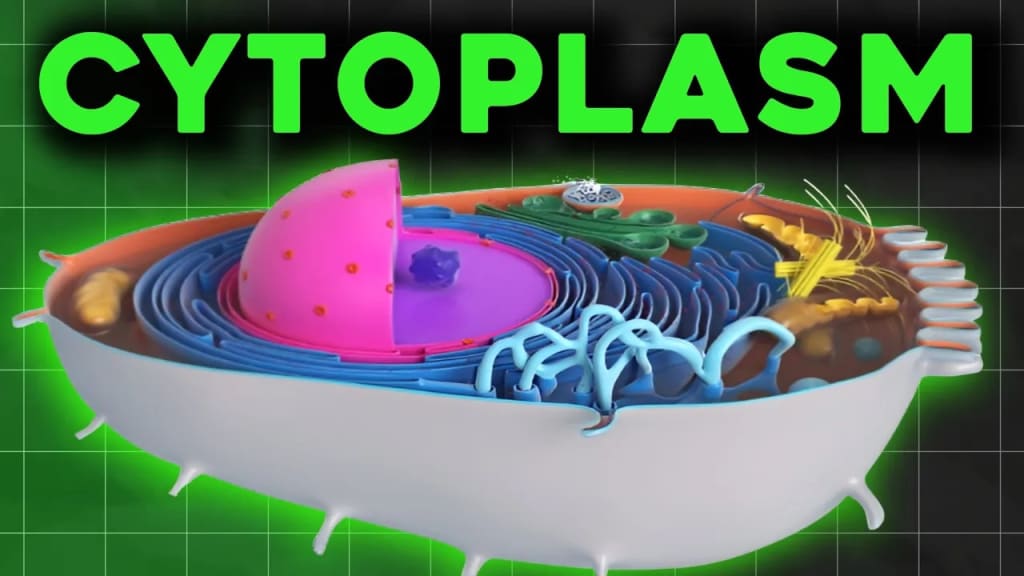
What is Cytoplasm? The Gel That Keeps Your Cells Alive
When we think about cells, we often picture the nucleus — the control center. But what about the space between the nucleus and the outer cell membrane? That jelly-like substance that holds everything together and keeps your cells functioning smoothly? That’s called cytoplasm, and it's more important than you might think.
A Gel Full of Life
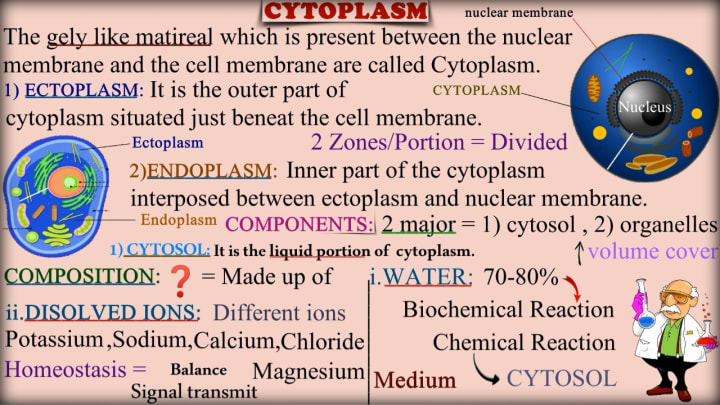
Cytoplasm is the gel-like material present between the nuclear membrane and the cell membrane. Think of it as the "filling" of a cell sandwich, where it cushions and supports the cell's internal structures. But it’s not just a passive filler — it’s buzzing with activity, chemical reactions, and movement.
Two Key Regions: Ectoplasm & Endoplasm
Cytoplasm isn’t uniform — it has layers. Scientists often divide it into two main portions:
Ectoplasm: This is the outer layer of the cytoplasm, located just beneath the cell membrane. It tends to be clearer and more gel-like.
Endoplasm: This is the inner part, found between the ectoplasm and the nuclear membrane. It’s usually more granular and packed with organelles.
This division isn’t just about appearance — it reflects differences in function and density within the cell.
The Components of Cytoplasm
Cytoplasm contains two major components:
1. Cytosol: This is the fluid portion of the cytoplasm. It’s like the broth in a bowl of soup — rich in water, dissolved ions, and small molecules.
2. Organelles: These are the cell's tiny "organs," like mitochondria, ribosomes, and the Golgi apparatus. They float in the cytosol and perform specific functions to keep the cell alive and well.
What’s in Cytosol?
Cytosol itself is mostly water — around 70–80% — making it the ideal medium for biochemical reactions. Besides water, it’s packed with:
Dissolved Ions: Like potassium, sodium, calcium, chloride, and magnesium. These ions help maintain homeostasis (the balance of internal conditions) and assist in signal transmission within the cell.
The cytosol is not just a passive environment. It’s the chemical playground of the cell, where reactions happen and life processes unfold.
Final Thoughts
Cytoplasm is far more than just "cell filler." It's a dynamic, essential environment where life happens at the microscopic level. Without it, our cells — and by extension, we — wouldn't survive.
Cytosol: The Real MVP of Cell Chemistry
Now that we’ve introduced the cytoplasm, let’s zoom in on one of its key components — cytosol. If cytoplasm is the city, then cytosol is the busy downtown where all the action happens!
A Soup of Life
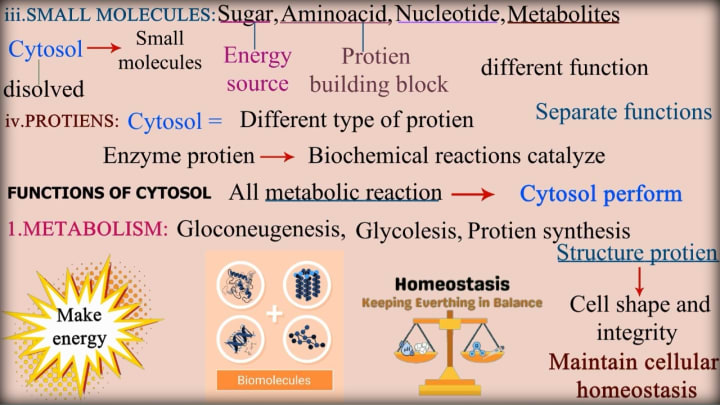
Cytosol is a fluid filled with small molecules like sugars, amino acids, nucleotides, and metabolites. These aren't just floating around aimlessly — they are:
Energy sources (like glucose),
Building blocks (like amino acids for proteins), and
Messengers and materials that help the cell do its job.
This soup of dissolved molecules supports essential life processes by providing the raw materials for biochemical reactions.
Proteins at Work:
Cytosol is also home to different types of proteins. These include:
Enzyme proteins – They act like catalysts, speeding up chemical reactions necessary for life.
Structural proteins – These help the cell maintain its shape and integrity.
Each protein plays a unique role, just like different workers in a factory.
Functions of Cytosol: More Than Just Filling
Let’s break down some core functions of the cytosol:
1. Metabolism
This is where biochemical magic happens — reactions that make and use energy. Key metabolic processes like:
Gluconeogenesis (making glucose),
Glycolysis (breaking down glucose), and
Protein synthesis
all occur within the cytosol.
2. Energy Production
You guessed it — the cytosol helps make energy that powers everything your body does, from blinking to thinking.
3. Maintaining Cellular Homeostasis
Ever wonder how your cells stay balanced despite constant changes? The cytosol helps regulate pH, ion concentrations, and temperature — ensuring your cells remain stable and functional.
Final Thoughts
Cytosol might not be as famous as the nucleus or mitochondria, but it's the unsung hero that keeps the cell alive, balanced, and buzzing with energy. From fueling metabolism to supporting structure, it’s the invisible engine behind life's tiniest machines.
Cytosol in Action: Transport, Shape, and Support
We've seen how the cytosol is packed with molecules and proteins—but its role doesn't stop there. This jelly-like fluid is also the highway system of the cell!
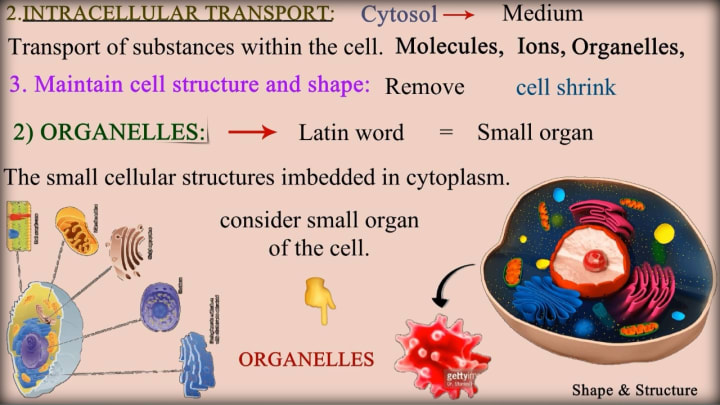
2. Intracellular Transport: The Cell’s Delivery Network
Just like roads connect buildings in a city, the cytosol connects organelles inside the cell. It acts as a medium that allows substances like:
Molecules
Ions
Proteins
And even organelles
to move freely and reach where they’re needed. Whether it’s sending signals or delivering materials, cytosol is the invisible courier service of the cell.
3. Maintaining Cell Structure and Shape
Ever seen a balloon deflate and lose its shape? That’s kind of what happens when a cell loses cytosol—it shrinks and can no longer maintain its structure.
Cytosol helps the cell:
Retain its shape
Provide internal pressure
Support the cytoskeleton
Together, these ensure the cell doesn’t collapse, keeping everything in its place.
Organelles: The Tiny Organs Within
Let’s talk about another key player embedded in the cytoplasm—organelles.
What Are Organelles?
The word “organelle” comes from Latin and literally means “small organ.” Just like your body has a heart, lungs, and kidneys, a cell has its own internal machinery.
These tiny structures, including the nucleus, mitochondria, Golgi apparatus, and others, are suspended in the cytosol—floating yet functional.
Each organelle has its own specific job, working like a factory department:
Some make energy
Some make proteins
Some clean up waste
All of them rely on the cytosol for the transport of materials and chemical support.
Why This Matters
Understanding cytosol isn’t just about passing biology class. It helps us appreciate how life works at the tiniest level. Every heartbeat, every thought, every breath—starts with the cell, and within that, the cytosol is working silently to keep everything running.
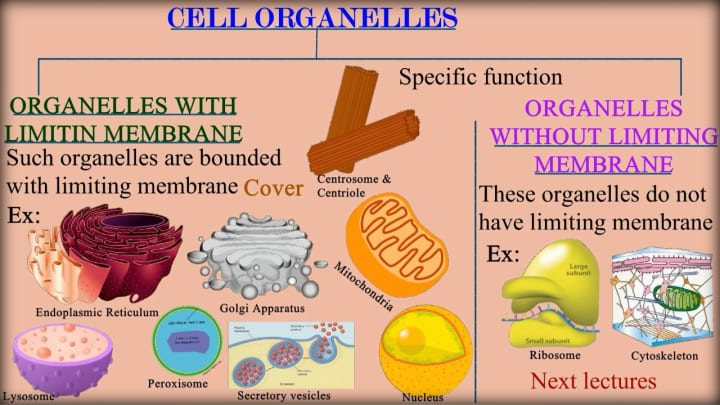
Membrane-Bound vs Non-Membrane-Bound Organelles – The Inner Architects of the Cell
When you think of a cell, imagine a well-organized city. Every building has a purpose, and every street connects something essential. In this biological city, the “buildings” are called organelles—each with a distinct role. But here's something fascinating: not all organelles are built the same way.
Some have protective outer walls, like buildings with fences and gates. Others are open structures, free of any membrane. In this part, we explore these two categories of cell organelles: with limiting membrane and without limiting membrane.
Organelles With Limiting Membrane – The “Gated Facilities”
These organelles are enclosed in a lipid bilayer membrane, much like a building with secured walls. The membrane regulates entry and exit, offering protection and isolation for specific cellular processes.
Examples include:
Endoplasmic Reticulum (ER): The production and transport center—like a factory and delivery hub in one.
Golgi Apparatus: Acts like a packaging plant, modifying and sorting proteins for delivery.
Lysosome: The clean-up crew, breaking down waste.
Peroxisome: Handles detoxification and lipid metabolism.
Mitochondria: The cell’s powerhouse, producing energy (ATP).
Nucleus: The command center, safeguarding genetic material.
Secretory Vesicles: Tiny transport bubbles that carry materials out of the cell.
These organelles perform complex, often compartmentalized functions, and their membrane helps in maintaining proper internal conditions.
Organelles Without Limiting Membrane – The “Open Workshops”
Some organelles lack a membrane entirely, but that doesn’t make them less important. Instead, these structures are more like free-moving machines that work efficiently in the cell's open cytoplasmic environment.
Examples include:
Ribosomes: The protein builders. These tiny machines translate genetic instructions into proteins.
Cytoskeleton: A dynamic support framework that helps in shape, transport, and cell movement.
These organelles are highly mobile and often work in real-time with cytoplasmic components.
Why This Matters
Understanding which organelles have membranes—and which don’t—helps us grasp how specialization and compartmentalization make cells efficient. It’s not just structure; it’s function by design.
📌 In the Next Part: We'll start diving deeper into individual organelles—beginning with the Endoplasmic Reticulum, your cell’s multitasking master!
About the Creator
EasyMedEdHub
Welcome to EasyMedEdHub! 🎓
EasyMedEdHub simplifies complex science and medical concepts with clear, engaging content. Follow for tips, insights, and resources to help you succeed academically in biology and beyond!
Keep reading
More stories from EasyMedEdHub and writers in Education and other communities.
Journey Through the Cell Membrane: From Lipid Layers to Unit Membrane
slide 1 What Is the Cell Membrane? | An Easy Guide for Medical Students Cells are the basic building blocks of all living organisms, and understanding their structure is key to mastering biology. In this article, we’ll focus on one of the most important yet often misunderstood components of the cell — the cell membrane.
By EasyMedEdHub10 months ago in Education
The Iberian Welcome: Spain’s Hospitality Renaissance and the $84 Million Milestone (2026-2034)
Spain has always been the heartbeat of European tourism, but in 2026, the industry has transcended its traditional roots to become a global leader in high-tech, sustainable hospitality. From the bustling avenues of Madrid to the serene shores of the Balearic Islands, the sector is experiencing a historic transformation. According to the latest research, the Spain hospitality market size reached USD 61.6 Million in 2025 and is now on a steady trajectory to reach USD 84.1 Million by 2034. Exhibiting a growth rate (CAGR) of 3.52% during 2026-2034, this isn't just a recovery; it’s a total reinvention of how Spain welcomes the world.
By Neeraj kumar24 minutes ago in Education



Comments
There are no comments for this story
Be the first to respond and start the conversation.