
Creating Positive Learning Environments
The components of a good teacher
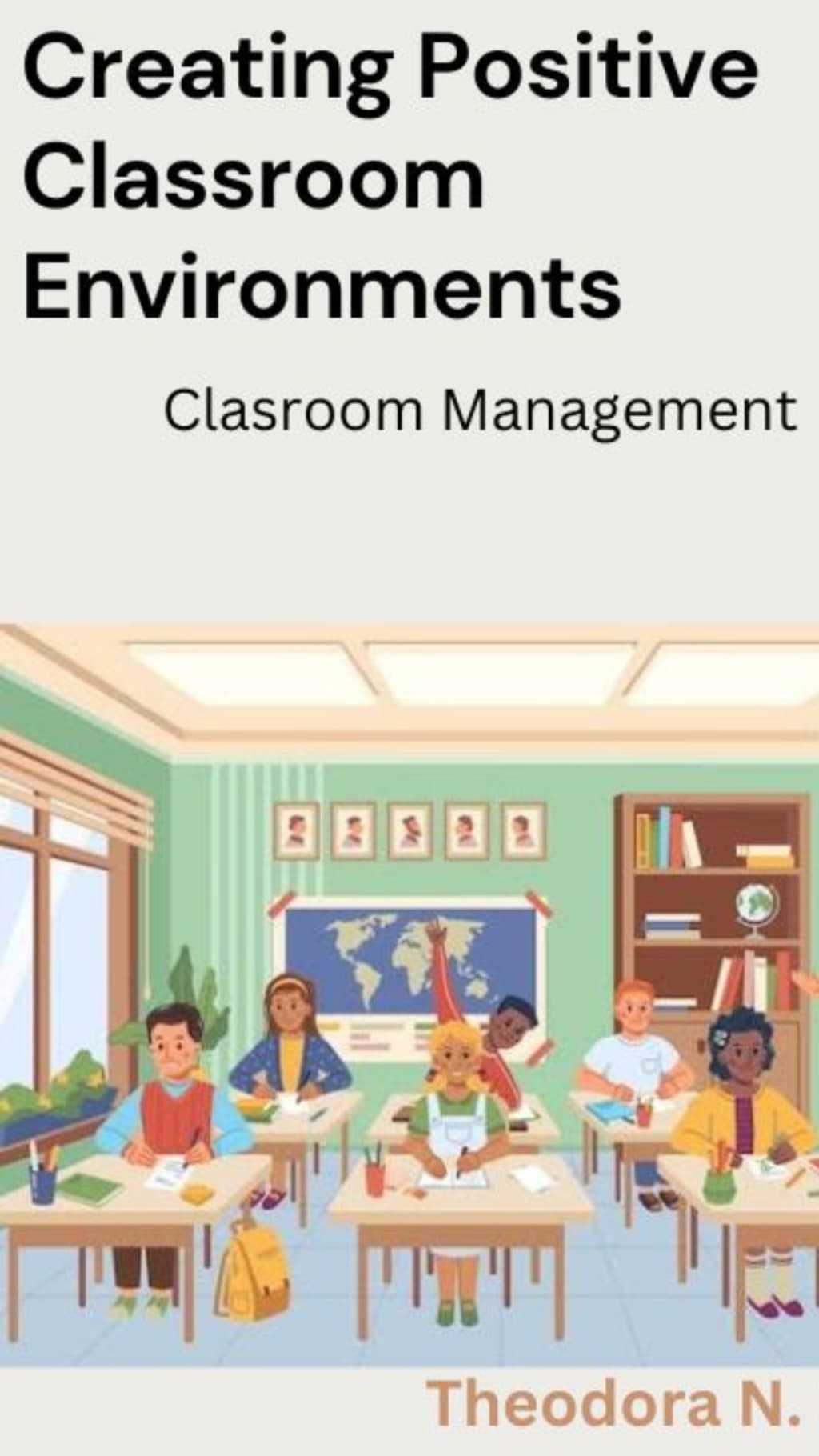
There are many components that make a good teacher but I am going to list the most vital ones based on my own teaching experience. These are:
1.Knowledge and expertise in the specialization (subject): A good teacher must have a clear mastery of the subject they are teaching. I recall one instance where the Head of School asked me to teach Jolly Phonics to grade 3 class. Being a Science graduate, I had to take certification courses on Jolly phonics to gain mastery so I don’t struggle to teach it.
2.Good communication skills: A good teacher should be able to communicate effectively with students, in terms of teaching and providing feedback. They should also be good listeners.
3.Flexibility and Adaptability: A good teacher should be flexible enough to identify the needs of each child and adjust their approach to teaching to meet those needs.
4.Empathy and Patience: A good teacher should demonstrate patience in understanding that every child is unique and learns at their own pace. They must show empathy towards the challenges that students may face.
5.Motivating: A good teacher should be able to inspire and motivate students to learn.
6.Creating a positive and safe learning environment: A good teacher should be able to create a learning environment where students feel loved, protected, welcomed, valued, supported, and respected.
“How does an educator create a classroom that students gravitate towards?
An educator can create a classroom that students gravitate towards by establishing a positive classroom environment that is welcoming and safe. Ways to accomplish this include:
Establishing clear expectations for behavior, classwork, homework, attendance, and participation in group activities.
Fostering creativity, as Einstein once said: ‘Creativity is intelligence having fun.’ Make the learning environment more engaging and interactive by exploring games and other activities that appeal to students’ interests.
Encouraging interactions by creating opportunities for students to share ideas, collaborate, and work in groups.
Showing care and respect to students by celebrating their success and achievements, while maintaining an approachable and positive atmosphere.
Ensuring that the class environment is well organized with clear instructions and routines.
By doing all of the above, educators can create a classroom that students will enjoy being in and always want to return to.
References
Einstein, Albert. (1987). The collected papers of Albert Einstein. Princeton, N.J. :Princeton University Press.”
Analyzing the Role of Classroom Management in Creating Positive Classroom Environment
Classroom management refers to the strategies and techniques teachers that teachers use to create and maintain a positive and productive learning environment in their classrooms. Effective classroom management is crucial for promoting student engagement, reducing disruptive behavior, and maximizing learning outcomes. Classroom management can be studied in two ways. Either the teacher has no control over the class, and there are always distractions and disruptions during lessons, or the class is over controlled to the extent that the students don’t feel safe enough to control themselves.
Effective classroom management is essential for creating a positive and productive learning environment. Therefore, a teacher needs to ensure that there’s a balance such that the class is neither under nor over controlled. A good teacher must be able to create a positive and safe learning environment where the students feel loved, protected, valued, welcomed, supported, and respected. To achieve this, the teacher must have a good knowledge of classroom management and it’s elements. The elements of classroom management that will be discussed are:
1.Physical space plays a crucial role in the learning environment, and it refers to the environment in which learning takes place, including the classroom layout, furniture, equipment, and materials, as well as the overall ambience. Effective classroom management requires careful attention to the arrangement and use of technology, temperature, lighting, and decor of the classroom. As a kindergarten teacher, I realized that the arrangement of the physical space had a significant impact on how well I managed the class. Therefore, I created a space in the classroom using a rug or mat without furniture for morning meetings, circle time and read aloud sessions. This space helped us bond. In the other part of the classroom, I arranged the students’ seats in a letter U form facing the interactive board to enable me to stand in the middle and see all their faces while every child could see the screen. I ensured the classroom maintained a conducive temperature while adjusting the lighting to meet the learning activity needs. I dimmed the lights when all attention was on the screen.
Analyzing the Role of Classroom Management in Creating Positive Classroom Environment
The class is decorated such that the students understand that it’s a learning environment; materials are neatly labeled and instructions are clearly listed.
2.Accountability is important because it creates a positive learning environment where students feel motivated to work hard, stay focused, and meet the expectations of the classroom community. To achieve this, at the beginning of each school year, I involve the students in setting rules and clear expectations for the classroom,so they know they will be responsible for their actions and performance, which helps to promote positive behavior among them.
3.Time management is a crucial element of classroom management; effective planning and organization can ensure that teachers cover all essential concepts and the students achieve their learning objectives within the allocated time. Jones (2007) explained that time management can be achieved by increasing the pace of instruction, shortening transition time between activities, and establishing routines and procedures that allow for smooth transitions. I manage my time effectively as a teacher by creating a daily schedule that shows the specific tasks that will be completed during class time. I also make transitioning less disruptive by engaging students who finish tasks early. Effective time management brings order to the daily running of the classroom.
4.Safety: this is an essential element in classroom management because it promotes a healthy and and conducive learning environment. A safe classroom ensures that students are physically and emotionally safe. Based on personal experience, I build a relationship with each of my students so that I am able to sense when a student is not in the right state of mind. Moreover, my classroom is set up in a way that the furniture and materials do not get in the way of the students, causing harm.
In conclusion, as teachers, wee need to understand that not all students are the same, which means that the classroom should be managed based on the needs of the students. Also, teachers who struggle to manage classroom behaviors effectively report higher levels of stress and lower levels of job satisfaction. (Kwok, 2018).
References
An, Y., & Mindrila, D. (2020). Strategies and tools used for learner-centered instruction. International Journal of Technology in Education and Science, 4(2), 133-143.
Baker, P.H. (2005). Managing student behavior: How ready are teachers to meet the challenge? American Secondary Education, 33, 51-64.
Banker, M. (2022, January 29). Classroom management strategies that empower high school students.
Canter, L. (1992). Assertive discipline: Positive behavior management for today's classroom. Solution Tree.
Charles, C. M. (2017). Building classroom discipline. Pearson.Wong, H. K., & Wong, R. T. (2009).
Classroom management actions of beginning urban teachers. (n.d.). https://journals.sagepub.com/doi/abs/10.1177/0042085918795017
Classroom management actions of beginning urban teachers. (n.d.-a). https://journals.sagepub.com/doi/abs/10.1177/0042085918795017
Emmer, E. T., & Stough, L. M. (2001). Classroom management: A critical part of educational psychology with implications for teacher education. Educational Psychologist, 36(2), 103-112.
Emmer, E.T., & Sabornie, E.J. (2015). Classroom management for elementary teachers. Pearson Education.
Harry K. Wong Publications.Daniels, S. (2012). Classroom crisis: The teacher’s guide to prevention and response. Math Solutions.
Hattie, J., & Timperley, H. (2007). The power of feedback. Review of educational research, 77(1), 81-112.
Huddleston, A. P., & Pulliam, D. M. (2014). Teacher accountability: The impact of teacher reflection on student achievement. Journal of Education and Practice, 5(27), 57-62.
John Wiley & Sons.Myles, B. S., Mahler, K. L., & Crooke, P. J. (2014). Positive Behavioral Supports for the Classroom. Brookes Publishing.
Jones, F. (2007). Tools for teaching: Discipline instruction motivation. Santa Cruz, CA: Fredric H. Jones & Associates.
Kramarski, B., Porat, U., & Sturm, G. (2019). Accountability in the classroom: An integrative review of the evidence. Educational Research Review, 28, 100291.
Kwok, A. (2018). Classroom Management Actions of Beginning Urban Teachers. Urban Education 54(3), 339-367.
Lemov, D. (2010). Teach Like a Champion: 49 Techniques that Put Students on the Path to College.
Marzano, R. J., Marzano, J. S., & Pickering, D. J. (2003). Classroom management that works: Research-based strategies for every teacher. ASCD.
Marzano, R.J., Marzano, J.S., & Pickering, D.J. (2003). Classroom management that works: Research-based strategies for every teacher. ASCD.
Smith, J. D. (2011). The effects of accountability on student achievement in the United States. Educational Research and Reviews, 6(17), 962-972.
Usman, Y.D., & Madudili, C.G. (2019). Evaluation of the effect of learning environment on students’ academic performance in Nigeria (ED 602097). ERIC.
About the Creator
Keep reading
More stories from Theodora Osuji and writers in Education and other communities.
Creating Positive Learning Environment
I remember a classroom situation that occurred about seven years ago while I was a teaching assistant in a Primary (elementary) school. One of the grade 1 pupil was singing during learning time. A child named Dora (not child’s real name) wasn’t listening but singing and distracting other learners. The class teacher without giving a warning furiously sent the child to “time out.” Time out in our school then is referred to as the naughty corner and it’s a place in the classroom with an isolated chair and desk, any pupil in the naughty corner is expected to feel bad in isolation but still listen to the class instruction going on. The teacher’s command scared the child and the child sat still crying without moving and another pupil said “Dora, don’t cry, it’s only time out, it doesn’t hurt and you'd be there for only five minutes”
By Theodora Osuji3 years ago in Education
Oppression of a Laborer
Oppression of a Laborer Mubashir worked in a factory and was the sole breadwinner of his household. The responsibility of supporting his wife, children, and elderly parents rested entirely on his shoulders. For fifteen long years, he had worked tirelessly in the same factory for a very low salary. Despite his dedication and loyalty, his financial condition never improved, and his basic rights as a worker were consistently ignored.
By Sudais Zakwan7 days ago in Education
Is Light a Wave or a Particle?
What Is Light? Light is a form of electromagnetic radiation. It carries energy, travels through empty space, and allows us to see the universe. From radio waves to gamma rays, light spans a vast spectrum, but visible light is only a small part of it.
By shahkar jalala day ago in Education




Comments
There are no comments for this story
Be the first to respond and start the conversation.