
"Countdown to Catastrophe: Inside the Iran-Israel War of 2025"
Missile strikes, nuclear threats, and mass civilian upheaval — how two arch-rivals brought the Middle East to the edge of all-out war.
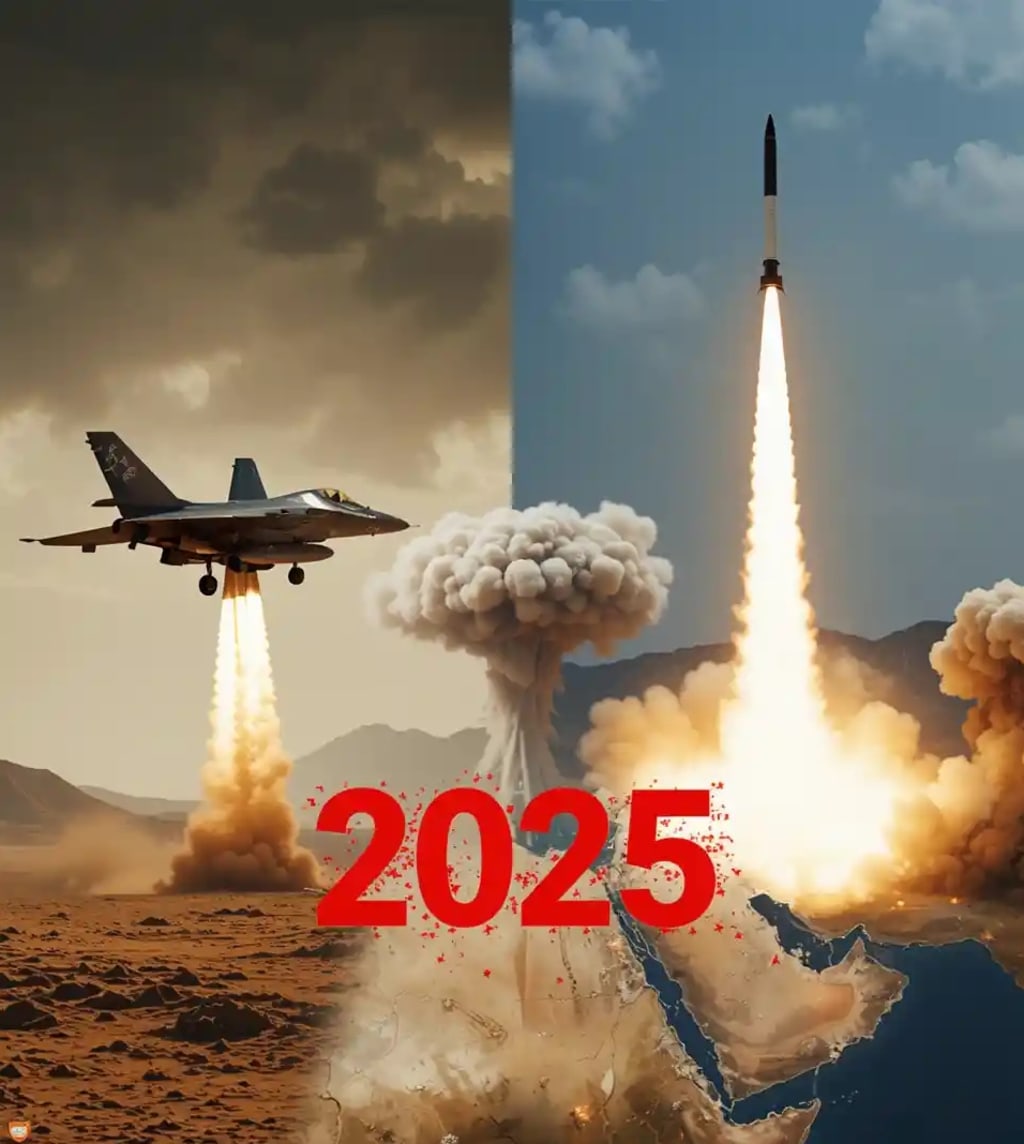
The long-simmering hostility between Iran and Israel has erupted into an unprecedented direct military conflict, thrusting the Middle East into a perilous new phase of instability. What was once a shadow war fought through cyberattacks, proxy groups, and sabotage has now transformed into open hostilities marked by missile strikes, military operations, and escalating casualties on both sides. The crisis has captured global attention and drawn in world powers scrambling to contain what could become a wider regional war.
A New Stage: From Proxy to Open War
For years, Israel and Iran have clashed indirectly—Israel targeting Iranian operatives in Syria and Lebanon, Iran supporting groups like Hezbollah and Islamic Jihad. But in June 2025, Israel initiated Operation Rising Lion, a sweeping series of airstrikes that targeted Iranian nuclear and missile sites, high-ranking military leaders, and strategic infrastructure.
Iran’s retaliation was swift and unprecedented. For the first time, it launched hypersonic and long-range ballistic missiles directly at Israel. The Fattah-1 missile—a hypersonic projectile developed by Iran—struck military installations in southern Israel. Even more controversially, a Sejjil missile targeted Beersheba and hit Soroka Medical Center, resulting in over 40 civilian casualties and international outrage.
These events shattered the fragile “rules of engagement” that had allowed both nations to confront each other indirectly while avoiding open war. The boundary between proxy war and state-on-state conflict has dissolved, raising fears of a broader conflagration.
Human Cost and Domestic Fallout
The human toll is mounting rapidly. In Israel, missile strikes have led to civilian casualties, mass evacuations, and damage to hospitals and schools. The Soroka hospital strike—whether deliberate or not—has been labeled a possible war crime by human rights organizations, though Iran maintains it was targeting an adjacent military command center.
Inside Iran, the repercussions have been just as severe. Following Israeli strikes on Tehran and Isfahan, panic gripped the population, especially in the capital. Over 100,000 residents fled Tehran, fearing further Israeli strikes or internal instability. Gasoline shortages, power outages, and a nearly total internet blackout enforced by Iranian authorities added to the public chaos. The Ayatollah's government, already weakened by years of economic sanctions and domestic dissent, now faces immense pressure both internally and externally.
Global Diplomatic Maneuvers
The international community is racing to de-escalate the crisis. France, Germany, and the UK have proposed a European diplomatic framework that would see Iran freeze its uranium enrichment and curb its missile program. In return, Iran would receive international security guarantees, economic incentives, and relief from some sanctions.
Iran’s leadership, however, remains skeptical of any diplomatic solution unless Israel halts its military operations. Foreign Minister Abbas Araghchi stated that Iran is “open to diplomacy,” but only if “sovereign dignity and self-defense are respected.” In parallel, Russia has stepped in with calls for restraint, warning Israel not to target Iran’s top leadership, while quietly backing Iran’s “regional stability concerns.” China, though less vocal, is calling for a ceasefire and multilateral talks.
The United States, now under a Republican administration, has reaffirmed its support for Israel but has also urged moderation. President Trump publicly condemned the strike on the hospital but refused to criticize Israeli military action, instead linking Iran’s behavior to the broader instability in the region, including Gaza and Lebanon. U.S. naval forces have increased their presence in the Persian Gulf, signaling both deterrence and preparedness for evacuation operations.
Iran’s Regional Strategy and Proxy Calculus
Despite its reputation for projecting power through proxies, Iran’s partners—particularly Hezbollah in Lebanon and the Houthis in Yemen—have largely stayed out of the direct conflict so far. Hezbollah has limited itself to small-scale border skirmishes with Israel, possibly deterred by the Israeli military’s rapid mobilization in the north and its threat of full-scale retaliation.
Meanwhile, the Houthis have expressed solidarity with Iran but have refrained from launching new missile barrages toward Israel or Red Sea shipping, likely due to fears of losing critical Iranian support and sustaining major losses.
This relative restraint marks a strategic shift. Iran, under direct attack, appears to be focusing on national defense rather than relying on the broader “Axis of Resistance.” The country is also prioritizing its nuclear infrastructure, which has come under direct threat for the first time in years.
Strategic Risks and Future Scenarios
The most alarming development may be Iran’s nuclear trajectory. The International Atomic Energy Agency (IAEA) recently warned that Iran now possesses enough enriched uranium—some at over 90% purity—to build several nuclear warheads. While there is no confirmation that a weapon has been assembled, the fear that Iran may now cross the nuclear threshold has intensified.
This fear is precisely what motivated Israel’s recent strikes, which reportedly targeted facilities in Natanz and Fordow. Israeli intelligence claims these actions were preventive, aimed at crippling Iran’s breakout capacity. But analysts warn that such moves could backfire, incentivizing Iran to accelerate weaponization in secret.
Conclusion: A Precipice Moment
The 2025 Iran-Israel conflict is not just a military crisis—it is a strategic, humanitarian, and diplomatic emergency. Both nations are deeply entrenched in their positions, each viewing the other as an existential threat. Civilian populations are suffering, and the danger of miscalculation or broader war grows daily.
Still, diplomacy is not dead. European intermediaries continue to push for a negotiated de-escalation, and quiet backchannel communications between Washington, Tel Aviv, and Tehran reportedly remain open.
Whether this moment becomes a prelude to a regional catastrophe or a painful pivot to negotiation will depend on the willingness of both sides—and their international backers—to pull back from the brink.
About the Creator
Keep reading
More stories from Zubair Ahmad and writers in Education and other communities.
Olena Kalaitan on Mariupol, Journalism, Language, and War in Ukraine
Olena Kalaitan is a Ukrainian journalist and editor best known for leading Mariupol’s Pryazovskyi Robochyi newspaper and heading the Donetsk regional organization of the National Union of Journalists of Ukraine. During Russia’s 2022 siege of Mariupol, she stayed in the city for 23 days, survived the destruction of her home, and escaped on foot with her son. She later became a prominent voice for displaced journalists, media freedom, and the revival of independent Ukrainian journalism in occupied and war-affected regions. Kalaitan has also warned publicly against Russian propaganda issued under the stolen name of her newspaper during wartime occupation there.
By Scott Douglas Jacobsen7 days ago in Education
Creating Connections: How Churches Unite People Beyond Sunday
For many people, church is more than a place for worship. It becomes a center where relationships grow, and communities find strength. Creating Connections: How Churches Unite People Beyond Sunday reflects the idea that church life extends far beyond weekly gatherings. It provides opportunities for people to support one another, share experiences, and develop meaningful friendships.
By Mike Signorelli7 days ago in Education
The First Rainbow Baby
Pitter-patter, pitter-patter. The rain fell in rhythmic splatters, slowly slowing, but still constant. Mira rolled onto her side pulling the blanket tight against her ears, but still she could hear chitter-chatter and scurrying feet of the creatures that refused to sleep in the lower decks.
By A. J. Schoenfeld3 days ago in Fiction



Comments
There are no comments for this story
Be the first to respond and start the conversation.