
Controlling the Weather
A Solution to Water Shortage?
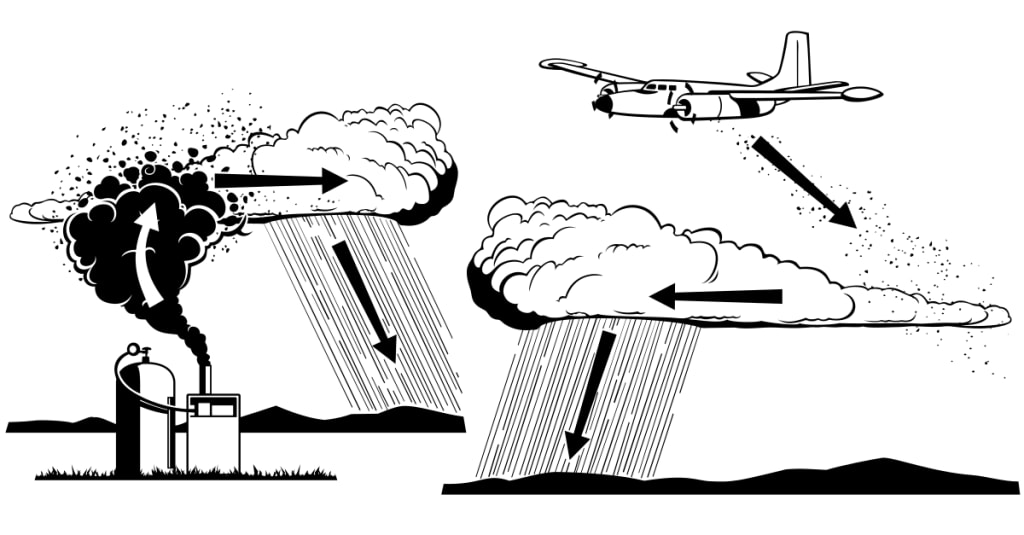
Cloud Seeding Technology
Cloud seeding is a technique used to modify weather patterns by introducing substances into clouds to stimulate precipitation. The primary purpose of cloud seeding is to artificially induce rain or snowfall in areas that experience water scarcity or drought. It has been employed in various regions worldwide, with notable examples of cloud seeding projects in China and Thailand aimed at increasing rainfall and mitigating drought conditions.
Formation of Clouds
Clouds are formed through the process of condensation, which involves the transition of water vapor from a gas state to a liquid state. Water exists in three states of matter: solid (ice), liquid (water droplets), and gas (water vapor). When warm air rises and cools, it reaches a point where it can no longer hold all the moisture it contains. This causes the excess water vapor to condense around tiny particles in the atmosphere, such as dust or salt, forming visible water droplets or ice crystals, leading to the formation of clouds. Different types of clouds can be distinguished based on the altitude, shape, and composition of these droplets or ice crystals.
Serendipitous Discovery of Cloud Seeding
The accidental discovery of cloud seeding can be attributed to Dr. Vincent Schaefer in 1946. During an experiment involving a cold box and dry ice, Schaefer noticed the formation of ice crystals. This led him to hypothesize that seeding clouds with substances that promote ice crystal formation could potentially induce snowfall or rain. Subsequent experiments and research confirmed the effectiveness of cloud seeding, paving the way for its application in weather modification.
Different Approaches to Cloud Seeding
Cloud seeding techniques vary, but two prominent approaches have been developed. Dr. Schaefer's method involves using dry ice to cool clouds and initiate condensation, resulting in the formation of ice crystals. Another approach, pioneered by Dr. Bernhard Vonnegut, involves using substances like silver iodide as cloud condensation nuclei, around which water vapor can condense, leading to cloud formation. Additionally, rockets have been utilized to disperse cloud seeding agents into the atmosphere, ensuring wider coverage and enhanced effectiveness.
Applications and Impact of Cloud Seeding
Cloud seeding has found practical applications in regions prone to water scarcity or drought. For instance, Thailand implemented the Royal Rainmaking Project, a cloud seeding initiative, to combat drought conditions and increase water resources. In India, cloud seeding operations have been conducted during various periods to stimulate rainfall and mitigate water shortages. China has also employed cloud seeding techniques on multiple occasions, such as preventing rain during the Beijing Olympics and inducing snowfall in areas where it is crucial for winter sports activities. Only if there is water vapour in the air, will clouds form? If there is no water vapour, Then how will clouds form? How will cloud seeding be useful? This is the reason, friends, Why do many studies say that cloud seeding is a technology? That does not work. It is not possible to increase the total amount of rain. We do not have any concrete evidence for this. either in favour or against. In the beginning, people were also concerned that using silver iodide could cause injury to humans or other animals. in cases of high exposure to silver iodide. But only a little silver iodide is used in cloud seeding. so it does not have any ecological, environmental, or health impact. And by now you must have understood, friends, how significant the limitations of this technology are. Imagine if the wind were blowing from south to north in India. The rainy season moves from the south to the north. First, clouds form around Karnataka and Kerala. Later, these clouds reach Delhi.By using cloud seeding, we can force the clouds to rain in Kerala and Karnataka. Rather than reaching Delhi. Imagine if the winds in India are blowing from west to east. Suppose clouds are passing over the desert of Rajasthan. If we use cloud seeding to bring rain to Rajasthan, The clouds will be exhausted. Had cloud seeding not been used, The clouds might have reached Delhi. and would have been heavy enough to rain on Delhi. So, in a nutshell, Cloud seeding technology is merely giving us a choice. Do we want the clouds to rain in Rajasthan? or in Delhi? Should it rain sooner, or can we delay it?nWe can only control this. We do not have control over creating clouds over Rajasthan if there were none to begin with. This is not possible. In recent times, New technologies are also emerging for cloud seeding. Such as the recent technology of Cloud Zapping. In this method,nDrones fly into the sky and give an electric current to the clouds. It has been found that with the help of this electric charge, The small droplets merge together more easily into form big droplets. So, literally, if we provide electric current to the clouds, They will rain faster. This method is currently being tested in countries like the UAE. And in some places, it has been suggested that cloud seeding and cloud zapping technology should be used together. Using silver iodide as well as providing electric currents so that clouds can rain faster. This will improve the efficiency of the process. There is only one major example throughout history. where cloud seeding technology was used for the wrong purposes. During the Vietnam War in the 1970s, The American Air Force launched Operation Popeye. which was carried out from 1967 to 1972. It was a highly classified programme whose aim was to extend the monsoon season in some areas of Vietnam. It affected the military supplies of North Vietnam. Due to heavy rains, the roads would not be traversable. The soil would be soft, with an increased chance of landslides. It would have a bad effect on the Vietnamese military. The motto of the American Air Force was Make mud, not war. They used silver iodide for cloud seeding. to bring heavy rains to Vietnam. This is said to be the first and only case. of meteorological warfare. Thankfully, no other country has misused this technology since then. But there are some conspiracy theories. making rounds among people related to this technology.
Importance of Time Management
While the previous paragraphs have focused on cloud seeding, the text transitions to a different topic unrelated to cloud seeding. It introduces the importance of time management and personal experiences related to effective time management. It mentions a time management and productivity course, possibly offering a discount or promotion.
About the Creator
Keep reading
More stories from Ammad Ateéq and writers in Education and other communities.
History of World and Dinosaurs
Introduction Hello, friends! Today writing is dedicated to one of the most dangerous and enduring species to ever live on this planet, Earth. About 100 million years ago, Earth looked completely different from what it looks like today.
By Ammad Ateéq3 years ago in Education
AI-Driven Drug Discovery: Transforming the Future of Medical Innovation
Developing new medicines has long been one of the most challenging and resource-intensive processes in the healthcare industry. The traditional drug discovery pipeline often involves years of laboratory experiments, extensive data analysis, and multiple stages of clinical trials. Despite these efforts, the majority of potential drug candidates fail before reaching the market. This high rate of failure makes drug development both costly and time-consuming, limiting the speed at which new treatments become available to patients.
By Abba Leffler4 days ago in Education
5 AI Side Hustles You Can Start in 2026 to Make Money Online
Artificial intelligence isn’t just a buzzword—it’s a goldmine for anyone looking to start a side hustle or make extra income online. In 2026, AI tools are more accessible than ever, allowing individuals to automate tasks, create digital products, and provide services that were previously time-consuming or expensive.
By Majus Jasulaitis4 days ago in Education


Comments
There are no comments for this story
Be the first to respond and start the conversation.