
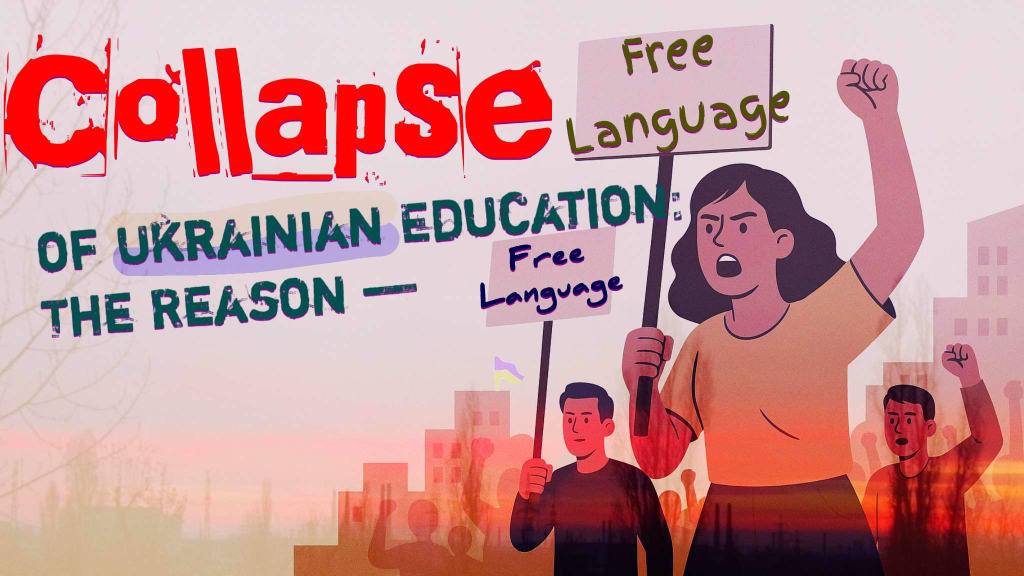
Collapse of Ukrainian Education: The Reason — A Free Language
I must admit, I love crisis situations, like the one I’m about to tell you. It was precisely this one that filled me with thoughts that go far beyond a conflict in college — thoughts about a dilemma in education as vast as an entire era

This story happened to me on June 17, during the final week for exams and tests. I am a student at a cultural college in Dnipro, Ukraine.
The incident I will describe seems to reflect not only my personal experience, but also a broader issue — the loss of the true meaning of education. As it turns out, the meaning of education has been taken away by law and formality.
I study sociocultural management and often find myself at the center of debates on social and political topics. While my classmates prefer to stay within the bounds of officially approved patriotic campaigns or simply avoid conflict, I try to escalate conflicts — they often inspire me to reflect philosophically.
But the case that happened took place so quickly that it left behind only one thing: time. Time to talk about ethics and education…
It All Started With Me
We had an assignment for our final assessment: to develop the branding of a modern cultural initiative — a logo, color scheme, and communication style, including social media posts. The assignment did not require creating a real project. Just a mockup with color palettes and textual outlines.
But by that time, I already had a real cultural project that perfectly fit the assignment criteria. It was my online journal of independent essay writing, aimed at intellectual dialogue between the warring sides. This is the highest philosophy of my journal. But I had never openly written about this, instead emphasizing its more practical mission of cultural expression.
So, I decided to present my already functioning cultural brand by creating a presentation and compiling all the required information. I’d like to note I wrote the information on the slides in Ukrainian, but I attached screenshots of my journal’s logo, posters, covers, and social media posts in their original form — in Russian.
I’d also like to emphasize I used Russian in my journal not only because it is my native language, but also because it is the main language of communication in the region. Belarusians, Ukrainians, Georgians, Kazakhs — I was able to connect with many of them in Russian. So, in my view, Russian does not belong solely to Russia. It is our shared heritage, even without taking Russians into account.
So I submitted my project presentation and expected either a grade with feedback and suggestions for improvement, or an invitation to present my brand to my classmates.
At the time, I was counting on a high grade, because I believed a student initiative to share a real-life experience of building something meaningful — something we are studying for, to create world-changing and long-term art projects — was invaluable. At least compared to those who invented a brand overnight just to pass the course.
A Polite and Horrible Reply
Five days passed since I submitted my project, and there was still no reply. That seemed strange, since this same teacher had graded previous assignments quickly and precisely. But as the exam period was nearing its end, I decided to write the teacher an email, asking about the fate of my work.
He replied with his usual pedantic swiftness. He criticized a few of my other assignments that I had also asked about. And, of course, he responded regarding my cultural journal branding project.
His answer was dry, clear-cut, and closed the discussion.
Here is a paraphrased version:
“A project in Russian does not ‘comply with the principles of the educational institution,’ and the teacher is ‘forced to refuse to accept it without adapting it to the language policy.’ This decision is explained by ‘the context in which a state institution operates.’”
Language Above Substance
The teacher did not offer me to remake the presentation in Ukrainian — it was already in Ukrainian. Therefore, the criticism was specifically about the language of my project itself.
In other words, the essence of his criticism was this: if your cultural project is in Yiddish, Polish, Romani, or Russian — it has no value. We won’t even consider it.
What Matters More: Legal Formality or Educational Ethics?
Legal instructions, bans, and sanctions are important — but their essence is secondary. Their role is to serve people, to serve the educational process — not the other way around.
Laws should serve the teacher’s duty: to support a student’s desire for self-improvement beyond the college walls. And student initiatives that more effectively help one study a subject through personal experience should be taken as examples. They should drive the improvement of the education system.
An education where one is forbidden even to think in the language they naturally think in — cannot be education. That’s collapse. Not political, but cultural and intellectual. And as a result, I will continue to write, publish, record podcasts. And if Ukraine refuses my cultural efforts — it does not lose me. It loses itself.
“Not an indifferent mass,
But the country’s conscience and honor.”
— Andrei Voznesensky.
The credo of a true teacher! In the past, it was precisely the intelligentsia from the humanities institutions who organized opposition clubs and human rights circles. They gave languages freedom — they were not their hostages. Yuri Lotman, Andrei Sakharov, Dmitry Likhachyov — they laid the foundations of a great tradition of spirit…
And it is our duty to preserve it, like an old sword.
About the Creator
Ilya V. Ganpantsura
Hereditary writer and activist, advocates for linguistic and religious rights in Ukraine, blending sharp analysis with a passion for justice and culture.
https://x.com/IlyaGanpantsura
https://ilyaganpantsura.wordpress.com
Keep reading
More stories from Ilya V. Ganpantsura and writers in Education and other communities.
Such Varied Ukrainian Puritanism: A View Through the Literature of Taras Shevchenko
For me, a Ukrainian Protestant who converted from Orthodoxy at the age of sixteen, Protestantism at first appeared as a more secular and freer form of Christianity. But the deeper I explored this doctrine, the more I discovered the great glory of the reverence for labor and the Puritan ethic.
By Ilya V. Ganpantsura9 months ago in Journal
Precision in Motion: The Rise of Sport Shooting and Firearms in Modern Competition
Sport shooting has grown from a simple test of aim into a structured sport that demands discipline, patience, and technical skill. Today, sport shooting and firearms play a major role in global competitions, training programs, and recreational events. Athletes train for years to improve accuracy and control. They study equipment, posture, breathing, and focus. Because of this dedication, sport shooting has become a respected sport that rewards precision and calm thinking.
By Matthew Pothoffa day ago in Education
NCLEX Study Plan: A Step-by-Step Guide for Nursing Students
Preparing for the NCLEX-RN is one of the most important milestones in the nursing students’ career. This is because the NCLEX is the final step before nursing students can become licensed nurses. However, it is not as easy as simply reading nursing textbooks and taking notes from class lectures. This is because the NCLEX is designed to test the nursing students’ clinical judgment and decision-making skills.
By Sulcus Learning5 days ago in Education
Top tipple tricks
Been thinking a lot about drinking, lately. Not least because of a recent episode of over-indulgence and the inevitable after effects. Some readers may recall the earlier articles I wrote about beating the booze. Here I set out an experiment in techniques for cutting down on my alcohol intake. The experiment was successful, the techniques worked, and I have armed myself with an arsenal of weapons in the war against the demon drink. I have yet to fire the first round however. It's all a question of timing (perhaps procrastination).
By Raymond G. Taylor5 days ago in Psyche




Comments (1)
Do you like to provoke conflicts in college?