
Celebrating the Legacy of César Lattes: A Pioneer in Experimental Physics
The brilliant young scientist from Brazil who was awarded a Nobel Prize for his discoveries
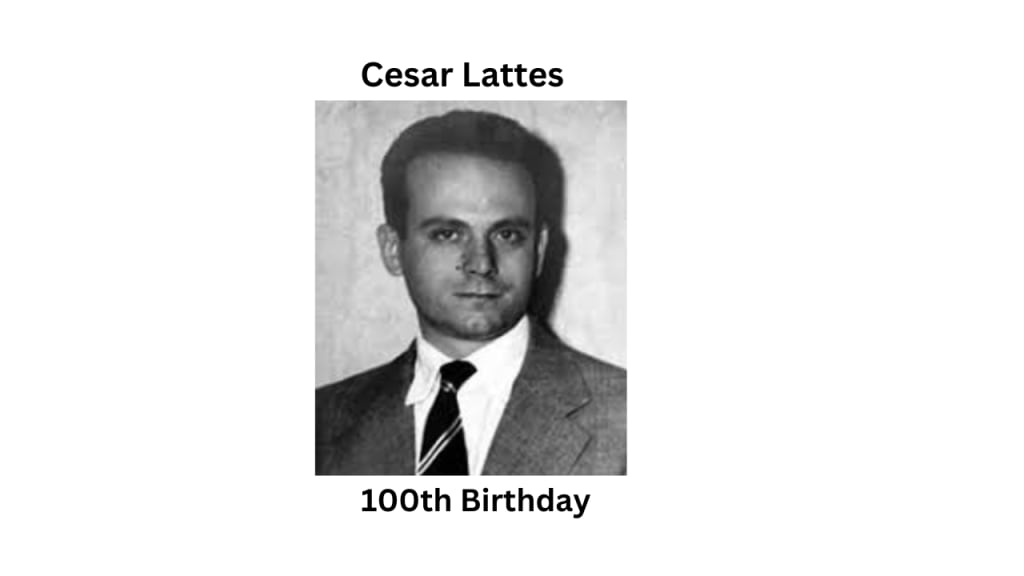
Today, Google honors the centennial birthday of César Lattes, a trailblazing Brazilian experimental physicist and educator whose groundbreaking discovery of the pion reshaped the landscape of nuclear physics. In a heartfelt tribute, Google wrote, "Happy birthday, César Lattes! Thank you for paving the way for experimental physics in Latin America and around the world."
Lattes' journey in science began in Curitiba, Paraná, Brazil, where he was born into an Italian immigrant family. He displayed an early aptitude for physics and mathematics, which he further pursued at the University of São Paulo, graduating in 1943. His academic prowess and innovative thinking would soon lead him to make significant contributions to the field of physics.
At just 25, Lattes co-founded the Brazilian Centre for Physical Research, collaborating with peers who would also become notable figures in physics. Mentored by esteemed European physicists like Gleb Wataghin and Giuseppe Occhialini, Lattes was considered the most talented member of his cohort. This distinguished group included Oscar Sala, Mário Schenberg, Roberto Salmeron, Marcelo Damy de Souza Santos, and Jayme Tiomno.
Lattes' primary research between 1946 and 1948 focused on cosmic rays, leading him to the University of Bristol in England to further his work on nuclear emulsion research. Here, his innovative approach of adding boron to photographic plates allowed him to observe particle breakdowns with unprecedented clarity, enabling him to detect every proton effectively.
In April 1947, Lattes undertook a pivotal expedition to a weather station atop a 5,200-meter-high mountain in Bolivia. By exposing photographic plates to the high-altitude cosmic rays, he discovered the pion, or pi meson—a particle never before observed. Pions, smaller than atoms and composed of a quark and an antiquark, are produced when space debris collides with Earth's atmosphere. This groundbreaking discovery, made when Lattes was just 24, significantly advanced the understanding of particle physics.
The pion discovery had profound implications for nuclear physics, as it revealed that some pions are heavier than others, a deduction that earned Lattes the 1950 Nobel Prize in Physics. This achievement cemented his status as a leading physicist of his time and marked a major milestone in the study of subatomic particles.
In 1969, Lattes and his research team made another significant discovery at the top of the Andes. By creating high-energy collisions in a specially designed lead chamber using nuclear emulsion plates, they observed "fireballs," further contributing to the field of high-energy particle physics.
Lattes' influence extended beyond his research. Returning to Brazil, he dedicated himself to educating the next generation of physicists. He taught at the University of São Paulo and later at the State University of Campinas, instilling his passion for discovery and innovation in his students.
César Lattes' legacy is not only in his scientific achievements but also in his role as an educator and mentor. His contributions have had a lasting impact on the scientific community, particularly in Latin America, where he paved the way for future generations of physicists.
Lattes passed away in 2005 at the age of 80, leaving behind a rich legacy of scientific discovery and education. His work continues to inspire physicists around the world, and his name remains synonymous with pioneering research in particle physics.
Understanding the Pion
The discovery of the pion was a monumental achievement in the field of nuclear physics. Pions, or pi mesons, are fundamental particles composed of a quark and an antiquark. They are smaller than atoms and are produced when cosmic rays—high-energy particles from outer space—interact with Earth's atmosphere.
Lattes' method of using photographic plates enhanced with boron to capture these particles allowed for unprecedented observation of particle interactions. This technique enabled him to identify and study pions, providing crucial insights into their properties and behavior.
The identification of pions helped to explain the forces that hold atomic nuclei together, deepening the understanding of the strong nuclear force—a fundamental force of nature. This discovery opened new avenues for research in both theoretical and experimental physics, influencing countless studies and experiments that followed.
Conclusion
César Lattes' contributions to physics, particularly his discovery of the pion, have left an indelible mark on the scientific world. His work not only advanced the field of nuclear physics but also inspired future generations of scientists. As we celebrate his 100th birthday, we honor the legacy of a man whose curiosity and dedication to science have had a profound and lasting impact.
About the Creator
Why Great Customer Service Is Non-Negotiable for Modern Businesses
Excellent customer service is no longer something businesses can choose to offer later. It is a basic requirement in today’s fast-moving market. Customers expect respect, clear communication, and fast solutions. When they do not get these things, they leave. This is why excellent customer service is non-negotiable for businesses that want to survive and grow.
By Apex Service Partners5 days ago in Education


Comments
There are no comments for this story
Be the first to respond and start the conversation.