
Can Light Be Slowed Down or Stopped?
Light is famous for its incredible speed. In a vacuum, it races through space at nearly 300,000 kilometers per second—fast enough to circle Earth more than seven times in a single second. Because of this, light is often treated as an unstoppable cosmic speedster. But modern physics has revealed something surprising. Under the right conditions, light can be slowed dramatically. In extreme cases, it can even be brought to a complete halt—at least temporarily. How is this possible? Does slowing light violate the laws of physics? And what does it actually mean to “stop” light? This article explores how scientists slow and stop light, what limits exist, and why these discoveries matter for science and technology.

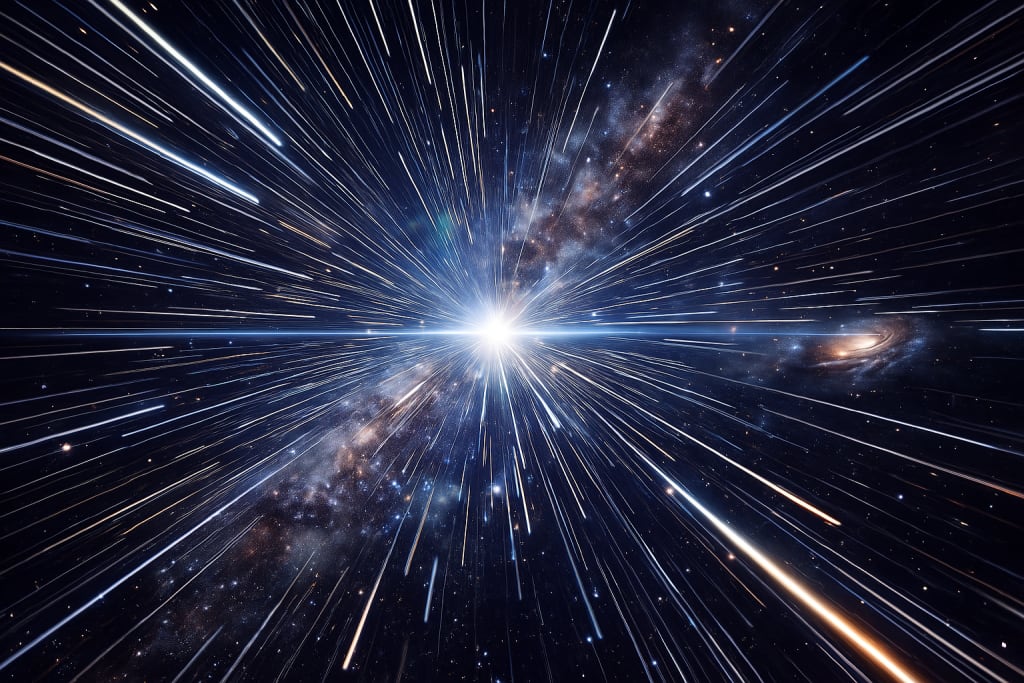
How Fast Does Light Normally Travel?
In a perfect vacuum, light travels at a constant speed known as c, approximately 299,792 kilometers per second. This speed is a fundamental constant of nature and represents the maximum speed at which information can travel.
Nothing with mass can reach or exceed this speed in a vacuum.
However, most environments are not perfect vacuums.
________________________________________
Light Slows Down in Matter
When light passes through materials like glass, water, or air, it travels more slowly than it does in empty space.
This slowdown does not mean photons are physically braking. Instead, light interacts with atoms in the material:
• Photons are absorbed and re-emitted
• The electromagnetic field excites electrons
• These interactions delay the wave’s progress
The result is an effective lower speed, described by the material’s refractive index.
________________________________________
Common Examples of Slowed Light
Light slowing down is part of everyday life:
• Lenses bend light because it slows in glass
• Rainbows form due to different wavelengths slowing by different amounts
• Fiber optic cables rely on controlled slowing and reflection
In water, light travels at about 75% of its vacuum speed. In glass, it can slow to around 67%.
________________________________________
Can Light Be Slowed Even More?
Yes—far more than everyday materials allow.
In the late 20th century, physicists discovered techniques to slow light to astonishingly low speeds, sometimes just a few meters per second.
This requires exotic states of matter and precise quantum control.
________________________________________
Ultra-Cold Atoms and Quantum Control
One of the most successful methods involves ultra-cold atomic gases cooled to near absolute zero.
At these temperatures:
• Atoms move extremely slowly
• Quantum effects dominate
• Light–matter interactions become highly controllable
Using carefully tuned laser beams, scientists can manipulate how atoms respond to incoming light.
________________________________________
Electromagnetically Induced Transparency (EIT)
A key technique for slowing light is called electromagnetically induced transparency.
Normally, a dense atomic gas would absorb light. With EIT:
• A control laser alters atomic energy levels
• The medium becomes transparent
• Light pulses propagate extremely slowly
This method allows light to slow from billions of meters per second to just meters per second.
________________________________________
Stopping Light Completely
In 2001, physicists achieved something extraordinary: they stopped light.
Using EIT, researchers reduced the speed of a light pulse to zero inside a cloud of ultra-cold atoms.
But what does “stopping” actually mean?
________________________________________
What Happens When Light Is Stopped?
When light is stopped:
• The photons themselves do not freeze in place
• The light’s energy and information are transferred to atomic states
• The pulse becomes a stored quantum excitation
Later, the control laser can be turned back on, releasing the light pulse again.
In effect, light is converted into matter-based information—and back again.
________________________________________
Is This the Same as Freezing Light in Space?
No.
Light cannot be stopped while freely traveling through a vacuum. That would violate relativity.
Stopping light always involves:
• A material medium
• Strong interaction with atoms
• Temporary storage in matter
The speed of light in a vacuum remains unchanged and unchangeable.
________________________________________
Does Slowing Light Break the Speed Limit?
No physical law is violated.
The universal speed limit applies to information traveling through empty space. When light slows in a medium, the delay comes from interactions—not reduced photon speed between interactions.
Causality remains intact.
________________________________________
How Long Can Light Be Stored?
Current experiments can store light for:
• Microseconds to seconds
• In some cases, minutes under ideal conditions
The main limitation is how long the atomic system can maintain coherence.
________________________________________
Why Slowing and Stopping Light Matters
These discoveries are not just scientific curiosities. They have real-world implications:
• Optical data storage
• Quantum memory
• Secure quantum communication
• Improved sensors
• Future quantum computers
Controlling light is essential for next-generation technologies.
________________________________________
Slow Light vs Frozen Light: A Clarification
Slow light refers to reducing the group velocity of a light pulse.
Stopped light refers to transferring the pulse’s information into matter.
In neither case do photons violate the rules of relativity.
________________________________________
Could Light Ever Be Truly Frozen?
As far as current physics allows, no.
A freely moving photon cannot have zero speed. Massless particles must always travel at c in a vacuum.
What experiments achieve is something subtler—and more powerful.
________________________________________
Philosophical Implications
Slowing and stopping light challenges everyday intuition. It shows that speed, motion, and even “existence” depend on interactions and context.
Light is not just a thing—it is a process involving fields, energy, and matter.
________________________________________
Conclusion: Mastering Light Without Breaking Physics
Can light be slowed down or stopped?
Yes—but only through interaction with matter.
Light can be dramatically slowed and even temporarily halted by transferring its information into atoms, without violating any fundamental laws.
These achievements reveal not a flaw in physics, but its elegance. By understanding how light interacts with matter, scientists have learned to control one of nature’s fastest phenomena—opening the door to technologies that once seemed impossible.
About the Creator
Keep reading
More stories from shahkar jalal and writers in Education and other communities.
Understanding PMP Certification in Pakistan: A Guide for Project Professionals
As industries in Pakistan continue to expand and modernize, the need for skilled project managers is becoming increasingly clear. From IT and telecom to construction, healthcare, and finance, organizations rely on structured project leadership to deliver results on time and within budget. One credential that frequently enters this conversation is the PMP certification in Pakistan, a globally recognized qualification for experienced project managers.
By James Mburu2 days ago in Education
Off the Book
It ended like every other stupid idea: badly, and by himself. He stated, “I’m researching digital confession ethics.” A tech ethics expert. He pointed at floating data I couldn’t see, then pulled out a physical notebook. Real paper. A fountain pen. He held it up like scripture.
By Silent Truth about 19 hours ago in Education



Comments (1)
The more interesting is the question of the spin angular momentum of light which does not depend on its frequency-the spin angular momentum of light (SAM)… give it here a try