
Can GenAI Reduce Human Bias in Financial Decision-Making?
Harnessing Generative AI to Promote Fair and Objective Financial Decisions
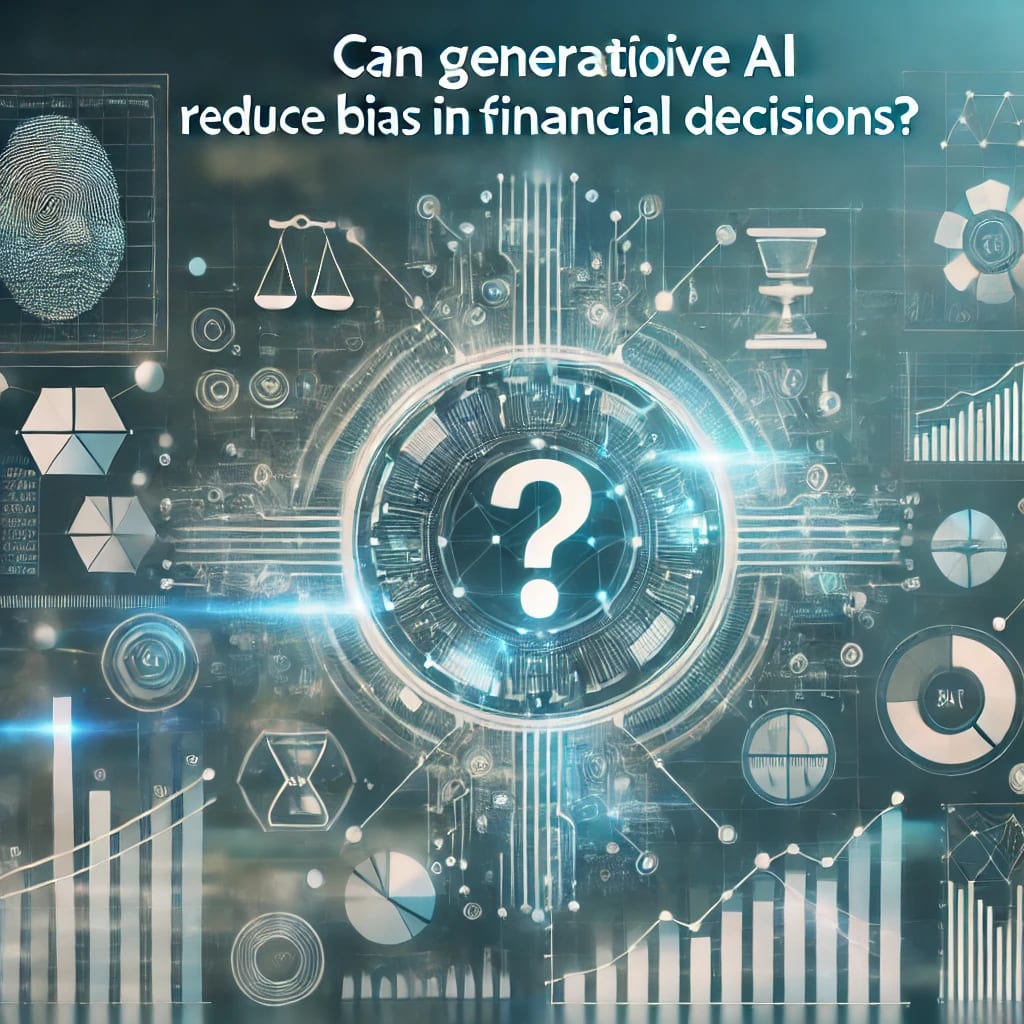
Human bias has remained a prevalent issue in the financial decision-making process for a long time. Overconfidence, fear of loss, and even herd action or conformity are responsible for the negative impact of personal biases. However, what if various superior technologies pivotal like Generative AI (GenAI) could help reduce these biases? GenAI can be incorporated into financial processes and decision-making systems, ensuring that decisions are based on objective analysis, not bias. However, when making critical financial decisions, managers must know how to use this technology to their advantage & that is why we are considering taking a Generative AI course for managers.
Understanding the Role of GenAI
Generative AI is a type of artificial intelligence proficient in creating new information or knowledge based on identifying patterns. Unlike traditional AI, which consists of rules and operations, GenAI can generate, analyze, and predict massive datasets, which is beneficial for financial matters. This technology can also analyze historical data, identify abnormalities, and independently make predictions.
Many biases in financial decisions stem from heuristics such as anchor or Confirmation Bias. GenAI, on the other hand, is inherently non-biased. Its function is designed to be entirely neutral, making decisions based on facts and actual data rather than emotions and opinions. However, it's important to note that human bias can seep into the training sets of AI systems. This is why newly developed Generative AI training programs for managers stress the need to detect and inspect AI models and data, ensuring that the objectivity of GenAI is maintained.
Key Ways GenAI Reduces Human Bias
1. Data-Driven Decisions Over Gut Feelings
Financial decisions often rely on gut reactions, especially when dealing with high-stakes investments or market fluctuations. However, these instincts can be biased by personal experiences or overreliance on anecdotal evidence. GenAI shifts the focus from subjective judgment to data-informed strategies. For instance, a trained manager who has completed a Gen AI course for managers would know how to interpret the AI-generated outputs and identify which data point holds the most weight.
Example: Imagine you're a financial manager evaluating a high-risk investment portfolio. GenAI can simulate multiple economic scenarios and present risk assessments based solely on statistical probabilities, making it easier to trust the guidance rather than letting personal fears or biases interfere.
2. Mitigating Groupthink in Collaborative Decisions
Collaborative environments often lead to groupthink, where teams align on decisions not because they're optimal but because of social pressure to conform. AI-generated insights can act as a neutral third party, offering a perspective derived from facts. By presenting impartial recommendations, GenAI empowers managers to challenge biased group opinions.
Organizations that adopt Generative AI training programs for leadership teams equip their employees to use AI tools effectively, ensuring that these insights are correctly interpreted and acted upon.
3. Spotting Subtle Patterns Humans Miss
Personal biases often prevent people from recognizing hidden opportunities or risks. GenAI can analyze massive datasets far faster and more accurately than humans, unveiling patterns the human brain might overlook.
For example, consider hiring decisions for a financial advisory role. Humans might unconsciously favor candidates with similar education or backgrounds, ignoring qualified applicants with nontraditional experience. GenAI could analyze resumes and assess qualifications without being swayed by inherent biases, helping to make fairer financial and personnel decisions.
4. Automating Routine Decisions to Reduce Emotional Load
High-pressure situations in finance can lead to emotional exhaustion, exacerbating biases. Automating routine decisions, like credit risk assessments or portfolio rebalancing, ensures consistency and reduces reliance on emotional judgment. Managers familiar with tools learned through a Generative AI course for managers can better integrate this technology into day-to-day operations.
Why Managers Need GenAI Training
Managers must be prepared to use GenAI effectively. Without proper training, the risk of misusing AI, potentially reinforcing existing biases, grows. A Generative AI course for managers offers practical insights into harnessing GenAI effectively, including validating algorithms, reducing training bias, and ensuring ethical practices. Such courses demystify AI for non-technical leaders and prepare them to make informed decisions about where and how AI can be leveraged. They also help managers understand AI's limitations, ensuring they don't over-rely on technology at the expense of human oversight.
Such courses demystify AI for non-technical leaders and prepare them to make informed decisions about where and how AI can be leveraged. They also help managers understand AI's limitations, ensuring they don't over-rely on technology at the expense of human oversight.
Challenges of Using GenAI in Financial Decision-Making
While GenAI can help reduce biases, it is not a foolproof solution. Here are some challenges to consider:
Bias in Data
If AI models are trained on biased datasets, their outputs may reflect those biases. For this reason, diverse and high-quality training data is essential. Leaders trained through Generative AI programs can identify and address such data issues, emphasizing the importance of data quality in AI applications.
Overreliance on AI
When managers become too dependent on AI tools, they may stop questioning outputs critically. This underscores the need for proper education, such as completing a Gen AI course, to ensure managers maintain a balanced approach.
Ethical Concerns
AI can sometimes make decisions that, while logical, may not align with ethical considerations. Trained managers must factor morality into the decision-making process, underscoring the importance of human oversight in AI applications.
The Future of AI in Financial Decision-Making
With the increasing availability of data, financial institutions are turning to AI to gain a competitive edge. GenAI represents the next leap forward. By reducing human biases, enabling faster decision-making, and uncovering new opportunities, GenAI has the potential to revolutionize financial processes. Organizations investing in GenAI training programs for their teams will not only future-proof their operations but also ensure they create a more equitable and objective workplace.
The power of GenAI lies not just in its capabilities but in how humans choose to use it. Training programs like a Generative AI course for managers help bridge the knowledge gap, equipping leaders to use this tool for unbiased, ethical, and impactful financial decisions.
This is not about replacing people but about enabling them to work slowly with the help of technology. Who is better equipped to drive this change than empowered and well-trained managers?
About the Creator
The 1793 Chain Cent: America's First Large-Scale Copper Coin
Holding a 1793 Chain Cent is like holding the first argument of a new nation. More than just America’s first mass-produced penny, this coin is a piece of history that sparked public debate, fueled by a design many found utterly wrong. Its story—from a chaotic mint to a collector's dream—explains why it remains one of the most coveted pieces in all of American numismatics. This guide will walk you through its turbulent birth, teach you to spot the tiny detail that can mean a fortune, and explain what truly makes it valuable.
By Laura Bennett3 days ago in Education




Comments
There are no comments for this story
Be the first to respond and start the conversation.