
Business vs. Entrepreneurship: Key Differences and What Sets Them Apart
Understanding the Core Differences Between Running a Business and Being an Entrepreneur in Today’s Economy
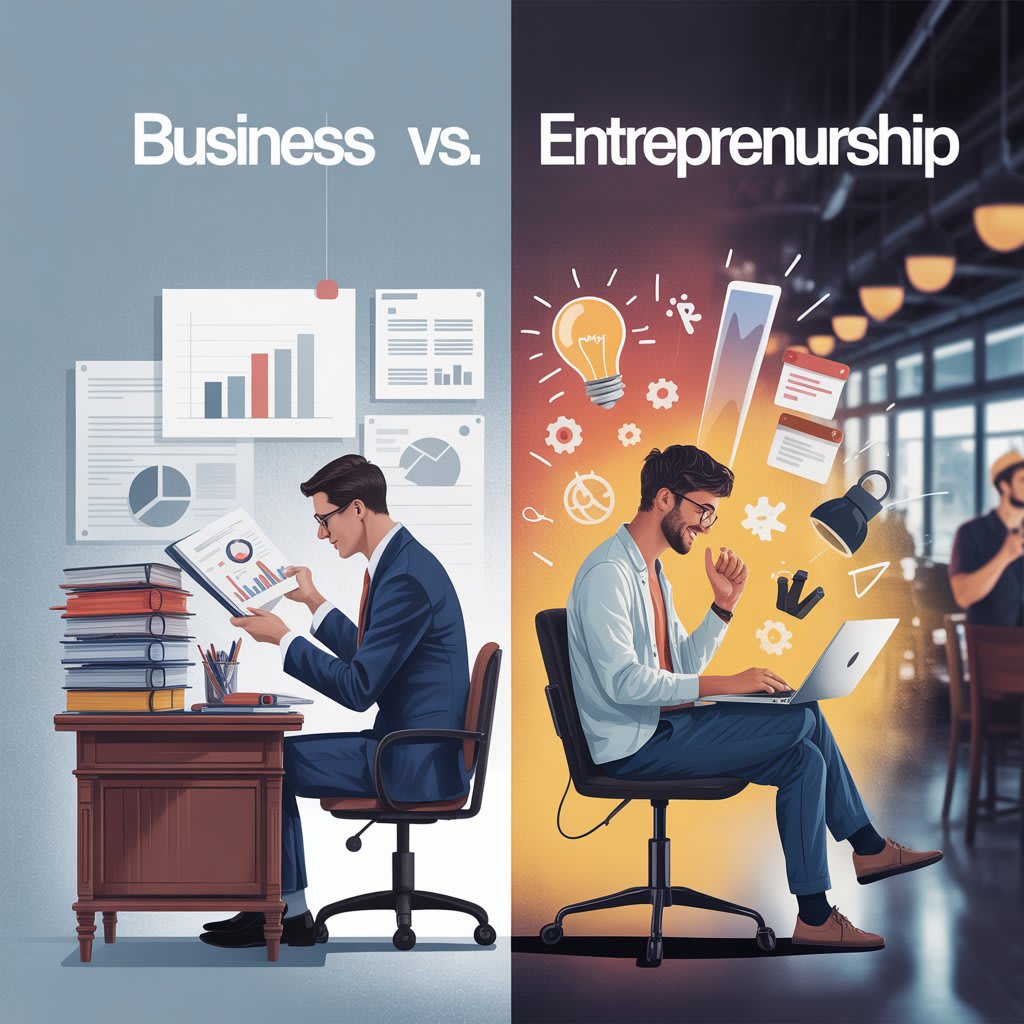
In today’s rapidly evolving economy, the terms business and entrepreneurship are often used interchangeably. On the surface, both involve starting and managing a venture that sells products or services for profit. However, the reality is that business and entrepreneurship are two distinct paths shaped by mindset, innovation, and long-term goals. Understanding the difference between business and entrepreneurship can help aspiring founders choose the path that aligns with their vision and personality.
The Foundation: What Is a Business?
A business is any organization that provides goods or services to customers in exchange for money. It may involve anything from a small retail store to a multinational corporation. The main focus of a business is usually profit generation, operational efficiency, and sustainability.
Traditional business owners often follow established models. For instance, opening a local bakery that uses a tried-and-tested recipe and sells to a consistent customer base is a classic example of a small business. Business owners typically seek stability, minimize risk, and focus on incremental growth.
The Spirit of Entrepreneurship
On the other hand, an entrepreneur is someone who starts a venture with innovation, risk-taking, and disruption at its core. Entrepreneurs often challenge the status quo, create new markets, and develop unique products or services.
Think of Steve Jobs or Elon Musk—these are individuals who looked beyond just selling a product. They envisioned changing how people live, work, and communicate. Entrepreneurs don’t just want to run a company—they want to create something that transforms the world.
Key Differences Between Business and Entrepreneurship
Let’s break down the core differences to better understand these two worlds.
1. Mindset: Stability vs. Innovation
Business owners prioritize safety and long-term consistency. They are more likely to follow proven strategies to minimize failure.
Entrepreneurs embrace risk and uncertainty. They are comfortable navigating uncharted waters and are constantly innovating.
2. Goals: Profit vs. Impact
The goal of a business is often profitability and sustainability. A successful business might serve a community need and earn steady income over time.
The goal of entrepreneurship goes beyond money. It’s about solving a real problem, disrupting markets, and creating impact at scale.
3. Approach: Established vs. Experimental
A business might follow a conservative strategy, optimizing what's already working.
Entrepreneurs usually take an experimental approach, testing, failing, and iterating quickly until they find product-market fit.
4. Risk Profile
Businesses often operate with calculated, lower-risk decisions. Expansion happens slowly.
Entrepreneurs are risk-takers. They bet big on ideas that may not even exist yet, knowing the potential reward is worth the uncertainty.
5. Role of Innovation
Most businesses adopt existing solutions to serve their market.
Entrepreneurs often create new solutions, driven by creativity and a vision of the future.
Real-World Example: Coffee Shop vs. Coffee App
Imagine someone opens a local coffee shop. They use high-quality beans, create a cozy environment, and cater to neighborhood customers. This is a business—focused on product quality, customer satisfaction, and consistent profits.
Now imagine someone creates a mobile app that connects independent coffee roasters to global consumers, disrupting traditional supply chains. That’s entrepreneurship—leveraging technology to change how people discover and consume coffee.
Why the Difference Matters
Understanding the difference between business and entrepreneurship is critical because it affects how you plan, fund, and grow your venture. If you're more comfortable with structure and tradition, you might thrive as a business owner. If you're driven by big ideas and change, you might be a natural entrepreneur.
Additionally, investors, partners, and even customers will respond differently based on whether you're building a scalable startup or a local business. Knowing your path helps you communicate your vision clearly and attract the right support.
Which Path Should You Choose?
You don't necessarily have to pick one over the other—many people start as business owners and evolve into entrepreneurs. Others build hybrid models that blend stability with innovation.
Ask yourself:
Do you prefer predictability or adventure?
Are you more focused on serving existing demand or creating new demand?
Would you rather optimize a working system or build a new one from scratch?
There’s no right or wrong answer. Both roles are essential to the economy and society. While entrepreneurs might receive more media attention, businesses form the backbone of communities around the world.
Conclusion: Embrace Your Identity
Whether you’re drawn to the safety of business or the chaos of entrepreneurship, knowing the difference gives you a strategic edge. In the end, success lies in understanding who you are and building a venture that reflects your strengths, passion, and long-term vision.
If you're still figuring it out, start small. Test ideas. Observe what excites you more—stability or innovation—and let your journey evolve from there.
About the Creator
Keep reading
More stories from Shafi Ullah and writers in Education and other communities.
Lessons from Rich Dad and Poor Dad: A Tale of Two Mindsets About Money
In a quiet town nestled between mountains and marketplaces, a young boy named Adam grew up torn between two very different teachers in his life — his biological father, whom he lovingly called “Poor Dad,” and his best friend’s father, “Rich Dad,” who took him under his wing and taught him how to think like an entrepreneur.
By Shafi Ullah10 months ago in Education
The Overlooked Consequences of Weak Healthcare Program Planning
Healthcare programs are created to expand access to care, improve patient outcomes, and strengthen public health systems. Governments, hospitals, nonprofits, and health organizations invest significant resources into developing programs that address disease prevention, treatment, and community wellness. When these initiatives are carefully planned and strategically executed, they can transform healthcare delivery and improve the quality of life for entire populations.
By Evyatar Nitzany3 days ago in Education
A Transparent Look at Vocal Challenges and Top Stories
Almost three years ago, we shared a resource article that served as a place for people to suggest new challenge prompts. We thought it would be a good idea to refresh that thread, and take the opportunity to answer a few common questions about top stories, how challenges are judged and how submissions are reviewed.
By Vocal Curation Teamabout 13 hours ago in Resources



Comments
There are no comments for this story
Be the first to respond and start the conversation.