
British people are being systematically lied to by our political elites.
Labour have taken the art of political lying to a whole new level


In the wake of constant political turmoil and an overwhelming sense of disillusionment, one fact remains clear: Britain is being systematically lied to by its political elite. From misleading campaign promises to half-truths about the economy, we have become accustomed to a culture of spin and deception at the highest levels of government. It’s a bitter pill to swallow, but it’s the truth—our politicians have made a habit of misrepresenting reality to serve their own agendas, leaving the public to sift through the wreckage.
The issue isn’t just the occasional falsehood or well-meaning stretch of the truth. It’s a deep-rooted, institutionalised practice that pervades all corners of our political landscape. Take, for example, the infamous promises made during the Brexit campaign. The claim that leaving the European Union would instantly release £350 million a week for the NHS—a promise emblazoned on the side of a bus—has since been debunked time and time again. Yet, despite this, the narrative persists. Why? Because the political elite knows that repetition works. Even after being proven false, the claim is still invoked by certain factions to justify their positions.
This is not an isolated case. Time and again, politicians distort the truth to advance policies that favour their political interests, all while positioning themselves as the champions of the people. The promises of austerity, for example, were sold to the public as a necessary evil to restore economic balance. Yet, the public was never fully informed about the long-term social and economic consequences of these cuts. The people who endured the worst of the cuts—the elderly, the sick, the disabled—are now grappling with a sense of betrayal. For many, austerity was a lie dressed up in economic rhetoric.
But it’s not just about individual promises or policies. The entire political system is complicit in perpetuating a culture of deceit. When faced with inconvenient truths, the political elite tends to employ the age-old tactic of deflection. Take, for instance, the government’s response to the ongoing cost-of-living crisis. Instead of addressing the root causes—wage stagnation, energy price hikes, housing shortages—many politicians choose to shift the blame elsewhere: to the global market, to Russia, to anything other than the government’s own failings. This deflection is another form of manipulation—masking the real issues with distractions and scapegoats, all while avoiding meaningful solutions.
Another example can be found in the handling of the National Health Service. The government continually reassures the public that the NHS is safe in their hands. Yet, when hospitals are stretched to breaking point, staff morale plummets, and services become increasingly fragmented, the reality paints a much different picture. We are told that NHS funding is increasing, but what we’re not told is that inflation, rising demand, and mismanagement have eaten away at these supposed increases. The reality? An NHS struggling under the weight of promises that remain unfulfilled.
One of the most alarming aspects of these political lies is the erosion of trust. In a democracy, trust in leadership is paramount. When citizens feel misled, they become disengaged, disillusioned, and cynical. This, in turn, fosters an environment where populism and extreme ideologies can thrive, offering simplistic answers to complex problems. It’s easier to follow the loudest voices who promise “easy fixes” than to deal with the nuanced reality of policy-making. In a society where misinformation is rampant, both online and offline, it’s no wonder many feel lost, unable to discern fact from fiction.
It’s crucial to acknowledge that political elites often justify their actions by arguing that they are acting in the national interest, or that the public just “doesn’t understand” the complexities of certain decisions. This elitist mentality is dangerously out of touch. The truth is, people want honesty. They want transparency. And while political decisions are often complex, the general public is more than capable of grasping the truth if they are presented with it in a straightforward and honest manner.
As a society, we must demand more from our leaders. We deserve politicians who are transparent, accountable, and willing to tell us the hard truths—no matter how uncomfortable they might be. A healthy democracy requires trust, and trust is built on honesty, not on a constant barrage of lies and half-truths.
The time for complacency is over. We must hold our political elite accountable for the deception that has become all too commonplace. The stakes are high—not just for our generation, but for future ones. If we continue down this path of dishonesty, the very foundation of our democracy could crumble. It is time for a new era of political honesty, one where the truth is valued above the political gamesmanship that currently dominates Westminster. Only then can we begin to rebuild the trust that has been so systematically eroded.
Until then, the lies will persist. And so will the damage they cause.
About the Creator
Trina Tuthill
Journlaist and radio presnter, podcast host - Passionate about social justice, feminism, family issues, culture, and music opinions and reviews.
Tips welcome
Keep reading
More stories from Trina Tuthill and writers in Education and other communities.
Sainsbury’s cut 3,000 jobs across the UK
Sainsbury’s has announced plans to eliminate 3,000 jobs across the UK as part of a strategic cost-saving initiative. This will be achieved through the closure of its hot food counters and cafes, as well as a reduction of senior management roles by 20%, in response to increasing labour costs.
By Trina Tuthillabout a year ago in Education
THE SPHERICAL SPACETIME - ALEXIS KARPOUZOS
I. The Question of a Spacetime without Centre From Aristotle to Kant, Western philosophy approached space and time primarily as conditions of the possibility of experience or as properties of reality. In the Aristotelian tradition, space is defined topologically — as the place of bodies — and time arithmetically — as 'the number of motions with respect to before and after'. In Kantian critical philosophy, space and time become a priori forms of intuition, transcendental conditions of all phenomenal experience. Yet in both traditions a common assumption is preserved: space and time are structures that organise phenomena from a — however implicit — centre of reference. Alexis Karpouzos radically challenges this assumption. The Spherical Spacetime he introduces is neither place nor intuition; it is a dynamic ontological structure that refuses every privileged point of reference, every external centre, every principle that precedes the very movement of the world. The question posed from the outset is this: what does it mean to think a spacetime that does not 'contain' beings but is the very manner in which beings are? And what ontological consequences does this displacement carry for the understanding of existence, consciousness, and truth?
By alexis karpouzosabout 12 hours ago in Education
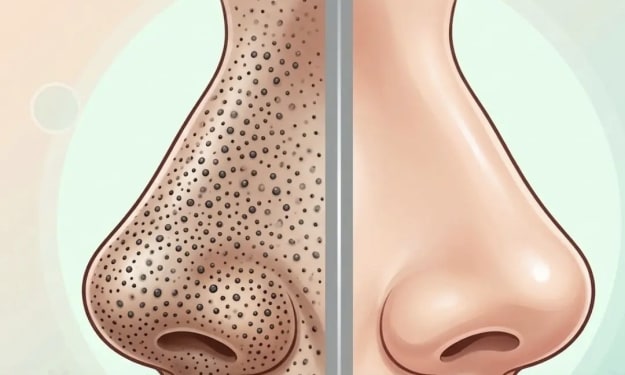
Natural Ways to Clear Blackheads and Whiteheads
Blackheads and whiteheads are very common skin problems that affect people of all ages. They usually appear on the nose, chin, forehead, and sometimes on the cheeks. These small bumps form when the pores of the skin become clogged with oil, dead skin cells, and dirt. Blackheads appear dark because the clogged material inside the pore reacts with air and becomes oxidized, while whiteheads remain covered by skin, giving them a white or flesh-colored appearance.
By DigitalAddi7 days ago in Education
My First Time Skiing and I Got Lost, Alone, in the French Alps
Looking back, I can trace some of my life’s biggest adventures to a simple action from my sister. She’d introduced me to Tommy (a very long time ago), a colleague of hers, who had overshared his penchant for Italian-looking women, and I ticked that box.
By Chantal Christie Weissa day ago in Humans



Comments
There are no comments for this story
Be the first to respond and start the conversation.