
For millennia, stars have been a source of wonder and inspiration. Their radiant glow in the night sky has captivated humans, poets, and scientists alike. Yet, the road to becoming a star is a journey as astonishing as the stars themselves. It is a complex and beautiful cosmic dance that begins with nothing more than hydrogen, the relentless force of gravity, and the patient passage of time. In this blog post, we will delve deeper into the extraordinary process of star formation, which showcases the intricate interplay of these cosmic elements.
The Cosmic Sculptor: Gravity
At the heart of star formation is the omnipresent force of gravity. It serves as the cosmic sculptor that shapes the destiny of celestial objects. It starts with a particular region of space containing vast clouds of gas and dust, often referred to as nebulae. Here, gravity acts as a unifying force, drawing these particles together into a centralized gravitational vortex. This initial step is fundamental to the formation of stars.
Heat and Pressure: A Cosmic Recipe
As the cosmic matter is drawn together by gravity, it undergoes a remarkable transformation. The particles, once scattered across space, are now compressed into a smaller volume. This natural compression is accompanied by an increase in temperature—a direct consequence of the laws of chemistry and physics. This heating process is similar to the rise in temperature when a sponge is squeezed. These rising temperatures serve as the catalyst for the remarkable journey that follows.
The Birth of a Cosmic Disk
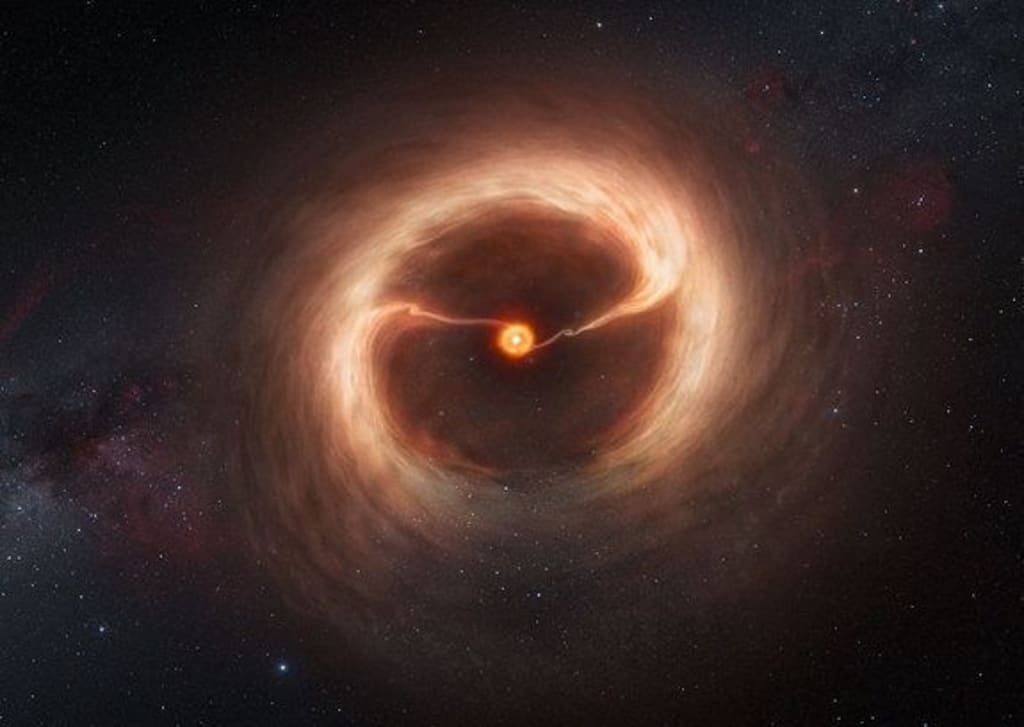
Over the course of hundreds of thousands of years, the cloud of matter thickens, and a colossal spinning disk begins to take shape. Astonishingly, this disk extends far beyond the boundaries of our entire solar system. Its emergence illustrates the immensity of the star formation process. Within this vast disk, gravity continues to work its magic, forcing the gas and dust particles into a super-dense, super-hot core.
Explosive Cosmic Eruptions
As the pressure within this super-dense core intensifies, powerful jets of gas erupt from the center, extending over vast distances, sometimes spanning many light-years. These explosive eruptions are a visual testament to the sheer violence and energy that accompany the process of star formation. These jets, stretching across the cosmos, are a stark reminder of the extraordinary forces at play within the universe.
A Star Begins to Shine
As the formation process continues, gravity relentlessly pulls in more gas and dust particles. These particles collide, generating even more heat. Over time, a young star takes shape, growing smaller, brighter, and hotter. The core temperature of the emerging star climbs to a staggering 15 million degrees.
The Crucial Moment: Nuclear Fusion
At this pivotal juncture, a truly extraordinary event occurs. The intense temperature within the star's core enables atoms of gas to undergo nuclear fusion. This process, which occurs at the heart of all stars, involves the combination of atomic nuclei. The outcome of nuclear fusion is the release of immense amounts of energy in the form of light and heat. This energy is what powers the star, allowing it to radiate its brilliance and warmth across the cosmos.
The Violent Beauty of Star Formation
Star formation is a dramatic and turbulent process, driven by the unforgiving laws of nature. Yet, out of this cosmic chaos emerges the serene and enchanting beauty of a star. It serves as a poignant reminder that even in the darkest corners of the universe, the forces of creation are at work, shaping the celestial wonders that adorn our night sky.
The birth of a star is an awe-inspiring journey, a testament to the elegance of the cosmos. It is a reminder that even amidst the chaos and unpredictability of the universe, there is an underlying order, a symphony of forces that orchestrates the creation of these luminous celestial bodies.
Every star that graces the night sky is a product of the intricate dance of hydrogen, gravity, and time. It continues to captivate our imagination as we gaze upwards into the vast expanse of the cosmos. Stars are more than just distant points of light; they are living testaments to the magnificent processes that shape the universe, and they will continue to inspire generations to come. So, next time you gaze at the stars, remember the incredible journey of their formation, a dance that unfolds in the grand theater of the cosmos.
About the Creator
Sagar Gurung
I'm student love to do research and know about new stories, news, mystery
Keep reading
More stories from Sagar Gurung and writers in Education and other communities.
EXPLORING THE COSMOS
In the ever-expanding realm of astronomical discoveries, the year 2023 has proven to be a year of intrigue and revelation, ushering in new insights into the universe. The year began with scientists utilizing the remarkable James Webb Space Telescope, a cutting-edge instrument, to venture into the depths of the cosmos. This remarkable telescope, in its exploration of the early universe, unveiled the existence of ancient stars that defy comprehension. These celestial giants, the first stars to grace the cosmos billions of years ago, are a staggering 10,000 times larger than our sun. This revelation, while astonishing, poses fundamental questions about the origins of these colossal entities and their significance in our understanding of the universe's evolution.
By Sagar Gurung2 years ago in Education
Shaping Compassionate Influence: How Medical Leaders Can Build a Philanthropic Way of Thinking
Medical leadership has evolved significantly as healthcare systems grow more complex and interconnected. Today’s leaders are expected not only to manage operations but also to shape culture and values. In this context, a philanthropic mindset becomes an essential leadership quality rather than an optional trait. By viewing leadership through the lens of service, medical leaders can guide their organizations toward broader social impact.
By Dr. Seth Eidemiller6 days ago in Education
Silicon Muscle The USD 8.88 Billion Rise of China Industrial Automation (2025-2033)
In 2026, the factory floors of Dongguan and Suzhou are no longer just places of manual labor; they are the new frontiers of "Embodied Intelligence." China has officially moved past being the world's workshop to becoming its premier robotics laboratory. As of this year, the industrial automation landscape in China has crossed a monumental threshold. Valued at USD 3.27 Billion in 2024, the sector is projected to hit a staggering USD 8.88 Billion by 2033, fueled by a 10.52% CAGR that is reshaping the global manufacturing balance.
By Neeraj kumar4 days ago in Education
When True Love Never Questions Your Soul
“And she’s going to learn that this life will hit you, hard, in the face, wait for you to get back up, just so it can kick you in the stomach but getting the wind knocked out of you is the only way to remind your lungs how much they like the taste of air.” — Sarah Kay’s Poem — If I Should Have a Daughter
By Chantal Christie Weiss2 days ago in Humans


Comments
There are no comments for this story
Be the first to respond and start the conversation.