
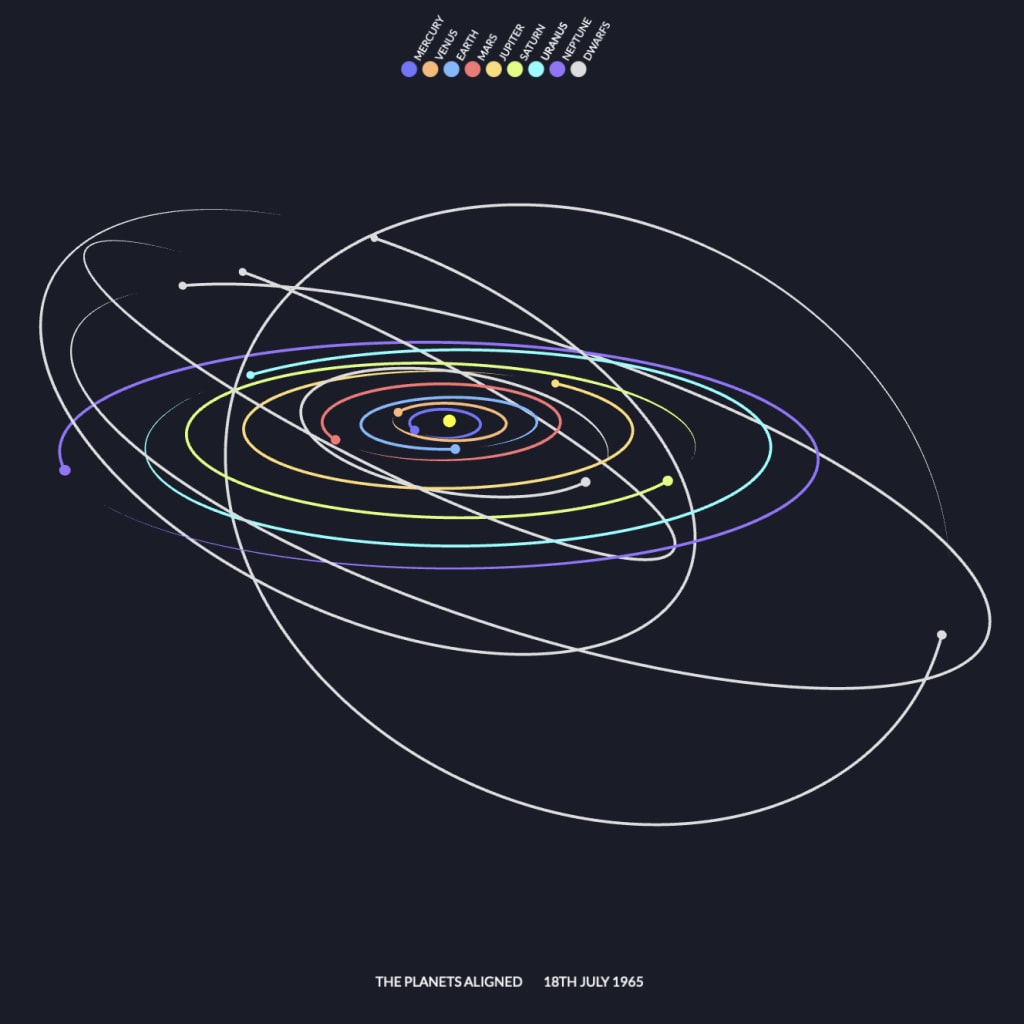
The night sky, adorned with twinkling stars, has always captivated human imagination. But beyond the distant constellations lie celestial wonders much closer to home—our very own solar system. This remarkable expanse, spanning billions of kilometers, comprises not only the Sun but also a diverse family of planets, moons, asteroids, and comets. Join us on an awe-inspiring journey as we unveil the origins, characteristics, and captivating stories of our solar system's eight planets.
*The Formation of Our Solar System*
Around 4.5 billion years ago, a cosmic drama unfolded. It began with a colossal cloud of mostly hydrogen gas, floating in the cosmos. This cloud started to contract, collapsing upon itself. As it did so, it gathered momentum and flattened into a spinning disk, akin to a cosmic pancake. At the heart of this swirling maelstrom, an incredible transformation occurred—the birth of our radiant Sun.
This newborn Sun blazed to life, radiating light and heat. Around it, the remaining gas and dust in the disk began to cool and coalesce under the pull of gravity, leading to the formation of a wide array of materials.
*Birth of the Planets*
Closest to the Sun, where temperatures soared, rocks and metals fused together, laying the foundation for the rocky inner planets. Farther from the Sun, where temperatures dropped, water and other ices crystallized into existence. These ices clumped together, forming planetesimals—small building blocks that were destined to shape the future planets.
As eons passed, these planetesimals merged and evolved, gradually giving rise to the remarkable celestial bodies that we know today as planets.
*The Gas Giants*
Among the planets, two behemoths stand out—Jupiter and Saturn, the gas giants. Scientists speculate that Jupiter might have been the first to form, followed by Saturn. The intriguing twist in this cosmic tale is that these giants didn't stay put. Instead, they embarked on a celestial migration. Jupiter, possibly the first to take this journey, moved inward, drawn by the swirling material in the inner disk. Saturn followed suit. This planetary migration had profound effects on the dynamics of our solar system.
*The Rocky Planets*
In the inner solar system, where rocky debris was abundant, planet-building continued. Chunks of metal and rock collided, merged, and grew in size. Earth, one of these rocky planets, emerged from this cosmic forge. However, this phase of planet formation was marked by a significant event—the Sun underwent a dramatic period of solar wind. This powerful outburst pushed away excess gas, thus preventing further growth of the rocky planets.
*Comets and the Asteroid Belt*
Within our solar system, we find intriguing cosmic remnants—the asteroid belt. This region, located between the orbits of Mars and Jupiter, is teeming with rocky scraps from the early days of our solar system. It's believed that these remnants are the leftovers from Jupiter's migration. This migration may also explain why Mars, the red planet, isn't as massive as scientists once expected. When Jupiter moved inward, it voraciously consumed vast amounts of material, leaving Mars with fewer building blocks.
Comets, on the other hand, played a pivotal role in shaping our solar system. Composed of ices, gasses, and dust, they often originated in the outer reaches of the solar system and journeyed inward. Along the way, they deposited ices and gasses on planets, contributing to their atmospheres. Comets also delivered water to Earth, potentially providing the life-giving liquid that sustains our planet.
*Impacts and the Moon*
In the tumultuous early years of our solar system, countless collisions between celestial bodies were a common occurrence. One of the most significant impacts likely resulted in the formation of our Moon. A colossal object collided with Earth, leading to the ejection of debris that eventually coalesced to form our lunar companion.
These impacts weren't limited to Earth and the Moon. Similar cosmic collisions may have influenced the spin of Venus and tilted Uranus onto its side. These events, though ancient, continue to shape the characteristics of these planets today.
*Beyond Our Solar System*
As we journey through our solar system's history, we're reminded of its uniqueness and the intricate interplay of forces that shaped it. Yet, our cosmic adventure doesn't end here. Astronomers and scientists are continuously exploring the vast universe, discovering new exoplanets orbiting distant stars.
The study of exoplanets provides valuable insights into the potential diversity of other solar systems. By comparing these distant worlds with our own, we gain a deeper understanding of the extraordinary nature of our solar system and the Earth's place within it.
In closing, our solar system is a testament to the enduring wonders of the cosmos. From its humble beginnings as a cloud of gas and dust to the diverse family of planets, moons, and celestial objects that grace our night sky, it reminds us of the boundless mysteries that the universe holds. As we gaze upward, let us continue to explore, learn, and marvel at the celestial wonders that surround us, for they are a testament to the vastness and beauty of the cosmos.
About the Creator
Keep reading
More stories from Mariam Melikidze and writers in Education and other communities.
The Composition of Stars: A Journey Through Time and Light
Throughout human history, the twinkling stars have captivated our imagination. When night falls, and the sky fills with countless pinpricks of light, our curiosity is piqued. We yearn to comprehend the cosmos, but there's a challenge—the vastness of the universe. How can we hope to understand something so distant, something we can't touch?
By Mariam Melikidze2 years ago in Education
Casie Hynes and the Future of Math Education Reform
Mathematics has always been a cornerstone of formal education. It strengthens reasoning, supports problem solving, and underpins critical fields such as science, technology, engineering, and economics. Yet despite its importance, math remains one of the most challenging subjects for students across the globe. Many learners struggle not because they lack ability, but because the way math is taught no longer aligns with how students learn or how the world now functions.
By Casie Hynes7 days ago in Education
Think Before You Build: How to Test a Business Idea the Smart Way
Launching a business without validation is like setting sail without checking the weather. You may feel confident at the start, but unseen risks can quickly turn excitement into regret. Many entrepreneurs lose time and money not because they lack skill or effort, but because they skipped the crucial step of validating their idea before committing fully.
By Rushi Manche3 days ago in Education


Comments (1)
Great work! Fascinating!