
Beyond One-Size-Fits-All: How Personalized Learning is Redefining Education for Real Kids
Harnessing Tech, Heart, and Data to Meet Every Learner Exactly Where They Are
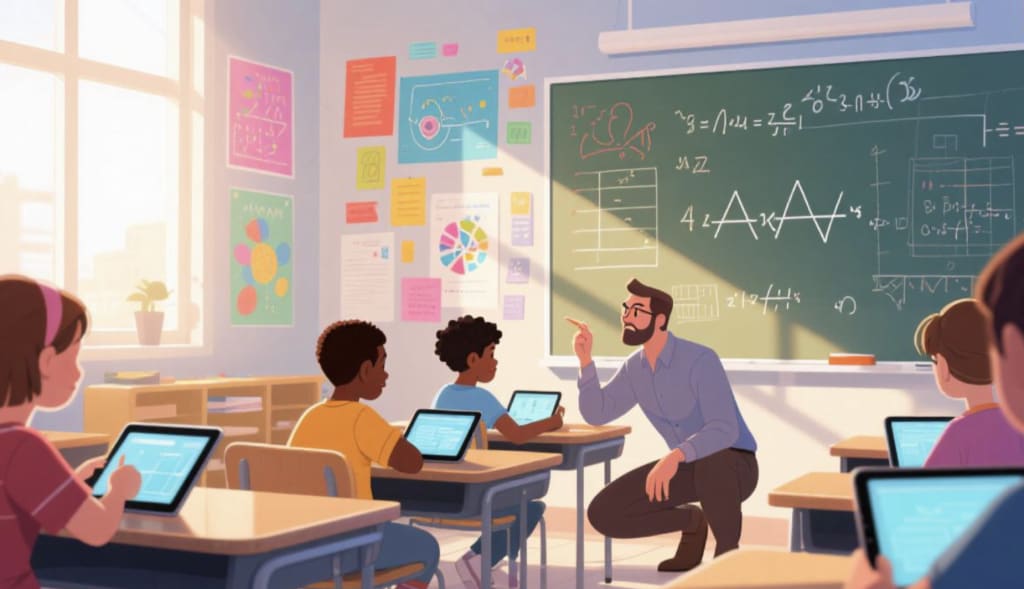
It’s a Tuesday morning in my 5th-grade classroom, and I’m standing at the front, trying to balance the needs of 28 students who all seem to be operating on different wavelengths. Mia, sitting in the corner, is already three chapters ahead in her math workbook, scribbling notes about fractions she’s “invented” in the margins. Across the room, Liam is staring at his worksheet, erasing so hard the paper is tearing—he’s stuck on subtracting decimals for the fourth time. Somewhere in the middle, Aisha is quietly raising her hand, but by the time I call on her, she’s forgotten her question.
This isn’t a story about “bad teaching.” It’s a story about reality: traditional classrooms, even with the best teachers, are built for the “average” student. But here’s the thing—there is no average student. Every child learns at their own pace, through their own style, and with their own gaps. And that’s where personalized learning steps in—not as a buzzword, but as a lifeline.
What Is Personalized Learning, Anyway?
Let’s get one thing straight: personalized learning isn’t just “letting kids pick their books” or “giving extra credit.” It’s about using data, technology, and human insight to create learning paths that adapt to each student—not the other way around. Think of it like a fitness app that adjusts your workout based on your progress, but for math, reading, or science.
For example, take a tool I’ve used for years: Khan Academy (khanacademy.org). It’s not just a repository of videos—it’s an adaptive platform that tracks what a student gets right or wrong, then serves up practice problems that target their specific weak spots. Last year, I had a student, Raj, who struggled with long division. Instead of moving him along with the class (and watching him fall further behind), Khan Academy diagnosed he needed to revisit place value first. Six weeks later, he aced his division test—and even started helping peers.
The Tech Behind the “Magic” (Spoiler: It’s Not Magic)
Critics might say, “Personalized learning sounds great, but how do you scale it?” The answer lies in tools that blend AI with teacher expertise. Take DreamBox Learning (dreambox.com), a math platform designed for K-8 students. Unlike traditional apps that just drill facts, DreamBox uses algorithms to adjust the difficulty of problems in real time. If a student masters multiplication quickly, it introduces multi-step word problems; if they’re stuck, it breaks concepts down with visual aids (like virtual manipulatives). Teachers get detailed reports showing where each student is thriving or needs support—so we can step in with targeted mini-lessons, not just homework.
Or consider Nearpod (nearpod.com), a tool I use to turn lectures into interactive journeys. Instead of lecturing for 20 minutes straight, I embed quizzes, polls, and collaborative boards into my lessons. If 70% of the class gets a question wrong, Nearpod flags it, and I pivot—maybe clarify a concept with a quick video or have students debate the problem in pairs. It’s like having a co-pilot in the classroom, helping me read the room instantly.
The Human Side of Personalization (Because Tech Alone Isn’t Enough)
Let’s not forget: personalized learning isn’t about replacing teachers—it’s about empowering them. When tech handles the “heavy lifting” of tracking progress and adjusting content, educators have more time to do what we do best: connect with students.
Take my student Lila, who’d been labeled “unmotivated” because she rarely turned in work. Using Canvas (instructure.com), our learning management system, I noticed she was engaging with science lessons—watching extra videos, commenting on peers’ posts—but she hated math. A quick check-in revealed she found word problems “boring” and “too abstract.” So we swapped traditional worksheets for real-world scenarios: “Plan a birthday party with a $50 budget” or “Calculate how much paint you need to redo your bedroom.” Suddenly, she was turning in detailed, creative projects—and her math scores soared.
Tech gave me the data to see her potential; human connection gave me the tools to nurture it.
The Future is Here—But It’s Up to Us to Shape It
According to a 2024 report by EdSurge, schools that adopt personalized learning see a 25% increase in student engagement and a 15% boost in test scores. But these tools only work if we use them intentionally. It’s easy to get swept up in the “shiny new app” hype, but the real magic happens when we pair technology with empathy.
So, whether you’re a teacher, parent, or student, here’s my challenge: Start small. Try one adaptive tool in your classroom or with your child’s homework. Ask questions: What does this tool actually measure? How does it help the learner grow? And most importantly, never forget the human element.
Because at the end of the day, education isn’t about algorithms—it’s about lighting fires. And personalized learning? It’s just a better way to hand out the matches.
P.S. Have a favorite personalized learning tool or story? Drop it in the comments—I’d love to hear how you’re redefining education, one student at a time.
---
[Author’s Note: Tools mentioned are used in real classrooms worldwide. Links provided for convenience; all opinions are my own.]
About the Creator
Keep reading
More stories from liang ming and writers in Education and other communities.
How Online Learning is Revolutionizing Education in 2026
The traditional landscape of education has undergone a massive transformation over the last decade. As we navigate through 2026, the concept of a "classroom" is no longer confined to four walls and a blackboard. Online learning has evolved from being a temporary solution during global crises to becoming a primary, highly effective method of gaining knowledge and professional skills. This shift is not just about convenience; it is about accessibility, personalization, and the democratization of information.
By MD. Rahmat Ullah4 days ago in Education
The Rise of Online Learning in Education
Online learning has become a fundamental part of education. Many institutions now view it as essential: one report notes that 65% of colleges consider online programs critical to their strategic plans. This shift is driven by both technological advances and changing learner needs. Surveys confirm strong student demand for digital options – for example, a study found that 95% of undergraduates wanted at least one online course per semester. In other words, schools are expanding online offerings because doing so improves access and meets modern expectations, all while maintaining high-quality instruction.
By Kashif Khan4 days ago in Education



Comments
There are no comments for this story
Be the first to respond and start the conversation.