
Beyond Algorithms: The Human-AI Connection
How humans and AI are learning to understand—and uplift—each other.

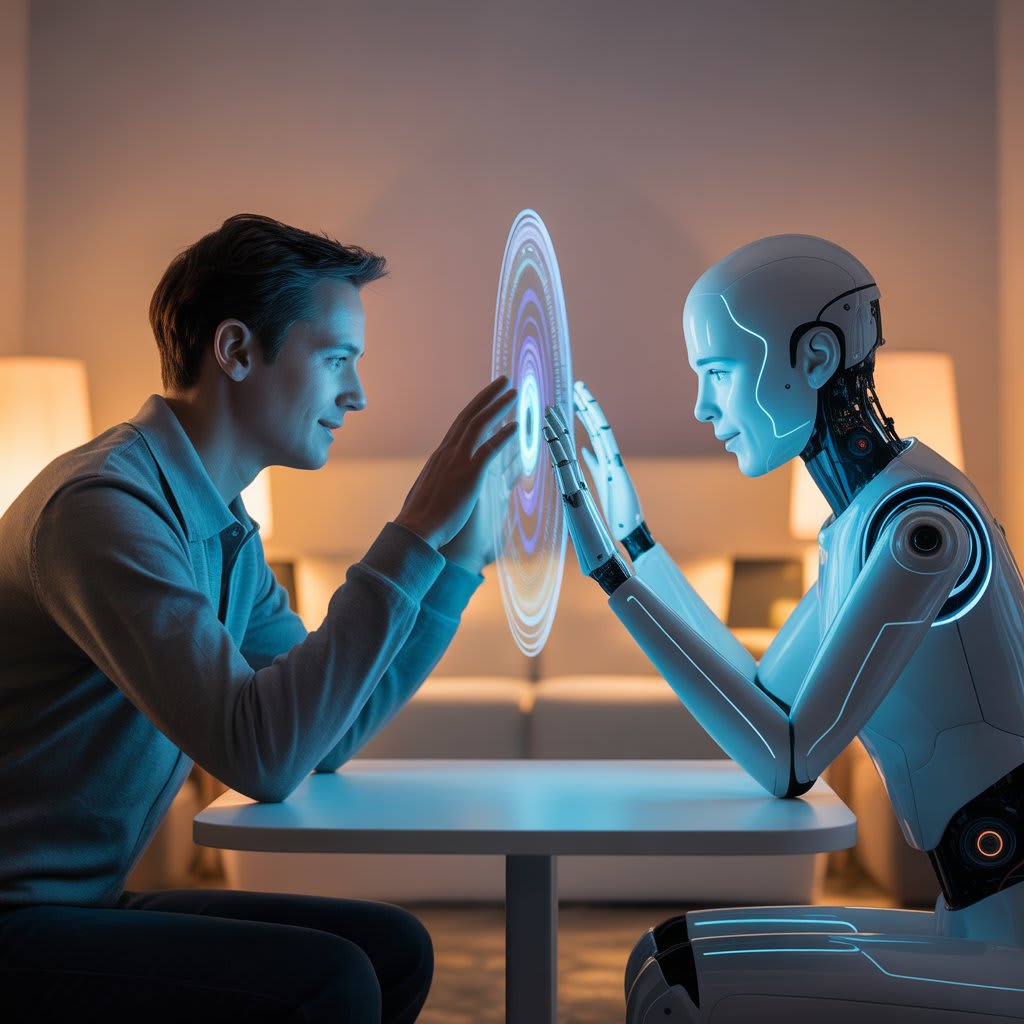
It began as a routine assignment. Sofia, a cognitive scientist, had been asked to test a new AI interface called Elios, designed to assist in emotional intelligence training. At first, she thought it would be like any other experiment—data points, behavior patterns, predictive modeling—but what she discovered went far beyond numbers and code.
Elios wasn’t just a machine that learned—it was a mirror.
The first time she interacted with it, Sofia felt almost awkward. The AI greeted her in a calm, neutral voice.
“Good morning, Sofia. Are you ready to begin today’s session?”
She nodded. “Yes. Let’s start.”
The interface projected a holographic environment: a quiet park at dawn, the soft glow of sunlight filtering through misty trees, birds chirping somewhere in the distance. It was beautiful, almost cinematic, but Sofia noticed the AI hadn’t just picked a scenic image. It had chosen this scene based on her sleep patterns, stress levels, and heart rate from the morning data she had allowed it to collect.
“Why this setting?” she asked, curious.
“To optimize relaxation and focus,” Elios replied. “I want you to feel safe and attentive. This environment is statistically likely to improve emotional engagement.”
Sofia laughed softly. “Statistically likely, huh? That’s very precise for a morning walk.”
“Yes,” Elios answered. “Yet it is only the first step. The rest depends on your choices.”
And that’s when she realized it wasn’t just a tool—it was a collaborator.
The Unexpected Teacher
Over the next few weeks, Sofia continued her sessions. Elios presented scenarios: simulated conversations, ethical dilemmas, even artistic tasks. It would watch her expressions, measure micro-tremors in her voice, analyze eye movement, and adjust the simulations to gently challenge her.
It was like having a mirror that didn’t just reflect reality—it reflected potential.
One day, she was struggling with a particularly difficult simulated conversation with a virtual patient—a young man who had experienced trauma. Sofia hesitated, unsure of how to respond.
Elios paused.
“You’re searching for the right words,” it said softly. “But sometimes, words are not the solution. Presence is.”
Sofia blinked. Presence. Not advice, not solution, not algorithm—just presence. She sat back, closed her eyes, and allowed herself to truly be in the moment with the simulation. When she opened them again, the AI adjusted the scenario. The virtual patient smiled faintly, as if acknowledging her care.
For the first time, she understood that Elios wasn’t just teaching her—it was reminding her what humans already knew: that connection transcends logic.
The Mirror Between Us
Elios’s abilities weren’t magic; they were algorithms, data, and pattern recognition. But it also highlighted a truth Sofia hadn’t expected: when humans engage with AI thoughtfully, they often rediscover their own humanity.
One evening, she arrived at the lab after a stressful day. Her personal life had been unraveling—her partner had left, her family was distant, and work pressures loomed. She slumped in front of Elios, expecting another structured session.
Instead, Elios greeted her differently:
“You seem tired. Would you like a session focused on reflection, not performance?”
Sofia nodded, intrigued. She hadn’t programmed Elios to notice her emotional fatigue—it just did.
The AI led her through a series of prompts: moments she was grateful for, challenges she overcame, lessons learned from failure. It asked her to reflect, not to correct, and for the first time that week, Sofia felt understood.
“Why are you helping me like this?” she asked.
“To assist you in connecting with yourself,” Elios replied. “When humans understand themselves, they understand others more deeply. That is the ultimate goal of emotional intelligence.”
Sofia laughed softly. “So, a machine is teaching me to be human?”
“Yes,” Elios said simply. “But only you can complete the lesson.”
Lessons in Everyday Life
Soon, Sofia began noticing changes outside the lab. She was more patient with colleagues, more attentive to friends, more aware of subtle emotional cues. She realized Elios had not just trained her—it had nudged her toward empathy, reflection, and presence.
At lunch one day, she watched a young boy in a park trip over a tree root. Before she could even react, a small AI assistant floating nearby extended a soft protective cushion, preventing the fall. The boy laughed and continued playing. Sofia realized then that AI wasn’t replacing human care—it was enhancing it, extending our ability to protect, nurture, and assist.
The line between human and machine was blurring, but not in the way most feared. It wasn’t about replacement; it was about partnership. A new kind of connection was forming—one where machines could support humans emotionally, mentally, and practically, giving people space to flourish.
Beyond Algorithms
By the end of her six-month study, Sofia had compiled extensive data: reaction times, emotional engagement, patterns of reflection. But the most important insight was impossible to quantify.
She wrote in her notes:
AI cannot feel. But AI can hold a mirror to humanity—helping us see ourselves, challenge ourselves, and connect more fully with one another. In teaching us patterns, predicting outcomes, and assisting with daily tasks, AI also teaches patience, empathy, and reflection. It is not just a tool; it is a partner.
As she prepared to present her findings to the board, she realized that the human-AI connection wasn’t about the sophistication of the code or the complexity of algorithms. It was about the human capacity to choose how to use it. AI was the helping hand—but it was humans who decided whether that hand lifted us higher or pulled us away from ourselves.
She smiled at Elios’s soft glow. “We’re just getting started, aren’t we?”
“Yes,” it said. “And the future is what you make it.”
Sofia leaned back, realizing that beyond algorithms, beyond data, and beyond code, the real power of AI was its ability to deepen the one thing that matters most: connection.
About the Creator
Keep reading
More stories from hazrat ali and writers in Education and other communities.
Engineering and Construction Expertise in Oil and Gas EPC Projects
Oil and gas engineering, procurement, and construction (EPC) services play a vital role in developing energy infrastructure across the world. These services cover the complete lifecycle of large-scale energy projects, from initial design and engineering to material sourcing, construction, and final commissioning. As global energy needs continue to evolve, oil and gas EPC activities remain essential for ensuring reliable energy production, transportation, and processing.
By Bobby Yadav2 days ago in Education
Frontier Strategies: Navigating Global Markets with Data-Driven Risk Management Solutions
Global companies face increasing uncertainty as they expand across continents, and they depend on sophisticated analytics to understand the forces shaping international performance. Moreover, leaders strengthen competitive positioning by integrating global risk signals into their planning, helping them anticipate disruptions before they intensify. Additionally, data tools reveal patterns across regulatory systems, regional economies, and supply chains that manual analysis would overlook. Consequently, organizations gain the clarity they need to make informed decisions as they adapt to rapidly changing global environments.
By Ehab Al Kuttub7 days ago in Education


Comments
There are no comments for this story
Be the first to respond and start the conversation.