
Introduction
A cell is the structural and functional unit of life and all living organisms are composed of one or more cells. Animal and plant cells are similar in many ways but also have some distinct differences.
A cell is the basic unit of life and all living organisms are composed of one or more cells.
The cell theory, first proposed by scientists Matthias Schleiden and Theodor Schwann in 1838, states that
- All living organisms are composed of one or more cells,
- Cells are the functional and structural unit of life, and
- New cells are produced through the division of existing cells.
Cell Organelles
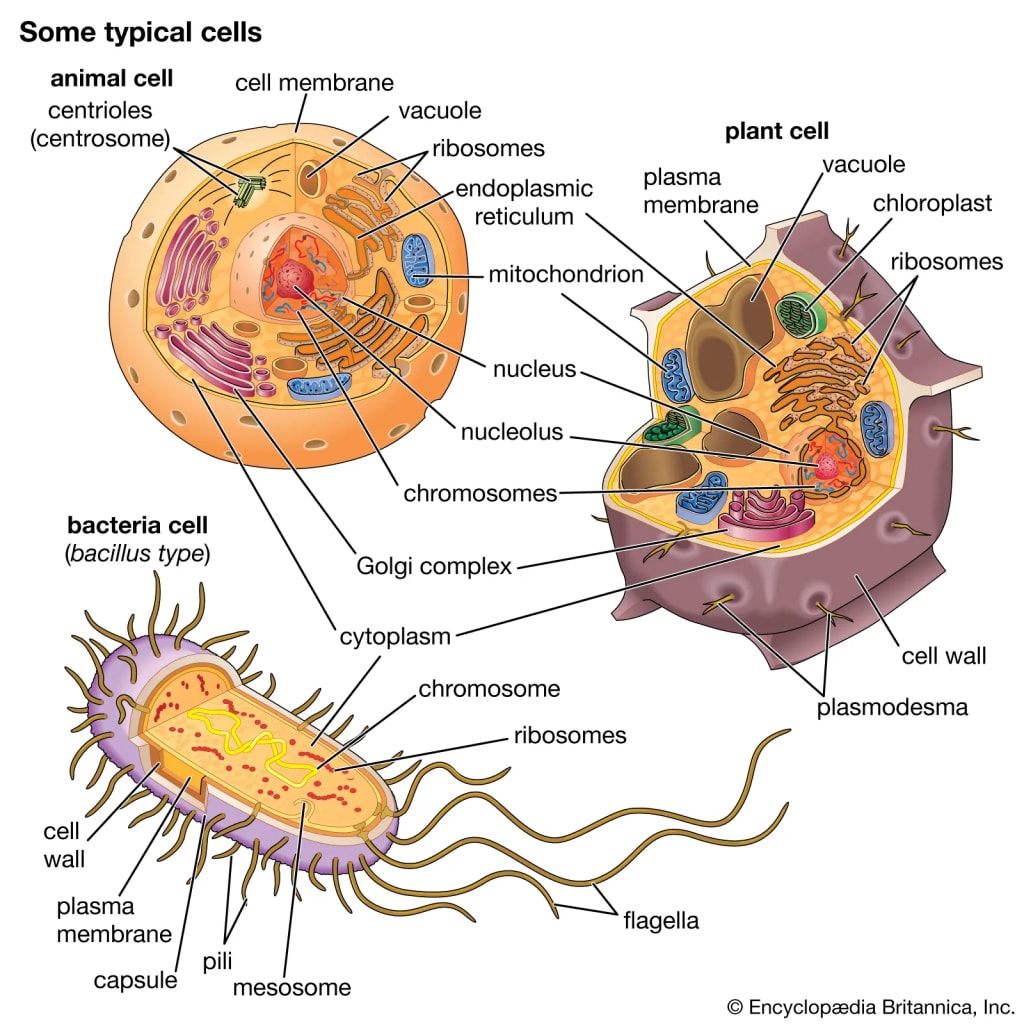
Animal cells have a plasma membrane, cytoplasm, and a nucleus. Plasma membrane: Also known as the cell membrane, is a thin layer of lipid and protein molecules that surrounds the cell and controls the movement of molecules in and out of the cell.
Cytoplasm: this gel-like substance that fills the cell and contains the cell's organelles. Nucleus: cell's control centre and contains the cell's genetic material, or DNA.
Plant cells also have a cell wall, a large central vacuole, and chloroplasts (for photosynthesis). The cell wall is a rigid, protective layer that surrounds the cell and provides support.
The large central vacuole is a storage compartment for water and other molecules. The chloroplasts, which are only found in plant cells, are responsible for capturing energy from sunlight and converting it into chemical energy through the process of photosynthesis.
Plant cells are generally larger than animal cells and have a more rigid cell wall.
Cell organelles are specialized structures within a cell that perform specific functions.
- Cell wall: Presents in only plat cell. The cell wall is a rigid, protective layer that surrounds the cell and provides support. Made of cellulose and also consist of lignin, pectin components.
- Plasma membrane: Also known as the cell membrane, is a thin layer of lipid and protein molecules that surrounds the cell and controls the movement of molecules in and out of the cell. Made of phospholipid and protein
- Cytoplasm: This gel-like substance that fills the cell and contains the cell's organelles.
- Nucleus: Cell's control centre and contains the cell's genetic material, or DNA.
- Mitochondria: Responsible for producing energy through cellular respiration. They are known as the "powerhouse" of the cell
- Ribosomes: Responsible for protein synthesis. They are found in the cytoplasm and on the endoplasmic reticulum
- Endoplasmic reticulum (ER) and Golgi apparatus: Responsible for processing and transporting molecules within the cell. The ER is a network of flattened sacs and tubules that can be rough (with ribosomes) or smooth (without ribosomes) in nature.
- Golgi apparatus modifies, sorts, and packages proteins and lipids that have been synthesized on the ER, to be transported to other parts of the cell or out of the cell.
- Lysosomes: Responsible for breaking down and recycling cellular waste. They contain enzymes that can break down proteins, carbohydrates, and lipids.
- Chloroplast: Present in only plant cell. Responsible for photosynthesis and store as starch
Cell Division
Cell division is the process by which a parent cell divides into two or more daughter cells. The two main types of cell division are mitosis and meiosis.
Mitosis is the process by which a single cell divides into two identical daughter cells, and it is responsible for growth and repair.
Mitosis and meiosis are two types of cell division that play important roles in the growth and reproduction of living organisms.
For example, when a person cuts their finger, the skin cells near the cut divide through mitosis to repair the wound.
Mitosis also plays a role in the growth and development of an organism. As cells divide and multiply, the organism grows in size.
Meiosis is the process by which a single cell divides into four non-identical daughter cells, and it is responsible for the production of reproductive cells (sperm and eggs).
These daughter cells, known as gametes, are used in sexual reproduction to produce offspring.
Meiosis is responsible for the production of sperm and eggs in animals and pollen and ovules in plants.
It plays a crucial role in the continuation of a species by allowing for genetic variation in the offspring.
The process of meiosis includes crossing-over and independent assortment of chromosomes which leads to the formation of unique combination of chromosomes in the resulting cells.
In summary, cells are the basic unit of life and all living organisms are composed of one or more cells. Animal and plant cells have some distinct differences, and cells have specialized organelles that perform specific functions. Cell division is the process by which cells reproduce and is essential for the growth and repair of living organisms.
About the Creator
Kavithran Shakthi
A person who is concerned with designed to have little or no damaging effect on the humanity
Keep reading
More stories from Kavithran Shakthi and writers in Education and other communities.
LinkedIn Ads are a form of advertising on the LinkedIn platform.
LinkedIn Ads are a form of advertising on the LinkedIn platform. Businesses can create and target ads to specific audiences based on factors such as job title, industry, location, and more. Ad formats include sponsored content, sponsored InMail, and display ads.
By Kavithran Shakthi3 years ago in 01
Greenland, the United States, and the New Arctic Power Game
For much of modern history, Greenland was viewed as a remote stretch of ice, distant from global decision-making and international power struggles. But that has changed. As the Arctic warms and world powers turn their attention northward, Greenland has become a central figure in a rapidly shifting geopolitical landscape.
By Muhammad Islam khan swati6 days ago in Education
How I Discovered Evan Roderick and Why His Work Stood Out
Sometimes, discovering a new actor feels like stumbling upon a hidden gem. That’s exactly how I felt when I first came across Evan Roderick. I wasn’t looking for anyone new to follow, and I had no idea who he was at the time. But as soon as I saw him perform, something clicked. His presence was different. His style was subtle but powerful. And as I explored more of his work, it became clear that Evan Roderick wasn’t just another rising actor—he was someone who brought something unique to the screen.
By Evan Roderick5 days ago in Education


Comments
There are no comments for this story
Be the first to respond and start the conversation.