
Bagua Feng Shui Series (4)
A Real-Life Feng Shui Case Related to the Front Door


In Chinese Feng Shui, the front door is critically important. Different Feng Shui schools have their own unique theories regarding the front door. However, despite their differences, the key focus is essentially the same—it can be analyzed from two main perspectives.
The first is Form (形势派), which concerns the environment surrounding the building—such as streets, nearby structures, mountains, and rivers—each possessing its own unique Qi (energy) field. In the Feng Shui academic system, all theories related to natural and man-made forms are categorized under the Form School, also known as Environmental Feng Shui.
The second is Qi related to direction and time. In Bagua Feng Shui, the orientation of the front door must correspond harmoniously with the Qi of the residence. For example, homes belonging to the East Four House category should have their main doors positioned in one of the East Four Trigrams, while West Four Houses should open toward the West Four Trigrams. This belongs to the theory of Qi dynamics, academically referred to as the Compass School (理气派).
The origin of Feng Shui can be traced back to Divination Feng Shui, which emerged about 3,000 years ago. Its theoretical foundation lies in the early version of the I Ching (Zhou Yi), which later became the essential philosophical and functional basis for all subsequent Feng Shui systems.
The Bagua (Eight Trigrams) form the fundamental structure of the I Ching. Bagua Feng Shui is built upon the Later Heaven Bagua Chart, which reveals the theory of time–space energy transformation—illustrating how Qi (energy) shifts, circulates, and interacts across both temporal and spatial dimensions.
Chinese Feng Shui can explain the phenomena of our lives by analyzing the relationship between our personal Qi and the time–space Qi of the environment in which we live. In today’s blog, I will introduce a real Feng Shui case, adapted from a popular Chinese Feng Shui book.
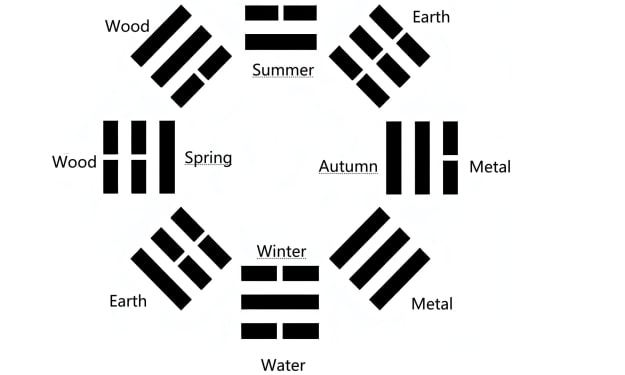
There was a man named Mr. Li, who lived with his wife in a house situated in the northeast and facing southwest. According to Feng Shui classification, this is a Gen House, associated with the Trigram Gen (艮卦), which occupies the northeast position on the Later Heaven Bagua Chart (see Figure 1). The Gen House belongs to the category of West Four Houses.

According to Feng Shui principles, the front door of a Gen House should ideally open toward the southwest, west, or northwest—directions that harmonize with its inherent Qi pattern. However, the front door of Mr. Li’s house was located in the southeast, corresponding to the Trigram Xun (巽卦) on the Later Heaven Bagua Chart—an inauspicious position known as “Jue Ming” (绝命), or “total loss of life energy.”
This unfavorable condition arises because the Xun Trigram belongs to the East Four Trigrams, carrying Yin Wood energy, while the Gen Trigram represents Yang Earth energy. According to the Five Elements theory, Wood overcomes Earth, meaning that the Wood energy associated with the front door weakens or damages the Earth energy of the house itself.
However, even though the energy of the front door conflicts with the energy of the house, it does not necessarily mean that misfortune must occur. In most cases, this unfavorable energy field maintains a subtle balance. If no third energy intervenes, nothing unusual is likely to happen. Yet when a strong external force disrupts this balance, inauspicious events may arise.
In this case, such an event happened in 1988, the Year of the Dragon. In September of that year, Mr. Li’s wife lent out a large amount of money but was unable to recover it, resulting in a serious financial loss.
Many of us may have experienced moments when we act impulsively, feeling that nothing can stop us. Why do we have such uncontrollable impulses? From the Feng Shui perspective, such actions may result from invisible energetic influences that disturb the equilibrium of our living environment, leading to unfortunate outcomes.
In Mr. Li’s case, the Dragon Year’s Qi carried a negative influence on the energy field of his house.
In the next blog, I will analyze how the powerful time-related energy of that year played a critical role in breaking the previous balance and triggering this unfortunate event.
About the Creator
Lidong Yu
I am a Chinese Feng Shui consultant and educator, raised and trained in China. My work draws on classical Feng Shui traditions to help people better understand the relationship between themselves, their environments, and time through Qi.
How Human Vision Limits What We See in Space
The Basics of Human Vision To understand the limits, we must first understand how vision works. Light enters the eye through the cornea and pupil, is focused by the lens, and reaches the retina at the back of the eye. The retina contains two types of photoreceptor cells:
By shahkar jalala day ago in Education
Essential Investment Approaches Every Professional Should Master
In today’s competitive financial landscape, professionals cannot rely solely on earning a high income to build lasting wealth. Instead, they must understand how to invest strategically and consistently. Therefore, mastering a handful of core investment strategies can make the difference between modest savings and substantial long-term growth. While markets fluctuate and trends evolve, certain principles remain reliable over time.
By Keith D'Agostino3 days ago in Education



Comments
There are no comments for this story
Be the first to respond and start the conversation.