
AWS Training in Bangalore: Mastering VPC Fundamentals
An Aspiring Architect’s Journey into AWS Networking
From Novice to Network Architect: Arjun's AWS Journey
Arjun, a software engineer based in Bangalore, had always been intrigued by cloud computing. Eager to elevate his career, he enrolled in an AWS Training in Bangalore program, aiming to achieve the AWS Certified Solutions Architect – Associate certification.
Early in the course, Arjun encountered the concept of Virtual Private Cloud (VPC)—a foundational element in AWS networking. This discovery marked the beginning of his deep dive into cloud architecture.
Demystifying VPC: The Backbone of AWS Networking
A VPC is a logically isolated section of the AWS cloud where users can launch AWS resources in a virtual network they define. It closely resembles a traditional network that one might operate in their own data center, with the added scalability and flexibility of the cloud.
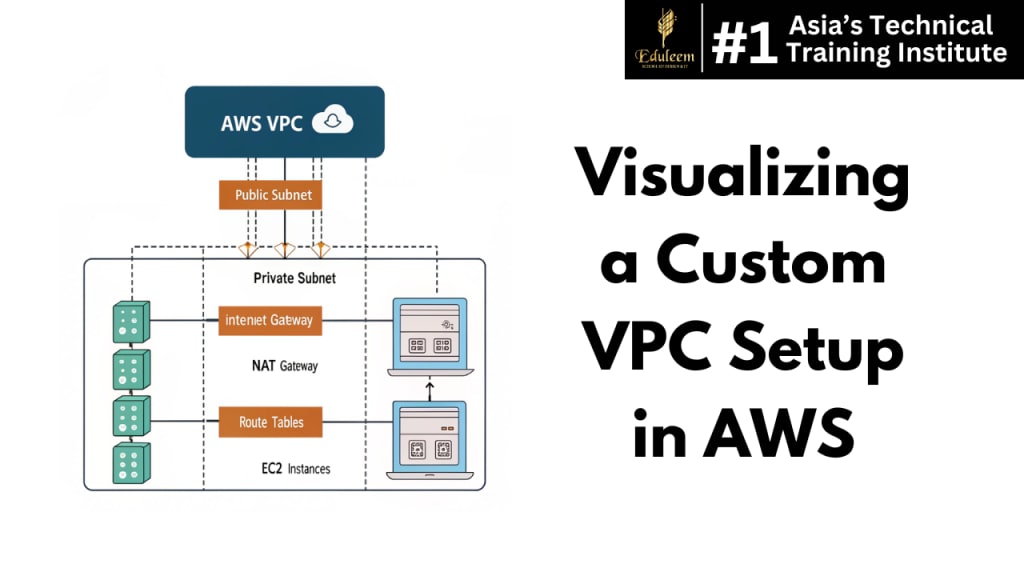
Key components of a VPC include
- Subnets: Segments within a VPC that allow users to group resources based on security and operational needs.
- Internet Gateway (IGW): Enables communication between instances in the VPC and the internet.
- Route Tables: Determine how traffic is directed within the VPC.
- Network Access Control Lists (NACLs) and Security Groups: Act as virtual firewalls to control inbound and outbound traffic.
- NAT Gateways: Allow instances in private subnets to connect to the internet or other AWS services, but prevent the internet from initiating connections with those instances.
Understanding these components is essential for anyone pursuing an AWS course in Bangalore, as they form the crux of designing secure and efficient cloud infrastructures.
Hands-On Learning: Building a Secure VPC
In one of the practical sessions, Arjun was tasked with creating a custom VPC. He:
- Defined a CIDR block to establish the IP address range for the VPC.
- Created public and private subnets across multiple Availability Zones for high availability.
- Attached an Internet Gateway to the VPC and updated the route tables to allow internet access for the public subnet.
- Deployed EC2 instances in both subnets, configuring security groups to control traffic.
- Set up a NAT Gateway in the public subnet to enable internet access for instances in the private subnet without exposing them directly to the internet.
This exercise solidified Arjun's understanding of VPCs, highlighting the importance of each component in maintaining a secure and functional cloud environment.
Real-World Application: Designing for a Client
Later, Arjun applied his knowledge in a simulated client project. The objective was to design a scalable and secure web application infrastructure. He:
- Utilized multiple subnets to separate web servers, application servers, and databases.
- Implemented security groups and NACLs to enforce strict access controls.
- Configured route tables to manage traffic flow efficiently.
- Ensured high availability by distributing resources across different Availability Zones.
This project mirrored real-world scenarios, emphasizing the practical importance of VPCs in cloud architecture.
The Path Forward: Certification and Beyond
Completing the AWS training and certification program, Arjun felt confident in his ability to design and implement robust cloud solutions. The comprehensive curriculum, focusing on both theoretical knowledge and practical skills, prepared him for the certification exam and real-world challenges.
For those aspiring to become cloud professionals, enrolling in the best AWS training institute in Bangalore is a pivotal step. Institutions like Eduleem offer in-depth courses that cover essential topics, including VPC fundamentals, ensuring students are well-equipped for the evolving demands of the tech industry.
Ready to embark on your cloud journey?
Understanding VPCs is just the beginning. Dive deeper into AWS networking and architecture by enrolling in a comprehensive training program.
What aspects of AWS networking do you find most challenging? Share your thoughts in the comments below!
About the Creator
Keep reading
More stories from Ayaaz Ghalib Mohammad and writers in Education and other communities.
Mastering Networking with AWS Training in Bangalore: IP Addressing Simplified
Story: The IP that Changed Everything—Ravi’s AWS Journey Ravi was once a junior tech support engineer, buried under tickets and repetitive scripts. Despite his passion for tech, he felt stuck. One day, during a server migration call, someone mentioned “CIDR blocks” and “VPCs”—terms Ravi had never heard before. That moment sparked a change. He realized the cloud wasn’t just the future — it was the now, and he wanted in.
By Ayaaz Ghalib Mohammad9 months ago in Education
From Job to Prison: Revenge, Sacrifice, and Ending
The story begins by showing a bald and strong man named Bradley, who is a car mechanic by profession. As usual, Bradley reaches the garage with a broken car, but after arriving there, he sees that the garage owner is anxiously waiting only for him, which makes him a little surprised. Then the garage owner calls him into his office. Hearing this, Bradley understands that he is about to be fired from his job, and exactly that happens. The owner tells him that these days the garage is going through a financial crisis, and that is why he is being forced to fire some workers. But this is only an excuse, because Bradley is a hard-tempered man, and the owner wants to remove him and hire someone who flatters him. Now since Bradley is a tough man, he does not argue with the owner. He goes to the locker room, takes out his belongings, takes his car, and silently leaves for home. And yes, friends, this is where the downfall of Bradley’s life begins, which continues straight until the end of the story and ends there. Anyway, Bradley stops his car in front of his house, and at the same time he sees that his wife Lauren is sitting in her car, talking to someone on the phone. Bradley becomes suspicious of her. To know the truth, he keeps watching her carefully for some time. When he becomes sure, he immediately goes to Lauren and tells her to open the car door. His wife says, “You came back from work very early today.” At the same moment, Bradley notices marks of someone else’s lips on her neck and says to Lauren, “Give me your phone.” But Lauren refuses to give the phone, because of which Bradley forcefully snatches the phone from her, and his suspicion turns out to be correct. She is talking on the phone with another man. In anger, Bradley tells Lauren to go inside the house. Lauren says, “At least listen to me.” Bradley says, “I said go inside the house.” Then Lauren silently goes inside the house. Now, he had already been fired from his job a little while ago, and now his wife’s affair, because of which he had become even more disturbed, so he starts taking out all his anger on Lauren’s car. How? You can see that yourself. Yes, he is so angry that he does not even realize that his hands have been badly injured. After that, he calms himself down and goes inside the house and questions Lauren about how many days she has been with the other man. Lauren tells him everything, that for the past three months she had been having an affair with someone else. Actually, Bradley’s wife had an abortion a few days earlier, because of which she used to remain sad, and Bradley often stayed busy with his work. Because of this, Lauren felt lonely and very depressed at home, and to fill this emptiness, she had to take support from another man. Hearing these things, Bradley realizes that he should have given time to Lauren. He apologizes to Lauren for this and says that from today, from right now, they will both start a new life. Lauren agrees. After that, Bradley tells Lauren that he has been fired from his job and now he will work for a man named Gil, who is a drug lord. As soon as she hears Gil’s name, Lauren clearly refuses and says, “You yourself said that you would never work with Gil.” Bradley says, “Yes, but in such circumstances, we cannot live like a prosperous family. To run a family, money is needed, and at this time I have no other option.” He also assures Lauren that he will do this work very carefully.
By Filmon Ke Raaz | Movie Mysteries Explained5 days ago in Education
Beyond Speed: How High-Performance Computing Is Shaping Tomorrow’s Discoveries
High-Performance Computing is changing how people explore ideas, test theories, and solve complex problems. It allows machines to work together at great speed. These systems can handle tasks that are far too large for standard computers. As a result, High-Performance Computing and the future of discovery are closely linked.
By Jason Pruet5 days ago in Education
Autonomy Is The Real Privilege
Good morning, freedom-seekers! Today we’re gonna be looking at autonomy. A strange word, I know; one many would probably look at blankly and run away from on sight. We’re gonna figure out what it actually means, consider how it’s achieved, and decipher just how deeply most of us are tangled up in dependence without realising it.
By That ‘Freedom’ Guy4 days ago in Humans



Comments
There are no comments for this story
Be the first to respond and start the conversation.