
Assessment Strategies for Enhancing the Four Key Skills in Educational Settings: Best Practices and Innovations
Teaching the 4 Key Skills: Listening, Speaking, Reading, and Writing


1. What are 3 of the mechanics of Teaching Listening Skills?
1) Listening must be integrated with the other three skills.
2) Early classroom work must be based on the sounds of the language.
3) You need to ensure that the learners experience a wide range of listening situations.
2. During listening passages what kinds of things must you ensure they do? Name 3.
1) You need to ensure that the students do not get over tired and make mistakes.
2) Always select materials which are appropriate to the level of the students and their culture.
3) Ensure appropriate length in line with students’ levels.
3. What things can you do to help students overcome the barriers in listening?
• At an early stage, I need to help my students to familiarize themselves with the sounds of the language.
• Choose materials that is appropriate for the level of my learners and the culture and background that they come from.
• Ensure that my speed and the length of the material I am using are appropriate for my learners.
• Ensure that my voice is clear and is not heavily accented.
• Ensure that my learners know most of the words in the passage they will be listening to.
• Share with them about the situation/context, before they listen.
• Identify any problematic words or grammatical instructions or expression and explain to them before they listen.
• I will let my learners experience a wide range of situations, accents, styles, from the very formal to language used in a TV interview to the far more informal language used between students or close friends.
4. What is TTT?
• Teacher Talking Time
5. Why is it important to restrict TTT?
Restricting Teacher Talk Time (TTT) is essential for creating a more student-centered learning environment. By minimizing TTT, we can elicit more ideas from our students, giving them more opportunities to practice, communicate, and engage with the content. This leads to improved language skills, greater participation, and a more interactive classroom experience. With less teacher talk, students are encouraged to take an active role in their learning, fostering a sense of ownership and increasing their confidence in using the language.
6. What are the 7 listening sub skills?
1) General Listening
2) Listening for Specific Information
3) Listening for the message
4) Following instructions
5) Predicting
6) Listening for the Gist
7) Discerning attitude
7. What kind of strategy can you use in practical approached to listening? Name 1 and explain.
• Questions and Answer.
The Questions and Answer (Q&A) strategy is a practical and effective approach to teaching listening because it actively engages students with the listening material and helps them focus on key details.
8. Explain some exercises you can use to get students to participate in listening?
Activity Title:
• Pass the message
Objective:
• To practice listening and communication skills while fostering teamwork among students.
Materials Needed:
• A short, fun message for each group (e.g., “Cooks cook cupcakes quickly”).
• A whiteboard or chalkboard and markers or chalk.
Group Formation:
• Divide the class into 4 groups with an equal number of students in each group.
Message Delivery:
The teacher will give the first student in each group a written message. The message should be concise but slightly challenging (e.g., tongue twisters). The first student must read the message carefully and remember it.
Pass the message:
The first student will whisper the message to the second student, and this continues until the last student in the group hears it. Students must whisper clearly but cannot repeat the message or ask for it to be repeated.
Message Writing:
The last student in each group will stand up, go to the board, and write down the message they heard.
Message Review:
Once all groups have written their messages on the board, each group will read aloud the message they wrote.
Teacher's Feedback:
The teacher will compare the original message with what was written by each group. Discuss any discrepancies with the class, highlighting how messages can change when communication isn’t clear.
Reflection and Discussion:
Encourage students to reflect on the activity. Discuss the importance of clear communication, attentive listening, and teamwork in daily life.
9. In speaking what does fluency mean?
Fluency is speaking at a normal speed without hesitation, repetition or self-correction, and with cohesion and coherence.
10. How would you stimulate learner speaking?
Role-playing: Divide students into pairs or small groups and assign them different roles or situations to act out.
11. Name 3 things a good speaker can do.
1) Select the correct vocabulary that is understandable and appropriate for the audience, the topic being discussed, and the context in which the speaking occurs.
2) Produce the correct sounds, intonation, stress patterns, and rhythmic structures.
3) Use grammar structures accurately.
12. Find a warmer that you could use in a speaking lesson. Explain it.
Agree/Disagree (5-10 minutes)
Write “I agree” on one side of the board and “I disagree” on the other side. Have everyone stand up and come to the front of the classroom. Say a statement, such as, “Dogs are better than cats.” or “Students shouldn’t bring cellphones to school.” Let students run to “agree” or “disagree” depending on their answer.
13. Why would you arrange learners in small groups for speaking?
By encouraging learners to engage directly with one another, the amount of learner talk naturally increases. This approach reduces the anxiety of those who may feel hesitant to speak in front of the entire class. At the same time, it provides an excellent opportunity for the teacher to monitor and assess learner speech in a more relaxed and interactive setting.
14. What kinds of topics do you think would stimulate a 13-year-old Chines girl?
• To stimulate a 13-year-old, it’s important to tap into their growing interests, sense of independence, and curiosity about the world. Topics related to social media and Technology:
• Talking about platforms like TikTok, Instagram, and YouTube, as well as viral challenges.
• New gadgets like smartphones, smartwatches, and other tech trends that are exciting to their age group.
• Gaming communities, fan clubs, or forums that they may participate in or follow.
15. What is 'The Hot Seat' activity? Can you explain it. Write a transcript of how you would explain it in the classroom.
Activity Title:
• Hot Seat Word Guessing
Objective:
• To develop students’ vocabulary, description skills, and teamwork in a fun and interactive way.
Materials Needed:
• A chair
• A whiteboard or chalkboard and markers or chalk
Steps:
• Set Up:
Place a chair at the front of the class, facing away from the whiteboard. This will be the "hot seat."
Select a volunteer to sit in the chair. This student will be the “guesser.”
• Choose a Word:
The teacher writes a word on the board behind the volunteer. Ensure the word is appropriate for the students' skill level and related to the lesson or theme.
Example words: elephant, friendship, pizza, computer.
• Prompting:
The rest of the class takes turns describing the word without saying it directly. Encourage them to use definitions, synonyms, or related concepts.
Example: If the word is elephant, students might say:
o “It’s a very big animal.”
o “It has a trunk and big ears.”
o “It’s often found in Africa or India.”
• Guessing:
The student in the “hot seat” listens carefully and tries to guess the word based on the descriptions.
If the guess is correct, select another volunteer to sit in the chair and continue with a new word.
• Rules:
Students cannot say the word or its root form.
Encourage creativity in descriptions and teamwork among classmates.
• Wrap-Up:
After several rounds, review the words used and discuss how students came up with their.
16. What are the mechanics of teaching writing?
Teaching writing involves a set of methods and strategies designed to guide students through the process of developing their writing skills. Below are the general mechanics of teaching writing, broken down into key stages and techniques: Pre-Writing Stage, Writing Stage, Revision Stage, Editing Stage, Final Draft Stage.
17. Name some problems students will face in punctuation. Write some examples.
• Extraneous Apostrophes
o Examples to avoid: It is all your’s. Five dollar’s off!
• Unnecessary Quotation Marks
o Example to avoid: We offer the ‘best price in town’!
• Missing Commas
o Example to avoid: I went to the store but they were closed so I went home.
• Too Many Commas
o Example to avoid: I went to the store, but they were closed, so I got in my car, turned my radio on, backed out, and then went home.
• Excess Exclamation
o Examples to avoid: Our products are the best! They really work! Get yours today!
• It’s versus Its
o Examples to avoid: I don’t know who its going to hurt more, you or me. Look into it’s eyes.
• The Oxford Comma
o Example with an Oxford comma: My favorite foods are pizza, spaghetti, and steak.
o Example without an Oxford comma: My favorite foods are pizza, spaghetti and steak.
• Hyphen (-) vs. Dash (–)
o Good example using a hyphen: Our products are built with high-grade steel.
o Good example using a dash: I prefer chocolate milk – it’s tastier than plain milk. But I really like strawberry milk – although the pink color bothers me – because the taste seems richer.
• Semi-colons versus Colons
o Example to avoid: I brought three things; a toothbrush, a blanket, and a pillow.
• Quotation Mark Placement
o Example to avoid: “I had a great day at work today”!
18. Explain what Imitative writing is.
Imitative writing is an essential stage for lower-level learners, focusing on the basics of writing. At this stage, learners practice imitating written forms by writing alphabet letters, words, and short sentences. This foundational practice helps build their familiarity with letter formation, spelling, and basic sentence structures. A useful activity to incorporate at this stage is dictation. In a dictation exercise, the teacher reads a short text aloud, then rereads it while breaking it into manageable chunks. Learners write down what they hear, helping to reinforce listening, comprehension, and writing skills simultaneously. This stage is particularly effective for developing accuracy and confidence in beginner writers.
19. Explain what Authentic writing is.
Authentic writing is purposeful and created with a specific audience in mind. It reflects real-world contexts and encompasses a diverse range of text types. These can include academic writing, such as opinion pieces, essays, and reports, as well as personal writing, such as diaries, letters, postcards, and notes. The key to authentic writing is that it serves a genuine purpose, whether to inform, persuade, express emotions, or maintain personal connections. By engaging in authentic writing tasks, learners develop skills that are directly applicable to real-life communication.
20. Why is reading an important skill to learn?
Reading is an essential skill that empowers students to explore a world of individual learning beyond the classroom. It fosters independence by allowing learners to access knowledge, develop critical thinking, and engage with diverse perspectives. Through reading, students can cultivate curiosity, expand their vocabulary, and enhance comprehension skills, which are crucial for lifelong learning and personal growth.
21. What is skimming and scanning in reading sub-skills?
Skimming is a reading technique that involves quickly running one’s eyes over a text to get a general idea of its content. The focus is on grasping the main points or overall message rather than understanding every word. This skill is especially useful for previewing material, identifying key themes, or finding specific sections within a text efficiently.
Scanning is a focused reading technique where learners search through a text to locate specific pieces of information. Instead of reading every word, they quickly move their eyes across the text to find details such as names, dates, numbers, or keywords. Scanning is particularly useful for tasks like answering questions, filling in blanks, or extracting facts from a document.
22. What is Independent Practice and how can you set a task for this strategy?
Independent practice is any activity, assignment, or dedicated working time that allows students to apply lesson skills and concepts without direct teacher guidance. It’s the “You Do” component of the “I Do, We Do, You Do” strategy. Few examples of this practice are Bell ringers, Exit tickets, Flashcards, Graphic organizers, Performance tasks, Student response cards, Worksheets, Workstations.
23. What kind of activities can you do to promote reading in your class? Name 3 and explain why.
1) Dramatizing Interviews Based on the Text
Dramatizing interviews involves students creating and performing an interview scenario inspired by a text they have read. This activity transforms the information, themes, or characters in the text into a role-playing exercise where students assume the roles of an interviewer and interviewee(s).
2) Creating Role-Play Situations of Cultural Experiences Based on the Text
This activity involves students using a text that explores cultural themes, practices, or experiences to create and perform role-play scenarios. By stepping into roles inspired by the text, students gain a deeper understanding of the cultural context, traditions, or challenges presented.
3) True/False Questions, Factual Questions, and 'Why' Questions
These are common question types used in assessments and classroom activities to test comprehension, critical thinking, and reasoning skills.
Like what you read?
Don't forget to please subscribe and like my story.
Thank you.
About the Creator
Domingo Añasco-Gaces Samontina, Jr.
.Professional Member of the Mechatronics and Robotics Society of the Philippines
.Certified Documented Information Controller with TUV Rheinland Qualifications
.Master of Science in Engineering (on-going) with Professional Teacher Certificate
Keep reading
More stories from Domingo Añasco-Gaces Samontina, Jr. and writers in Education and other communities.
Exploring the Dynamics of English Grammar Usage: Implications for Effective Communication in Professional Environments
1. What is the difference between prescriptive grammar and descriptive grammar? While prescriptive grammar provides practical rules for writing standard English, these rules derive directly from how well-educated persons speak and write in formal contexts such as education or professional settings. The core idea of workload prescriptive grammar is to resolve challenges of communication within the audience. Conversely, descriptive grammar tries to depict how languages are used by people in various contexts. It investigates the rules and organizational patterns of language in use by speakers of diverse origins. This encompasses both standard varieties of language commonly used in formal interactions and nonstandard varieties including regional varieties, slang, or informal language. The purpose of descriptive grammar is the description of language as it is used in everyday conversations and in written texts. It accepts the fact that languages develop and change with time and describe a variety of patterns and forms. It would not be a surprise at all to most speakers of different languages in response to such language evidence to say, ‘yes, that’s how language and people are in a very relatable context. This perspective helps us understand different ways of using language that are effective for achieving particular tasks.
By Domingo Añasco-Gaces Samontina, Jr.10 months ago in Education
Mastering X-Bar Theory in Grammar in 10 Minutes
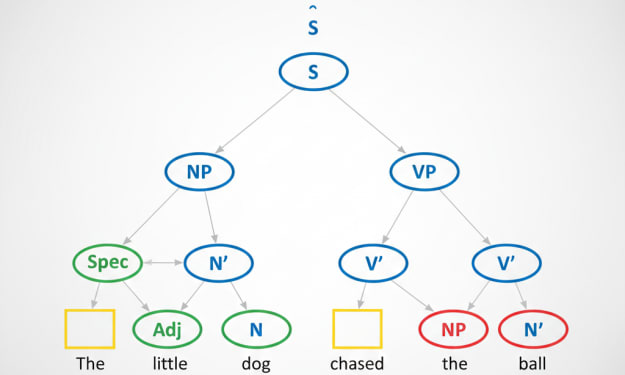
Grammar can often feel like a maze of confusing rules, especially when we dive into syntax — the study of sentence structure. One of the foundational tools in modern linguistics is X-Bar Theory, a framework that helps explain how words and phrases combine to form sentences. While it might sound intimidating, understanding X-Bar Theory can become straightforward if approached step by step.
By Games Mode Ona day ago in Education


Comments
There are no comments for this story
Be the first to respond and start the conversation.