
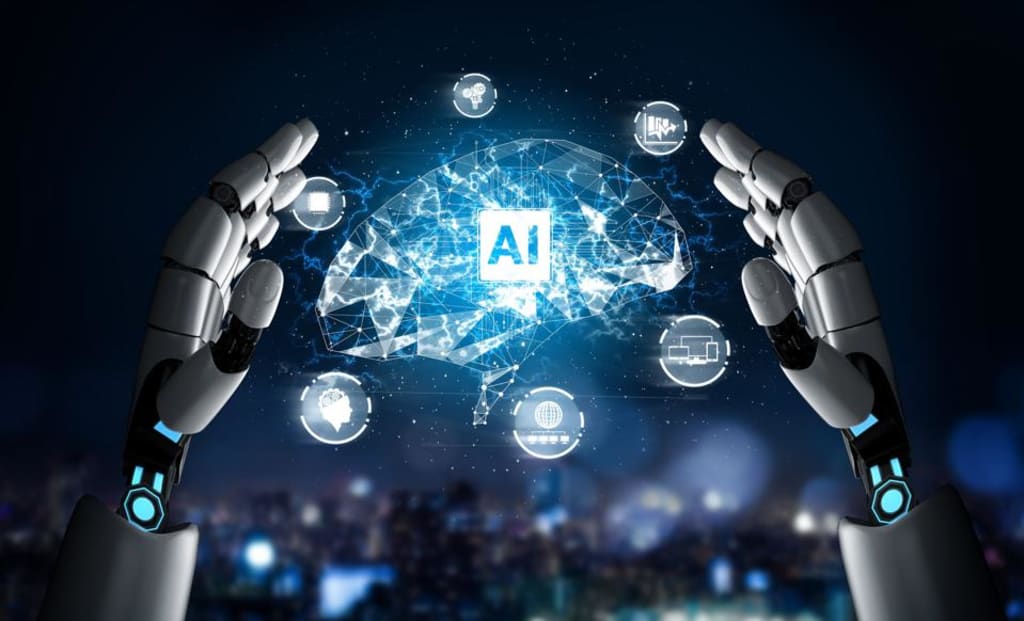
Artificial Intelligence (AI) is a branch of computer science concerned with the creation of intelligent machines that can perform tasks that typically require human intelligence. AI refers to the ability of a machine or computer program to perform cognitive functions that are normally associated with human beings, such as perception, reasoning, learning, and problem solving.
AI systems can be classified into two main categories: narrow AI and general AI. Narrow AI is designed to perform specific tasks, such as image recognition, language translation, or playing chess. These systems are trained on a large dataset to perform a specific task and can be very good at it. General AI, on the other hand, is a machine that can perform any intellectual task that a human being can. This type of AI does not yet exist and is still a subject of research and debate among experts in the field.
One of the most well-known applications of AI is machine learning, which involves training computers to perform tasks without being explicitly programmed. Machine learning algorithms use statistical methods to identify patterns in data and make predictions or decisions based on that information. There are three main types of machine learning: supervised learning, unsupervised learning, and reinforcement learning.
Supervised learning is used to train a machine to make predictions based on input data. In this type of learning, the machine is provided with labeled training data, which it uses to build a model. When a new, unseen data point is presented, the machine uses its model to make a prediction.
Unsupervised learning is used to identify patterns in data without the use of labeled data. In this type of learning, the machine is given a dataset and must identify structure and relationships within the data. This type of learning is commonly used in clustering, where the machine groups similar data points together.
Reinforcement learning is a type of machine learning that is used to train a machine to make decisions. In this type of learning, the machine receives a reward or penalty for each decision it makes and adjusts its behavior accordingly. Reinforcement learning is used in applications such as game playing, robotics, and autonomous vehicles.
The development of AI has raised important ethical and societal questions, such as the potential impact of AI on employment and privacy. There are also concerns about the development of autonomous weapons and the use of AI for malicious purposes. As AI continues to evolve and become more integrated into our lives, it is important to consider the implications and ensure that it is developed and used in a responsible and ethical manner.
In conclusion, Artificial Intelligence is a rapidly growing field that has the potential to transform the way we live and work. From self-driving cars to virtual personal assistants, AI is already impacting our lives in significant ways. As AI continues to evolve and improve, it is important to consider the ethical and societal implications of its development and use.
Advantages of AI:-
Increased efficiency: AI can automate tasks and processes, reducing the time and effort required to complete them. This can lead to increased productivity and cost savings.
Improved accuracy: AI systems can analyze vast amounts of data and identify patterns and relationships, helping to make more accurate predictions and decisions.
24/7 availability: AI systems can work continuously, without the need for breaks or time off, making them ideal for tasks that need to be performed around the clock.
Personalization: AI systems can provide customized experiences and recommendations based on individual preferences and behavior.
Improved customer service: AI-powered chatbots and virtual assistants can provide fast and efficient customer service, reducing wait times and improving the customer experience.
Increased safety: AI can be used in applications such as autonomous vehicles and medical diagnosis, helping to reduce the risk of human error and improve outcomes.
Better decision-making: AI can help organizations make data-driven decisions by providing insights and predictions based on analyzed data.
Better predictions and forecasting: AI can analyze large amounts of data and identify patterns, helping organizations make more accurate predictions and forecasts.
Cost savings: By automating tasks and reducing the need for manual labor, AI can help organizations reduce their costs and increase profitability.
Access to vast amounts of data: AI systems can process vast amounts of data and provide insights that would be difficult or impossible for humans to detect on their own.
Disadvantages of AI:-
Job loss: The increased automation of tasks may lead to job loss as machines and AI systems replace human workers.
Bias and discrimination: AI systems can perpetuate existing biases and discrimination if they are trained on biased data sets.
Lack of accountability: AI systems can make decisions and take actions that have significant impacts, but it can be difficult to determine who is responsible for those actions.
Privacy concerns: AI systems often collect and store vast amounts of personal data, raising concerns about privacy and the potential misuse of that data.
Dependence on technology: Overreliance on AI systems can lead to a loss of critical thinking and decision-making skills, as well as a decreased ability to solve problems without the aid of technology.
Lack of empathy: AI systems are not capable of understanding emotions and empathy, which can limit their effectiveness in certain applications, such as mental health care.
Security risks: AI systems can be vulnerable to cyber attacks and hacking, which can have serious consequences, including theft of sensitive information and disruption of critical systems.
Technical limitations: AI systems are only as good as the data and algorithms they are trained on, and they can be limited by the quality and quantity of data available.
High costs: Developing and implementing AI systems can be expensive, and ongoing maintenance and updates can add to the costs.
Unintended consequences: AI systems can have unintended consequences, such as creating new forms of bias or discrimination, or causing harm due to a lack of understanding or oversight.
About the Creator
Keep reading
More stories from writers in Education and other communities.
What your poop can tell you about your health
The average person poops out approximately 11,030 kilograms of cumulative waste. That's the equivalent of more than six SUVs. Now, oftentimes, that poop is brown. But why is that, considering all the colorful comestibles one consumes? And what's going on when poop appears in different colors and textures? Say you’re eating a beautiful, rainbowy salad. Your teeth and saliva first help break down the food and add lubrication. Each bite enters your esophagus and sequential muscle contractions push it towards your stomach.
By Munesh Yadavabout 13 hours ago in Education
What’s the Difference Between Utility Tokens and Security Tokens for Businesses?
Since then, as blockchain tokenization has shifted from an experimental fundraising approach to a serious consideration for many startups and established firms, which utilize the issue of tokens as a mechanism of raising funds, incentivizing user behavior, decentralizing existing platform ecosystems, and creating new digital marketplaces, a key question has centered on the difference between a utility token and a security token. It's not just semantic, it determines how a token can be sold, who can buy it, how it can be traded, and what obligations a business must take on under law.
By Henry james2 days ago in Education
Autonomy Is The Real Privilege
Good morning, freedom-seekers! Today we’re gonna be looking at autonomy. A strange word, I know; one many would probably look at blankly and run away from on sight. We’re gonna figure out what it actually means, consider how it’s achieved, and decipher just how deeply most of us are tangled up in dependence without realising it.
By That ‘Freedom’ Guy4 days ago in Humans




Comments
There are no comments for this story
Be the first to respond and start the conversation.