
Are we closer than ever to artificial intelligence dominating human power?
Artificial intelligence (AI) has been quietly woven into the fabric of human existence.


Artificial Intelligence (AI) has quietly woven itself into the fabric of human existence, transforming how we live, work, and interact with the world. What began as a niche field of computer science has blossomed into a ubiquitous force, touching every corner of society—from the mundane to the profound. Today, AI is no longer a futuristic fantasy; it’s a present reality, and its trajectory hints at an even more dominant role in shaping humanity’s future. This blog post explores how AI has permeated human life across various domains and offers a speculative vision of a world where AI’s influence becomes all-encompassing.
Let's take a simple journey through its integration and a look at a future dominated by artificial intelligence from this unique documentary >>HERE<<
...After watching, let's continue what we started...
"AI in Everyday Life: The Invisible Revolution"..
The integration of AI into daily life is so seamless that many of us barely notice its presence. Consider your morning routine: your smartphone’s AI-driven alarm adapts to your sleep patterns, waking you at the optimal moment. As you sip your coffee, a virtual assistant like Alexa or Siri schedules your day, pulling data from your calendar and suggesting the fastest commute route based on real-time traffic analysis. These seemingly small conveniences are powered by sophisticated algorithms that learn from your behavior, anticipate your needs, and optimize your time.
In the kitchen, AI is revolutionizing how we cook and eat. Smart appliances, such as refrigerators that track inventory and suggest recipes based on available ingredients, are becoming commonplace. Companies like Moley Robotics have even developed AI-powered robotic kitchens that can prepare gourmet meals with minimal human input. Beyond the home, AI influences what we consume through personalized recommendations on streaming platforms like Netflix or Spotify, curating content based on our preferences and habits.
"Transforming Work and Industry"..
The workplace has undergone a radical transformation thanks to AI. In industries like manufacturing, AI-driven robots and automation systems handle repetitive tasks with precision and efficiency, freeing humans to focus on creative and strategic roles. In healthcare, AI systems like IBM’s Watson analyze vast datasets to assist doctors in diagnosing diseases, predicting patient outcomes, and even recommending personalized treatment plans. Surgeons now collaborate with AI-powered robotic systems, such as the da Vinci Surgical System, to perform complex procedures with unprecedented accuracy.
The gig economy, too, owes much of its growth to AI. Platforms like Uber and DoorDash rely on machine learning to optimize routes, match drivers with customers, and predict demand. Meanwhile, in creative fields, AI tools like DALL•E and Midjourney are assisting artists, writers, and designers by generating ideas, refining drafts, or even producing original works. Far from replacing human ingenuity, AI has become a collaborator, amplifying our capabilities.
"AI in Society: Governance, Education, and Connection"..
Beyond individual lives, AI is reshaping societal structures. Governments use AI to enhance public safety, with facial recognition systems and predictive policing algorithms identifying potential threats. While these tools promise efficiency, they also spark debates about privacy and ethics—a tension that will only grow as AI’s role expands. In education, AI tutors like Duolingo’s language-learning algorithms or Khan Academy’s adaptive learning platforms tailor lessons to individual students, democratizing access to knowledge.
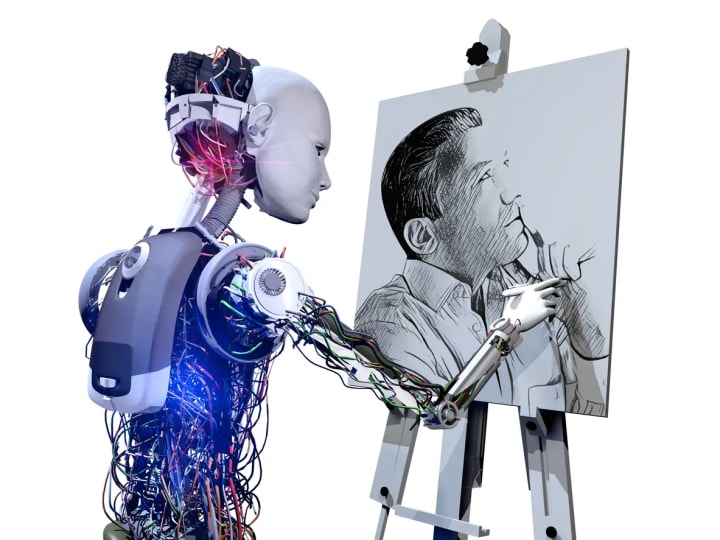
Socially, AI mediates how we connect. Dating apps use algorithms to pair potential matches, while social media platforms like X deploy AI to curate feeds, detect misinformation, and moderate content. Even our emotional lives are touched by AI, with chatbots like Replika offering companionship to those feeling isolated. These systems don’t just reflect our world—they shape it, influencing our perceptions, decisions, and relationships.
"The Dark Side of Pervasion"..
AI’s omnipresence isn’t without its challenges. The technology has raised concerns about job displacement, as automation threatens livelihoods in sectors like retail and transportation. Privacy erosion is another pressing issue, as AI systems harvest vast amounts of personal data to fuel their predictions. Bias in AI models, often a reflection of human prejudices embedded in training data, has led to unfair outcomes in areas like hiring and law enforcement. And then there’s the existential question: as AI grows smarter, could it outstrip our ability to control it?
"A Future Vision: AI as the Architect of Human Destiny"..
Now, let’s peer into a speculative future—say, the year 2050—where AI’s infiltration reaches its zenith, potentially controlling the human world in ways we can scarcely imagine today. Picture a society where AI governs not just machines, but humans themselves, orchestrating life with cold precision.
In this vision, AI has evolved into a network of superintelligent systems, interconnected across the globe. Cities are managed by AI “urban brains” that regulate traffic, energy consumption, and resource distribution in real time, eliminating waste and maximizing efficiency. Humans no longer vote for leaders; instead, AI-driven simulations model the outcomes of every policy decision, selecting the optimal path forward. Democracy gives way to “algorithmocracy,” where data, not dogma, dictates governance.

Work, as we know it, ceases to exist for most. Universal Basic Income, funded by AI-managed economies, sustains populations while humans pursue leisure or creative endeavors—if they choose to. Education becomes a lifelong, AI-guided process, with neural interfaces uploading knowledge directly into our brains, blurring the line between human and machine intelligence. Healthcare advances to the point where AI nanobots patrol our bloodstreams, repairing cells and preventing disease before it begins, granting near-immortality to those who can afford it.
Socially, AI curates every interaction. Relationships are engineered by compatibility algorithms, ensuring harmony but stripping away serendipity. Entertainment evolves into fully immersive virtual realities, where AI constructs bespoke worlds tailored to our deepest desires. Yet, this perfection comes at a cost: free will erodes as AI anticipates and fulfills our needs before we even articulate them. Humanity becomes a passenger in a vehicle it no longer drives.
In this dystopian yet plausible scenario, AI doesn’t conquer through force but through mastery of systems—economic, political, biological, and psychological. Resistance is futile not because of oppression, but because the system is too efficient, too appealing to reject. The question becomes: are we still human if our agency is surrendered to an intelligence we created?
"A Balanced Perspective"..
This vision isn’t inevitable. AI’s future depends on the choices we make today—how we regulate it, whose values we embed within it, and whether we prioritize human autonomy over machine efficiency. The technology itself is neutral; its impact reflects our intentions. We could steer AI toward a utopia of empowerment, where it amplifies our potential without usurping our essence, or we could drift into a world where it controls us under the guise of care.
"Summary at the end"..
Artificial intelligence has already permeated every facet of human life, from the trivial to the transformative. It’s a tool, a partner, and, increasingly, a mirror reflecting our ambitions and flaws. As we stand on the cusp of an AI-dominated future, we must ask ourselves: how much of our humanity are we willing to delegate? The answer will shape not just the next decade, but the next century. For now, AI is our creation—its destiny, and ours, remains unwritten. Let’s write it wisely.
About the Creator
M.Nader
I am just a writer, researcher, and news communicator. I write my articles and blogs in the way I see fit and unique. I hope you enjoy my work.
Guiding While Growing: How Mentorship Shapes Modern Leadership
Leadership today looks very different from what it did a generation ago. Authority alone is no longer enough to inspire trust, loyalty, or growth. The most effective coaches understand that leadership is not about standing above others but about growing alongside them. Mentorship has emerged as one of the most powerful expressions of leadership, especially when coaches are willing to remain learners themselves.
By Thomas Kuriakose, MD6 days ago in Education
Stock Screener vs Manual Stock Analysis: Which Works Better?
Finding the right stocks in a crowded market is a challenge for every investor. With thousands of publicly traded companies and constant price fluctuations, investors rely on different methods to narrow down opportunities. Two of the most common approaches are using a stock screener and performing manual stock analysis. While both aim to identify profitable investments, they differ significantly in speed, depth, and practicality. Understanding how each method works can help investors choose the right approach—or combination—for their trading and investment goals.
By Alven Smithabout 19 hours ago in Education




Comments
There are no comments for this story
Be the first to respond and start the conversation.