
API Integration and Third-Party System Integration in Web Development
Ever wonder how a modern application can deliver immense user-focused functionalities today.
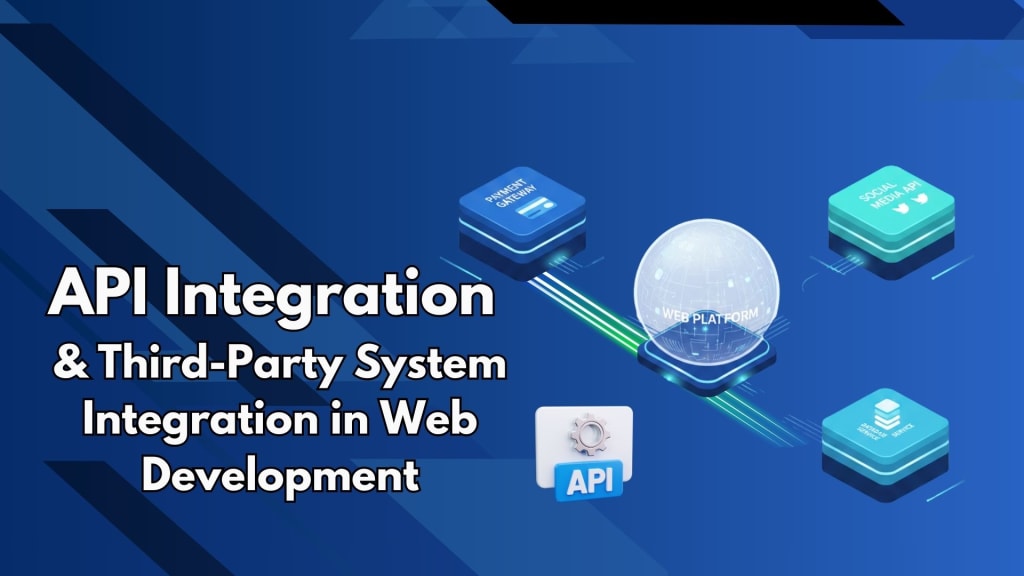
Ever wonder how a modern application can deliver immense user-focused functionalities today?
Basically, an app’s framework is supported by its core features. Along with that, they are integrated with various functionalities through API integration and third-party systems.
At its core, an API allows software programs to seamlessly communicate with each other. This further assists in the easier exchange of data, features, and functionalities. Furthermore, third-party systems extend this concept by integrating additional dynamic capabilities in the apps’ workflows.
Overall, they help the app perform better, which is why the user expectations have been set at a higher benchmark today. Leading towards the evolution of the web app landscape, this change is bringing immense value to enterprises today.
Let us understand this through an example.
Consider how users experience an app like Dominos. It is secure (from the payment point of view), allows easy menu searches, is fast and easy to use, and has no waiting time for users. Additionally, it allows real-time order tracking, which provides complete transparency of the process.
Thanks to third-party systems and APIs, such robust application performance can be delivered today. This app essentially uses APIs for location services and payment processes. Hence, enterprises that focus on API integrations and third-party systems can achieve the following benefits:
- Improved app features
- Delivering better app performance and efficiency
- Ensuring that user expectations can be met and surpassed without building core capabilities in the app framework.
With this perspective, this article focuses on understanding API integration and third-party systems for applications in the modern web app landscape.
What are API Integration and Third-Party System Integration?
Simply, an application’s framework today is built around its performance.
From a leadership viewpoint, this means that any investment in the app is made if it makes the system work seamlessly, thereby ensuring that the operations are smoother and smarter. At its core, this means that results matter.
This is why leaders today strive to build smarter apps that can deliver meaningful customer experiences. And to achieve this goal, an API integration can be trusted.
- Here, an API (application programming interface) helps one software to request data and services from another software through a secure digital bridge.
- Other than that, apps also rely on external providers for many functions. Here, the essence of third-party systems becomes important.
- This mainly involves externally integrating the app with the best payment gateways, logistics tools, marketing automation platforms, and more.
Essentially, it helps apps in the following ways:
- Sharing data instantly by syncing different tools like analytics, CRM, and more with the app.
- Allowing dynamic digital features to be built into the app without rebuilding existing platforms.
- Automating operational workflows that improve system efficiency.
That being said, modern app frameworks are connected through APIs by professionals offering web development services. These experts have the right know-how, and they help platforms to have a real-time view of data.
For teams, this means greater visibility across departments. Hence, investing in these services to connect with the right APIs is necessary. Result-wise, companies that invest in these integrations have lower development costs and improved in-app functions and performance. Moreover, this allows apps to perform well, which brings in higher engagement and retention.
This is why it can be said that modern-day apps are more intelligent owing to these integrations. In this context, the app framework is not built; instead, its capabilities can be assembled to attain these benefits.
Role of API Integration and Third-Party Systems in Web Development Ecosystem
As we know, modern web development is no longer centered on building every feature from the ground up. Instead, today it revolves around creating platforms that can connect with external services to deliver better app experiences.
This being said, API integration and third-party systems are the technical backbone of smart apps. They enable easy sharing of data and features that shape how users experience the app itself. With this perspective, this section explores the key role of these integrations in apps today.
Enabling System Interoperability
Interoperability as an attribute means easy exchange of information. And apps leverage this feature largely today.
That being said, APIs and third-party systems enable interoperability as they allow different software components, services, and platforms to exchange data seamlessly.
Comprehensively, this ensures that web applications function as part of a connected environment rather than isolated systems.
Moreover, it functionally allows the apps to deliver real-time updates to the users.
Accelerating Feature Development
Beyond easier data transfer, third-party systems incorporate advanced intelligence in apps’ workflows. And interestingly, this is achieved without even changing the core framework of the system itself.
Owing to APIs, teams can achieve the following:
Reduced development time
Minimal system complexity of incorporating smart features
Thus, development teams can benefit from API integration as it helps in accelerating the feature development process, which also leads to performance optimization.
Supporting Modular Architecture
Generally, API-driven apps encourage a modular framework. Herein, each module, such as payments, notifications, and analytics tools, can be added to the app as a separate service that is connected through APIs.
Mainly, this ensures that any component can be updated, replaced, and scaled without affecting the other components.
Moreover, failures or issues in one module are less likely to affect the entire application.
Updates in one component can be deployed faster by development teams.
Thus, investing in APIs and third-party systems enables enterprises to develop scalable app resources, which can improve their resilience and adaptivity in the long run.
Enhancing User Experiences
UX depends on both the front-end and the back-end framework. This is why integrating the app with payment platforms, inventory database, and customer profiles through APIs matters.
This allows users to enjoy personalized experiences in applications while getting all the important real-time updates.
Moreover, instant exchange of data through APIs helps in enabling smooth and responsive user interactions.
Overall, this helps apps to provide consistent and positive user experiences across the various digital channels.
Improved Flow of Data
Using APIs and third-party systems helps an app connect with multiple systems, such as CRMs, ERPs, analytics tools, marketing automation tools, and more. Essentially, this allows the framework to access accurate and up-to-date information at all times.
Herein, a unified view of data enables higher data consistency and operational visibility.
It also reduces the chance of errors and improves the team’s decision-making.
Hence, these integrations enable systems to be data-centric, which makes them more powerful and functional in real-time.
Final Thoughts
Wrapping up, we can say that API and third-party integration, done by professional web development services, offer immense business value. In fact, this radical shift redefines how apps are built and scaled today.
Owing to this, apps can be more user-focused and effective. API integration also helps platforms in performance optimization. At the same time, an update or an issue in one component doesn’t slow the entire system down. Rather, this makes the system smarter, more efficient, and interconnected.
Enabling better data visibility, APIs support smarter systems, which assist teams in informed decision-making. Apart from that, the innovations are faster and less costly (as development costs drop).
Hence, there is no doubt that a successful path to web development today includes the use of APIs and third-party integrations that connect systems intelligently.
About the Creator
Keep reading
More stories from writers in Education and other communities.
The Light She Gave Us
A Tribute to Dr. Shirley Ann Jackson and the Power of Fiber Internet Ladies and gentlemen, today I want to tell you a story a story about light, legacy, and the brilliance of a Black woman whose mind helped shape the very way our world communicates. Before fiber‑optic lines stretched across America… Before light traveled through glass to carry our voices at breathtaking speed… Before companies like Frontier and Verizon built vast modern networks… There was a little girl in Washington, D.C., collecting honeybee's in jars, studying the patterns of nature, and discovering curiosity as her superpower. That little girl grew into **Dr. Shirley Ann Jackson a name that deserves to be spoken with honor, with reverence, with pride.
By Organic Products about 9 hours ago in Education
Growing Strong Customer Loyalty Through Exceptional Customer Service
Building loyalty through exceptional customer service is one of the most effective ways to create long-term business success. Customers have many choices today, and they can easily leave if they feel unimportant. Loyalty is not built only through products or prices. It is built through experiences. The way a business treats its customers can make the difference between a one-time buyer and a lifelong supporter.
By Apex Service Partners2 days ago in Education
The Duelist
The rays of a dying red sun flashed against the onrushing blade. The grey beards say the key to dueling lies in size, speed, reach, righteous fury, whatever the person in front of them pays them to say. Matteo knew better than any it was none of these and had an undefeated record on these sands to prove it.
By Matthew J. Fromm5 days ago in Fiction




Comments
There are no comments for this story
Be the first to respond and start the conversation.