
Antimatter: Why It Exists and Where It Went — Searching for the Cosmic Mystery
Antimatter is one of the most fascinating and puzzling concepts in modern physics. It sounds like science fiction, yet it is very real — created in laboratories, detected in space, and essential to our understanding of the universe. But antimatter raises a profound question: if antimatter exists, where did it all go? According to our best theories, the universe should have been born with equal amounts of matter and antimatter. Yet today, the universe is overwhelmingly made of matter — stars, planets, galaxies, and life itself. So why does antimatter exist at all, and why does it seem to be missing? Let’s explore the science behind antimatter, its origins, and the cosmic mystery of its disappearance.

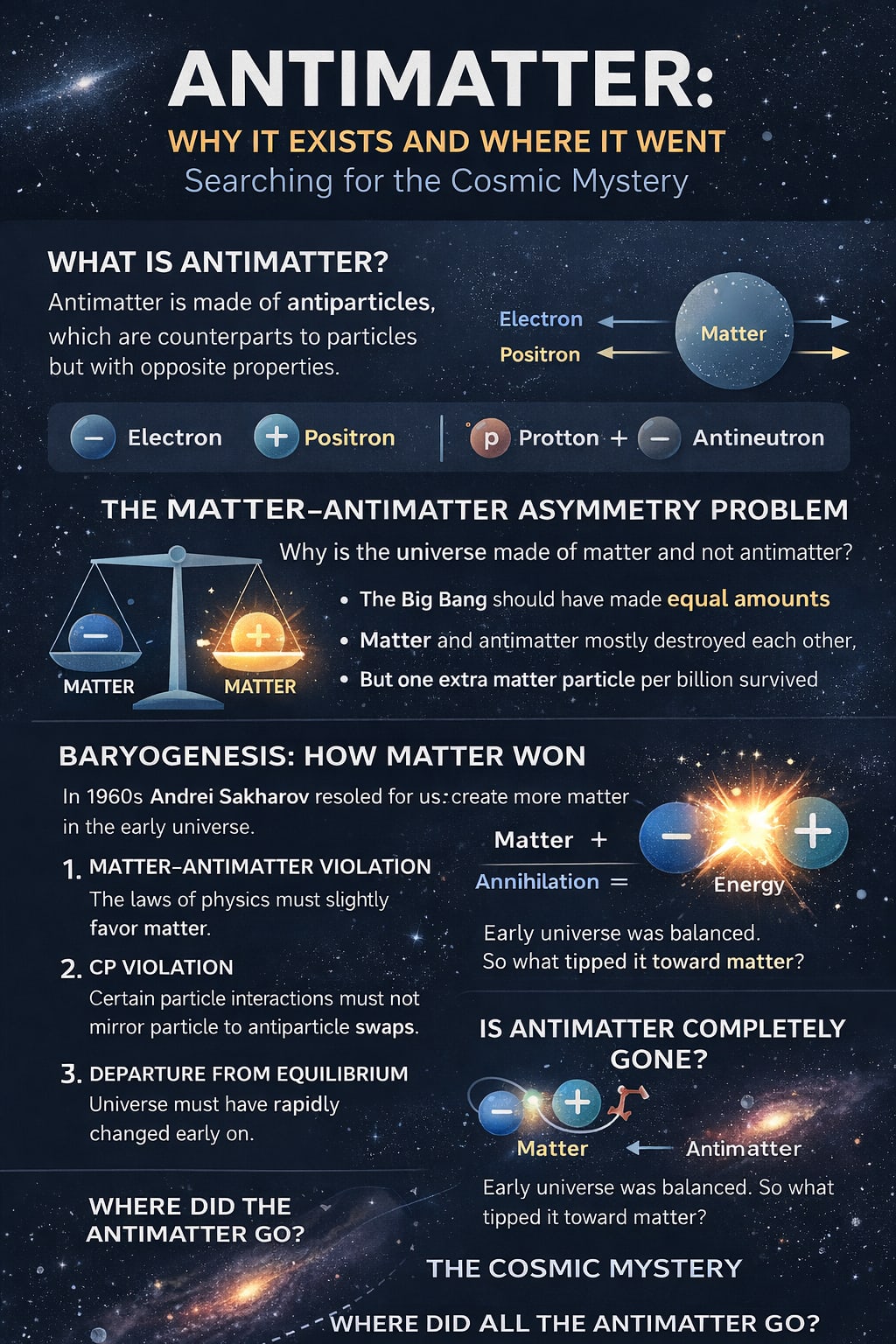
What Is Antimatter?
Antimatter is made of antiparticles, which are counterparts to ordinary particles but with opposite properties.
For example:
• The electron has a negative charge
• The positron (its antiparticle) has a positive charge
Similarly:
• Protons have antiprotons
• Neutrons have antineutrons
Antimatter particles have:
• The same mass as normal particles
• Opposite electric charge
• Other quantum properties reversed
________________________________________
What Happens When Matter Meets Antimatter?
When a particle meets its antiparticle, they annihilate each other.
Annihilation Produces Energy
• Matter + antimatter → energy
• The energy is released mostly as high-energy gamma rays
This process is extremely efficient. Even a tiny amount of antimatter can release enormous energy, which is why antimatter often appears in science fiction as a powerful fuel source.
________________________________________
Why Does Antimatter Exist?
Antimatter exists because of the fundamental laws of physics.
Dirac’s Prediction
In 1928, physicist Paul Dirac developed an equation combining quantum mechanics and special relativity. His math predicted particles identical to electrons but with opposite charge — antimatter.
Just a few years later, positrons were discovered experimentally, confirming the theory.
This showed that:
• Antimatter is not optional
• It is a natural consequence of quantum physics
________________________________________
Antimatter and the Birth of the Universe
The Big Bang Should Have Made Equal Amounts
According to standard cosmology:
• The Big Bang created enormous energy
• Energy turned into particles and antiparticles
• Matter and antimatter should have formed in equal quantities
If that were perfectly true:
• Matter and antimatter would have annihilated completely
• The universe would contain only radiation today
But clearly, that didn’t happen.
________________________________________
The Matter–Antimatter Asymmetry Problem
This brings us to one of the biggest unsolved problems in physics:
Why is there more matter than antimatter in the universe?
This imbalance is known as baryon asymmetry.
For every billion antimatter particles, there were roughly a billion plus one matter particles. After annihilation:
• Matter and antimatter destroyed each other
• That tiny excess of matter survived
• It eventually formed everything we see today
________________________________________
Where Did the Antimatter Go?
The simplest answer is:
It annihilated with matter in the early universe.
But this explanation raises a deeper question:
Why wasn’t the universe perfectly balanced?
To answer that, physicists look to a process called baryogenesis.
________________________________________
Baryogenesis: How Matter Won
Baryogenesis refers to theoretical mechanisms that created more matter than antimatter in the early universe.
In the 1960s, physicist Andrei Sakharov identified three conditions required for this imbalance:
1. Matter–Antimatter Violation
The laws of physics must slightly favor matter over antimatter.
2. CP Violation
Certain particle interactions must behave differently when particles are replaced with antiparticles and mirrored in space.
3. Departure from Thermal Equilibrium
The universe must have gone through rapid changes — which it did during expansion.
Experiments show CP violation exists, but not enough (so far) to fully explain the matter dominance. This suggests new physics may be involved.
________________________________________
Is Antimatter Completely Gone?
No — antimatter still exists, but in very small amounts.
Where We Find Antimatter Today
1. Cosmic Rays
High-energy collisions in space create antimatter particles like positrons and antiprotons.
2. Particle Accelerators
Facilities such as CERN routinely create antimatter for research.
3. Medical Technology
Positrons are used in PET scans, a common medical imaging technique.
However, large antimatter structures (like anti-stars or anti-galaxies) have never been confirmed.
________________________________________
Could There Be Antimatter Galaxies?
Some scientists once speculated that entire regions of the universe might be made of antimatter.
Why This Seems Unlikely
• Matter–antimatter boundaries would produce intense gamma radiation
• We don’t observe such large-scale annihilation signals
• Observations suggest matter dominates everywhere we look
While tiny pockets of antimatter may exist, an antimatter universe next door seems improbable.
________________________________________
Antimatter and Dark Matter: Are They Connected?
Antimatter is often confused with dark matter, but they are very different.
Antimatter Dark Matter
Opposite of matter Unknown type of matter
Annihilates with matter Does not annihilate normally
Rare today Makes up ~27% of universe
Detectable in labs Detected only indirectly
However, some theories suggest that unknown particles related to dark matter might help explain matter–antimatter asymmetry.
________________________________________
Why Antimatter Matters to Science
Antimatter isn’t just a curiosity — it’s a powerful tool for understanding reality.
1. Testing Fundamental Symmetries
Comparing matter and antimatter helps test whether physical laws are truly universal.
2. Searching for New Physics
Any difference between matter and antimatter behavior could reveal physics beyond the Standard Model.
3. Understanding the Early Universe
Antimatter research helps reconstruct conditions moments after the Big Bang.
Could Antimatter Help Explain the Cosmic Edge?
The phrase “searching for the cosmic edge” doesn’t mean a physical boundary — but rather the limits of our understanding.
Antimatter sits at this edge because:
• It challenges symmetry in nature
• It hints that known laws are incomplete
• It may point to hidden dimensions or forces
In this sense, antimatter is a gateway to deeper cosmic truths.
________________________________________
Why Didn’t Matter and Antimatter Cancel Everything?
Because the universe is not perfectly symmetric.
Even tiny asymmetries:
• One extra matter particle per billion
• Slight differences in decay behavior
• Early cosmic phase transitions
…were enough to shape the entire universe.
This shows how small quantum effects can have cosmic consequences.
________________________________________
What If Antimatter Had Won?
If antimatter had dominated instead of matter:
• Anti-stars and anti-planets could exist
• Anti-life (made of antimatter) might arise
• Physics would look similar — but interactions with matter would be catastrophic
The universe would still exist — just very differently.
________________________________________
The Mystery Remains Unsolved
Despite decades of research:
• We don’t fully understand why matter dominates
• Known physics explains only part of the imbalance
• Experiments continue to search for answers
Future discoveries in:
• Neutrino physics
• High-energy particle collisions
• Early universe cosmology
…may finally explain what happened to antimatter.
________________________________________
Conclusion: Antimatter and the Cosmic Puzzle
Antimatter exists because the laws of physics demand it. Yet its near-absence today reveals a deep imbalance written into the fabric of the universe.
Somewhere in the earliest moments of cosmic history:
• Matter gained a tiny advantage
• Antimatter largely vanished
• That small difference became everything
Antimatter is not just missing matter — it is a clue. A clue that the universe still holds secrets at its deepest level.
In searching for antimatter’s fate, we are truly searching for the cosmic edge of knowledge itself.
About the Creator
Keep reading
More stories from shahkar jalal and writers in Education and other communities.
Could the Universe Be Finite? Searching for the Cosmic Edge
What Does “Finite Universe” Really Mean? At first glance, a finite universe sounds simple: a universe with a definite size. But in cosmology, finite does not necessarily mean having walls or edges like a box.
By shahkar jalalabout a month ago in Education
The Human Guide Behind Technical Excellence
Mentorship of skilled technicians plays a decisive role in shaping strong careers and reliable work standards. Technical skill alone does not make a technician capable. Real growth comes from shared experience, steady guidance, and trust built over time. In many industries, mentorship fills the gap between classroom learning and real job demands. It helps technicians move from basic ability to confident performance. This article explores how mentorship supports learning, builds skills, and strengthens the future workforce.
By Michael Gastinel2 days ago in Education
Pioneering Therapies for Untreated Diseases
Medical science has made incredible progress in treating many illnesses. Yet, some diseases remain resistant to conventional therapy. These untreated diseases affect millions of people worldwide, causing long-term disability or shortened lifespans. Pioneering therapies for untreated diseases aim to fill this gap, offering hope where traditional treatments have failed. Scientists, clinicians, and biotech companies are working together to create therapies that are both innovative and effective.
By Dr. Janet Chollet3 days ago in Education
Miss Persephone's Manual to a Seemingly Ordinary Life
Miss Persephone was found at the dining table, her blue eyes swollen, her tears arriving and retreating like the tides of the ocean. Earlier that day, her family had visited her in the retirement home where she had lived for eight years. It was her eightieth birthday.
By Imola Tóth3 days ago in Fiction


Comments
There are no comments for this story
Be the first to respond and start the conversation.