
Could the Universe Be Finite? Searching for the Cosmic Edge
Is the universe infinite, stretching endlessly in all directions — or could it be finite, with a limited size and perhaps even an “edge”? This question has fascinated philosophers, astronomers, and physicists for thousands of years. Modern cosmology has brought us closer than ever to answering it, yet the mystery remains one of the deepest in science. In this article, we’ll explore whether the universe could be finite, what scientists mean by a “cosmic edge,” how space can be finite without boundaries, and what observations tell us about the true shape and size of the cosmos.

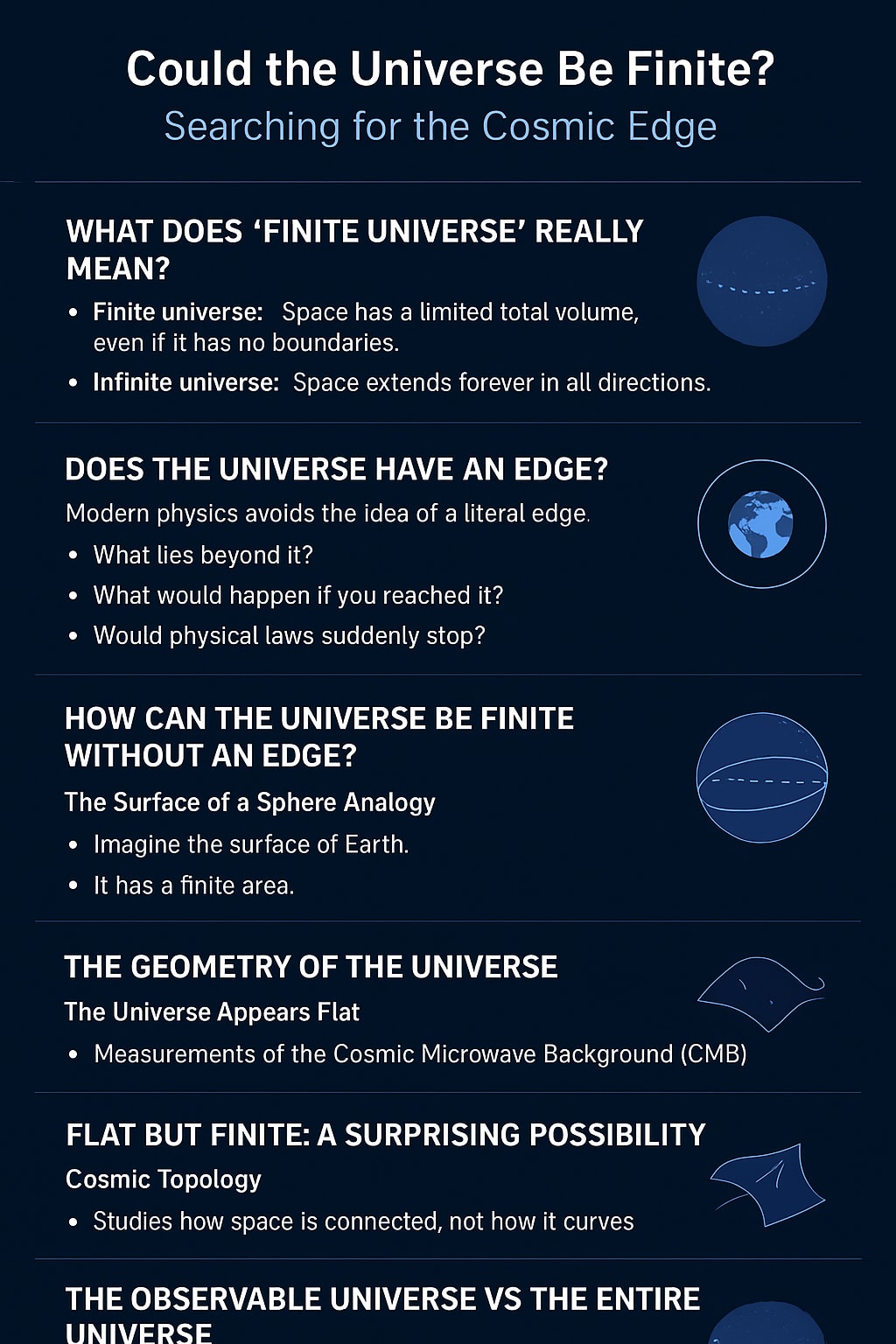
What Does “Finite Universe” Really Mean?
At first glance, a finite universe sounds simple: a universe with a definite size. But in cosmology, finite does not necessarily mean having walls or edges like a box.
Finite vs Infinite
• Infinite universe: Space extends forever in all directions.
• Finite universe: Space has a limited total volume, even if it has no boundaries.
This distinction is crucial. A finite universe does not automatically imply a visible edge or border.
________________________________________
Does the Universe Have an Edge?
When people imagine a finite universe, they often picture a cosmic boundary — a place where space simply stops. According to modern physics, this idea is misleading.
Why an “Edge” Is Unlikely
If space had a physical edge:
• What lies beyond it?
• What would happen if you reached it?
• Would physical laws suddenly stop?
These questions lead to contradictions. As a result, most scientific models avoid the idea of a literal edge.
Instead, physicists explore geometries where space is finite but unbounded.
________________________________________
How Can the Universe Be Finite Without an Edge?
This concept sounds strange, but we already have everyday analogies.
The Surface of a Sphere Analogy
Imagine the surface of Earth:
• It has a finite area.
• You can travel forever without hitting an edge.
• There is no boundary on the surface itself.
If you walk in a straight line long enough, you eventually return to your starting point.
Similarly, the universe could be finite in volume while having no edge in space.
________________________________________
The Geometry of the Universe
To understand whether the universe is finite, we need to examine its geometry — the way space is shaped on large scales.
Cosmologists describe space using three possible geometries:
1. Closed Universe (Positive Curvature)
• Space curves like a sphere.
• The universe is finite.
• Traveling far enough could bring you back to where you started.
2. Flat Universe (Zero Curvature)
• Space follows Euclidean geometry.
• The universe may be infinite — or finite with special topology.
3. Open Universe (Negative Curvature)
• Space curves like a saddle.
• The universe is usually infinite.
________________________________________
What Does Current Evidence Suggest?
The Universe Appears Flat
Measurements of the cosmic microwave background (CMB) — the afterglow of the Big Bang — indicate that the universe is extremely close to flat.
This finding comes from:
• Satellite missions such as COBE, WMAP, and Planck
• Precise measurements of cosmic temperature fluctuations
However, nearly flat does not necessarily mean infinite.
________________________________________
Flat but Finite: A Surprising Possibility
Even a flat universe can be finite if space has a non-trivial topology.
What Is Cosmic Topology?
Topology studies how space is connected, not how it curves.
For example:
• A video game world may look flat.
• But exiting one side makes you reappear on the opposite side.
In such a universe:
• Space loops back on itself.
• The total volume is finite.
• No edge exists.
This idea is mathematically valid and actively studied.
________________________________________
The Observable Universe vs the Entire Universe
A key source of confusion is the difference between the observable universe and the entire universe.
Observable Universe
• Limited by the speed of light and the age of the universe
• About 93 billion light-years in diameter
• Represents what we can currently see
Entire Universe
• Could be much larger
• Could be infinite
• Or could be finite but beyond our observational reach
Even if the universe is finite, its size could be so enormous that we only observe a tiny fraction of it.
________________________________________
Is the Cosmic Horizon an Edge?
Sometimes people mistake the cosmic horizon for the edge of the universe.
What Is the Cosmic Horizon?
• The farthest distance from which light has had time to reach us
• Defined by cosmic expansion and time since the Big Bang
This is not a physical boundary — just a limit of observation.
Beyond it, space likely continues.
________________________________________
What Would a Finite Universe Look Like?
If the universe is finite, scientists expect subtle observational clues.
Possible Signatures
• Repeating patterns in the cosmic microwave background
• Matching circles in the sky
• Identical galaxy structures appearing in different directions
So far, no conclusive evidence for such patterns has been found — but searches continue.
________________________________________
The Role of Cosmic Inflation
What Is Inflation?
Inflation is a theory proposing that the universe expanded extremely rapidly in the first fraction of a second after the Big Bang.
How Inflation Affects Finiteness
• Inflation makes space appear flat
• It can stretch a finite universe so large that it appears infinite
• Small curvature becomes nearly impossible to detect
As a result, inflation makes determining the universe’s true size extremely difficult.
________________________________________
Could We Ever Reach the Edge of the Universe?
If the universe is finite but unbounded:
• There is no edge to reach.
• Traveling far enough might bring you back.
If the universe is infinite:
• There is no end.
In both cases, reaching a “cosmic edge” is unlikely or impossible.
Additionally:
• Space is expanding.
• Distant regions are moving away faster than light (due to expansion, not motion through space).
• Many regions will remain forever unreachable.
________________________________________
Philosophical Implications of a Finite Universe
The question of finiteness goes beyond physics.
If the Universe Is Finite
• The total amount of matter and energy is limited
• The number of possible configurations may be finite
• Raises deep questions about repetition and cosmic cycles
If the Universe Is Infinite
• Everything that can happen may happen somewhere
• There could be infinitely many versions of similar regions
• Leads to unsettling ideas about duplicates of galaxies — or even people
Both possibilities challenge our intuition.
________________________________________
What Do Physicists Think Today?
Most cosmologists agree on a few key points:
• The observable universe is finite
• The overall universe appears nearly flat
• The universe could be infinite
• Or finite but vastly larger than what we can observe
At present, no definitive answer exists.
________________________________________
Future Clues and Observations
Scientists hope future advances may shed light on the universe’s true nature.
Potential Breakthroughs
• More precise CMB measurements
• Better galaxy surveys
• Detection of subtle topological patterns
• New theories uniting gravity and quantum physics
Each improvement tightens the constraints on cosmic geometry.
________________________________________
Why This Question Matters
Understanding whether the universe is finite helps answer fundamental questions:
• What is the global structure of reality?
• Did the universe have special initial conditions?
• Are the laws of physics universal everywhere?
• Is the cosmos unique or repetitive?
These questions lie at the heart of cosmology.
________________________________________
Conclusion: Still Searching for the Cosmic Edge
So, could the universe be finite?
Yes — it’s entirely possible.
But if it is finite, it almost certainly has no edge in the conventional sense.
Modern physics allows for:
• A finite, unbounded universe
• A flat universe with hidden topology
• Or an infinite universe extending forever
For now, the cosmic edge remains elusive — not because it’s hidden somewhere far away, but because the universe may not have one at all.
As our observations improve and theories deepen, we may one day discover whether space truly goes on forever — or quietly loops back on itself in ways we are only beginning to imagine.
About the Creator
Keep reading
More stories from shahkar jalal and writers in Education and other communities.
The Physics of Gravity: Is It a Force or Geometry?
What Is Gravity? A Simple Definition At its most basic level, gravity is the phenomenon by which mass and energy influence motion. Any object with mass attracts other objects with mass. The larger the mass, the stronger the effect.
By shahkar jalalabout a month ago in Education
The Human Guide Behind Technical Excellence
Mentorship of skilled technicians plays a decisive role in shaping strong careers and reliable work standards. Technical skill alone does not make a technician capable. Real growth comes from shared experience, steady guidance, and trust built over time. In many industries, mentorship fills the gap between classroom learning and real job demands. It helps technicians move from basic ability to confident performance. This article explores how mentorship supports learning, builds skills, and strengthens the future workforce.
By Michael Gastinela day ago in Education
Pioneering Therapies for Untreated Diseases
Medical science has made incredible progress in treating many illnesses. Yet, some diseases remain resistant to conventional therapy. These untreated diseases affect millions of people worldwide, causing long-term disability or shortened lifespans. Pioneering therapies for untreated diseases aim to fill this gap, offering hope where traditional treatments have failed. Scientists, clinicians, and biotech companies are working together to create therapies that are both innovative and effective.
By Dr. Janet Chollet3 days ago in Education


Comments
There are no comments for this story
Be the first to respond and start the conversation.