
America’s Deadliest Crisis: The Drug Epidemic No One Talks About
"With over 100,000 overdose deaths in a year, the U.S. is facing a silent war within its own borders."
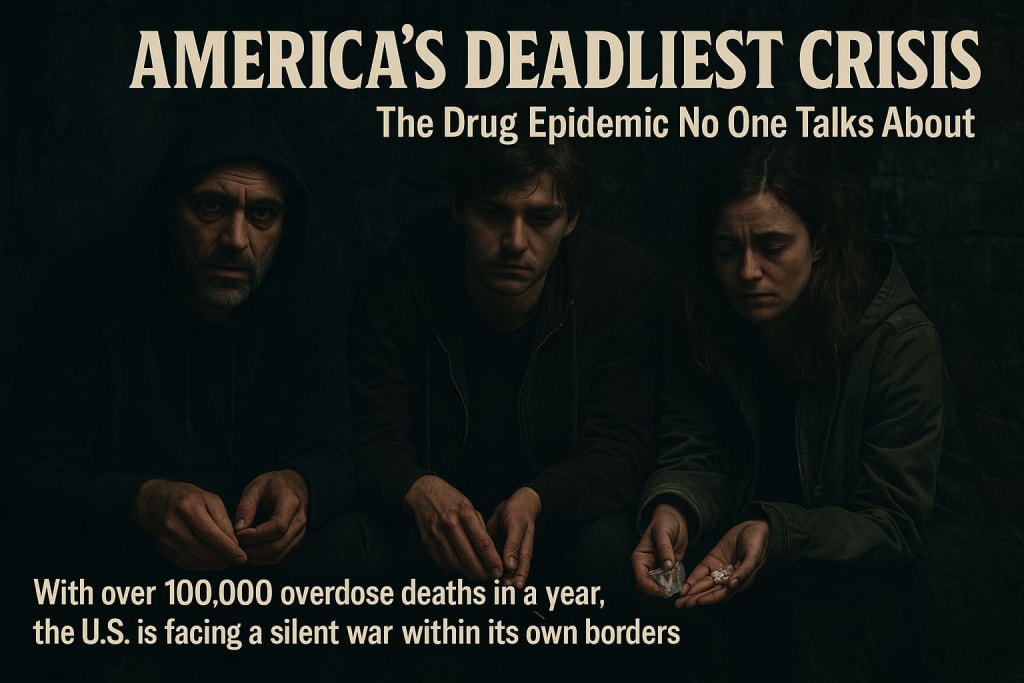
In the land often dubbed "the home of the free," a silent epidemic continues to tighten its grip. Drug addiction—once a taboo, then a public health issue—is now a national crisis affecting millions of American lives across every age group, race, and socioeconomic class. Despite technological advancement, economic growth, and a wealth of resources, the United States finds itself entangled in a dangerous spiral of substance abuse.
But how did it get this bad? And more importantly, what are we doing about it?
A Crisis Decades in the Making
The roots of America’s drug problem are complex and deeply embedded in its social, medical, and economic history. The modern opioid crisis began in the late 1990s when pharmaceutical companies assured healthcare providers that prescription opioids like OxyContin were not addictive. Encouraged by this claim, doctors began prescribing them in large quantities. The result? A surge in dependency, followed by a tidal wave of addiction.
As regulations tightened and prescription drugs became harder to access, many turned to illegal alternatives like heroin and, more recently, fentanyl—a synthetic opioid 50 times more potent than heroin and largely responsible for today’s skyrocketing overdose deaths.
According to the Centers for Disease Control and Prevention (CDC), over 110,000 people died of drug overdoses in the United States in 2023 alone. That’s roughly one person every five minutes.
The Demographic Shift: Addiction Has No Boundaries
What makes today’s crisis particularly disturbing is its reach. Addiction no longer fits the outdated stereotype of the homeless person on the street. It lives in suburbs, among college students, inside corporate offices, and even in high schools.
Teens are experimenting with pills disguised as candy. Middle-aged adults are misusing painkillers originally prescribed after surgery. Veterans are battling both PTSD and dependency. Even seniors, often overlooked in addiction statistics, are vulnerable due to chronic pain and isolation.
Social media and the dark web have made access to drugs easier than ever. Fentanyl-laced pills are sold online, disguised as legitimate prescription medications. One mistake can be fatal—and too often, it is.
Mental Health: The Invisible Trigger
A key yet often ignored factor in this growing crisis is America’s mental health epidemic. Depression, anxiety, PTSD, and trauma frequently go untreated, especially in underserved communities. In many cases, substance abuse becomes a form of self-medication.
The COVID-19 pandemic only worsened these issues. Isolation, job loss, and uncertainty led to a rise in both mental health disorders and substance use. For many, substances offered a temporary escape—one that too often became permanent.
The Ripple Effect: Families, Communities, and the Economy
The impact of drug addiction goes far beyond the individual. Families are torn apart. Children grow up in unstable environments. Communities face rising crime, homelessness, and healthcare burdens.
The financial toll is equally staggering. It’s estimated that substance abuse costs the U.S. economy over $600 billion annually due to lost productivity, healthcare expenses, and criminal justice involvement.
And yet, despite the enormity of the problem, many Americans still view addiction as a moral failing rather than a medical condition. This stigma only deepens the problem, preventing people from seeking the help they desperately need.
Are We Doing Enough?
To be fair, not all hope is lost. The federal government and various nonprofit organizations have ramped up efforts to combat addiction. There’s a growing focus on harm reduction, which includes distributing Narcan (a life-saving overdose reversal drug), expanding access to medication-assisted treatment (MAT), and increasing public education about the dangers of synthetic drugs.
Rehabilitation centers, support groups, and online therapy platforms are more accessible than ever. There’s also a cultural shift—slow but steady—toward understanding addiction as a disease, not a choice.
But progress remains uneven. In many rural areas, treatment facilities are few and far between. Insurance coverage for rehab is inconsistent. And for every person who receives help, many more fall through the cracks.
What Can We Do?
Addressing America’s addiction crisis requires a multi-layered approach:
Education: Early prevention programs in schools can teach young people the real risks associated with drugs.
Mental Health Services: Integrating mental health care into primary care settings can catch and treat co-occurring disorders before they escalate.
Decriminalization and Policy Reform: Shifting from punitive to rehabilitative policies can reduce incarceration rates and promote recovery.
Community Involvement: Local outreach, peer support groups, and neighborhood coalitions play a crucial role in fostering hope and resilience.
Ultimately, we must redefine how we view addiction—not as a shameful secret but as a public health issue that demands compassion, urgency, and collective responsibility.
A Nation at a Crossroads
America stands at a crossroads. The path ahead is steep, but not impassable. Every life lost to addiction is a story that could have had a different ending—with the right intervention, the right support, and the right policies.
This crisis isn’t about "them" anymore—it’s about all of us. The more we speak, share, and support, the fewer people will have to suffer in silence.
Let this not be the generation that watched an epidemic unfold and did nothing. Let this be the generation that fought back—with empathy, education, and action.
About the Creator
Whispers Beneath the Floorboards
From the moment he could remember, Ethan Carter knew what silence felt like—not the peaceful kind, but the heavy, suffocating kind that fills a house with absence. He was only six when his parents died in a fire that gutted their home in the middle of the night. There had been no time for goodbyes, no time to hold on. Just smoke, screams, and the sudden silence that followed. After that, life didn’t pause for him. It simply pushed him forward, cold and unfeeling.
By M Ali8 months ago in Motivation
A Dart at Dusk
Seconds ago, the sullen sun set on the two of us… my exuberant furry companion and me. A fresh breeze embraces us, delivering welcome relief from the day’s oppressive heat. His typical stumbling and staggering along — apace with a sloth — has turned into trip-trapping, high-stepping, almost skipping along.
By Angie the Archivist 📚🪶4 days ago in Petlife



Comments
There are no comments for this story
Be the first to respond and start the conversation.