
Albert Einstein: The Genius Who Redefined the Universe
From struggling student to scientific icon, Albert Einstein transformed our understanding of the universe—and proved that imagination can be more powerful than knowledge.

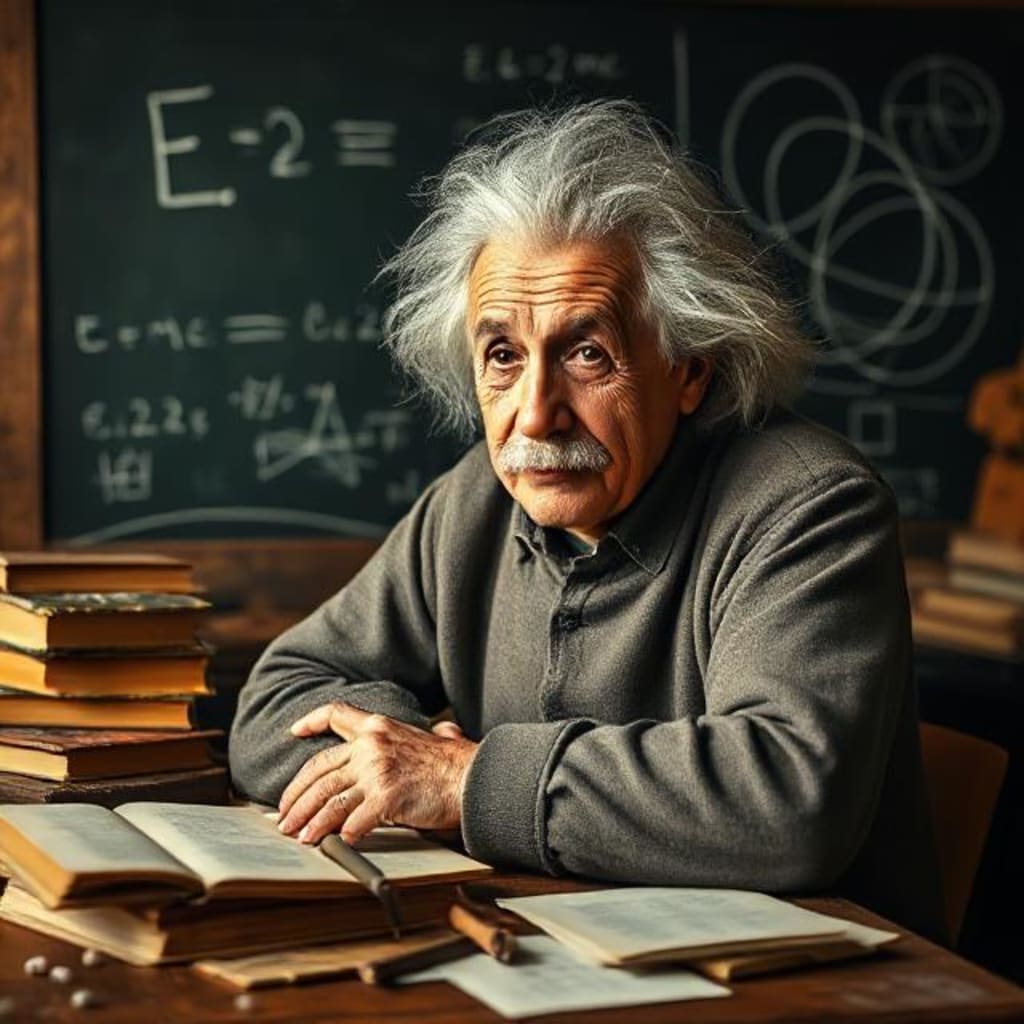
💡 The Hook
When people hear the word genius, one name almost always comes to mind: Albert Einstein. With his wild hair, kind eyes, and famous equation E = mc², he became more than a scientist—he became a global symbol of human intelligence itself.
But behind the legend was a man who struggled, doubted, loved, and believed in peace. Einstein wasn’t just a scientist; he was a storyteller of the universe.
---
🌍 Atmosphere: The World Before Einstein
The late 19th century was an era of discovery. Electricity was spreading, the telephone had just been invented, and science seemed to be answering everything. People believed the universe ran like a giant machine, predictable and fixed.
Then came Einstein—a young man from Germany who would shatter that certainty and replace it with something stranger, more mysterious, and infinitely more beautiful.
---
📚 Emotional Depth: The Struggles of a Young Genius
Einstein wasn’t always the icon we know. As a child, teachers thought he was slow. He spoke late, daydreamed in class, and hated rote memorization. Yet inside, his imagination was exploding.
At 16, he imagined himself riding alongside a beam of light—what would it look like? That playful thought experiment planted the seed for his most groundbreaking theories.
After graduating, he couldn’t even find a teaching job. Instead, he worked as a patent clerk in Switzerland. In that tiny office, surrounded by inventions, Einstein’s mind raced with bigger questions: What is time? What is space? What is reality itself?
---
🚀 The Rise of a Legend
In 1905—his “miracle year”—Einstein published four papers that rewrote physics. Among them was the equation that would make him immortal:
E = mc²
Energy equals mass times the speed of light squared.
With one stroke, Einstein revealed that matter and energy were two sides of the same coin. Stars shone, bombs exploded, and the universe itself pulsed with hidden power—all because of this relationship.
Scientists were stunned. The world had a new genius, though Einstein was still working his day job at the patent office.
---
🌌 The Theory That Bent Reality
Einstein didn’t stop there. In 1915, he unveiled his general theory of relativity—a theory so bold it seemed like science fiction.
He said gravity wasn’t a “force” at all. Instead, massive objects like stars and planets bent the fabric of space and time itself. Imagine the universe as a trampoline, with heavy balls sinking into it. Smaller balls rolled around those curves—that’s gravity.
It was tested in 1919, during a solar eclipse. Scientists observed starlight bending around the sun, just as Einstein predicted. Overnight, he became a global celebrity. Newspapers declared:
“Revolution in Science – Newton Overthrown!”
---
⚡ The Twist: A Genius at Odds with His Time
But fame came with challenges. Einstein hated being seen as a “prophet” and struggled with the darker uses of his ideas.
When physicists later developed the atomic bomb using his equation, Einstein felt guilt. Though he signed a letter warning about Nazi Germany’s nuclear ambitions, he remained a passionate pacifist, spending his life advocating for peace and warning against war.
Even in science, he wasn’t always right. He resisted quantum mechanics—the theory of uncertainty and randomness—famously saying:
“God does not play dice with the universe.”
Ironically, the future of physics proved otherwise.
---
✨ The Human Side of Einstein
Einstein wasn’t just equations. He loved music—playing the violin gave him joy and inspiration. He was witty, once saying:
“Imagination is more important than knowledge. For knowledge is limited, whereas imagination encircles the world.”
He was humble, often walking the streets without socks, avoiding fame’s trappings. And he stood for justice, speaking out against racism in America and fighting for civil rights.
---
🌠 The Legacy That Lives On
Einstein passed away in 1955, but his legacy never did. His theories still guide astronauts, GPS satellites, and black hole research. Every time you use Google Maps or scientists take a picture of a black hole, you’re witnessing Einstein’s mind at work.
But beyond science, he gave the world something deeper: the courage to wonder.
He proved that imagination, curiosity, and persistence could unlock secrets of the universe. That even a struggling student, once thought “slow,” could become the greatest thinker of the modern age.
---
❤️ Reader Connection
Einstein’s story is more than physics—it’s proof that genius isn’t about grades or approval. It’s about curiosity, passion, and daring to ask “what if?”
👉 What about you? If you could ask Einstein one question about life, time, or the universe, what would it be?
Drop it in the comments—I’d love to hear.
---
🏆 The Legacy of a Genius
Albert Einstein will forever be remembered not only as the man who bent time and space but also as the dreamer who reminded us:
“The important thing is not to stop questioning. Curiosity has its own reason for existing.”
And as long as humanity looks to the stars and wonders, Einstein’s spirit will live on.
---
About the Creator
Muhammad Riaz
- Writer. Thinker. Storyteller. I’m Muhammad Riaz, sharing honest stories that inspire, reflect, and connect. Writing about life, society, and ideas that matter. Let’s grow through words.
Keep reading
More stories from Muhammad Riaz and writers in Education and other communities.
Is Pharmacy Tech a Good Career Choice for 2026?
Given the recent shifts in the market and AI automation, people are now well aware that economic shakeups can drastically hinder their income sources. This is causing a lot of people to switch careers, and a majority of people are targeting healthcare roles. However, not all allied healthcare roles are created equal. Also, you can aim to become a medical assistant, but if you do not want to deal with patients, the ideal role for you is that of a Pharmacy Technician.
By Meaghan Howe4 days ago in Education




Comments
There are no comments for this story
Be the first to respond and start the conversation.