
Aims and Objective of Education
What are the aims of education?

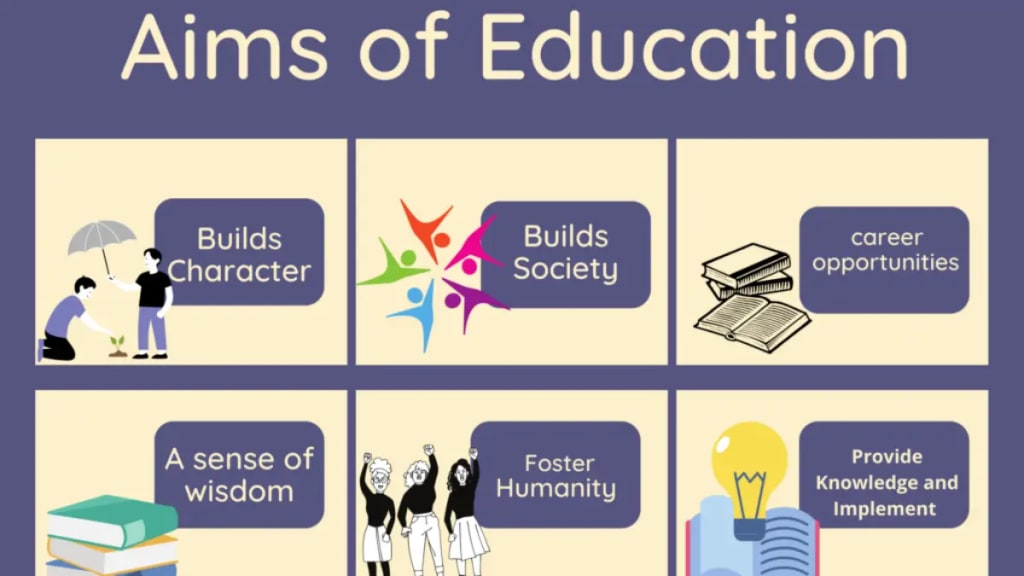
Different aims of Education
Life is very complex and complicated. But an aim in life can make the complex life simple and purposeful. Aims give us direction to work and without aim, destination, or objective life becomes incomplete and haphazard.
Individual has different interests, attitudes and needs. Every individual wants to achieve certain goals in life. But a clear-cut aim makes the road of life easy. Educational aims are varied. They have their different role in different fields. Some specific aims are listed below:
(i) Knowledge Aim
The aim of Education is the acquisition of knowledge, skills and attitudes. It helps to adjust properly in one’s own environment. Knowledge helps the man to overcome the nature and satisfy human wants. It links the teacher and taught with social situation. It helps with certain skills to live in a society as human being and civilized one. Philosophers and Educationists of the world believe in knowledge. It is the valuable asset of life, which helps the individual to overcome misery and problems of life.
(ii) Vocational Aim
Knowledge aim of Education is narrow by nature. The theoretical knowledge will never meet our basic needs of life. We need bread and butter to fill up our belly. We can get it if education is vocationalised. Gandhiji realized it in 1937 when he introduced Basic Education. Vocational aim develops the social efficiency of the individual. It reduces mental tension after completion of Education. Those who are lower, intelligence in vocational Education or training are a blessing for them. Realizing this aspect. Indian Education Commission (1964-66) introduces work-experience in the curriculum.
(iii) Character Building Aim
The Indian concept of Education believes in self-realization. Self-realization is possible through moral Education. So the individual should cultivate moral virtues or values which constitute character. Swami Vivekananda said, “We want that Education by which character is formed, strength of mind is increased, the intellect is expanded and by which one can stand on one’s own feet.”
(iv) Complete-Living Aim
The individual has various aspects to be developed. Every aspect of the personality is reflected in various activities to be performed. Education should help the individual to fulfill the various needs and necessities of life like self-preservation, fulfilling necessities of life, rearing and bearing of children, performing civic responsibilities and utilizing his leisure time properly.
Firstly, the individual must know the art of self-preservation. Secondly, Education should enable to him to earn his living. Thirdly, he should know how to take care of his own children. Lastly, he must have the idea how to utilize the leisure hours properly in a profiting manner.
(v) Harmonious
Development of the personality aim- Gandhiji said, “By Education, I mean an all-round drawing out of the best in the child and man-body, mind and spirit.” The meaning itself indicates to develop all-round aspects of individual-physical, intellectual, social and spiritual. All these aspects of the individual should be harmoniously developed. True Education is development of 3H’s instead of 3R’s.
The development of Head, Heart and hand of an individual makes him happy.
(vi) Democratic Aim of Education
One of the important aims and objective of Education suggested by Secondary Education Commission (1952-54) is to develop the democratic citizenship. India is a democratic country. Even citizen must have to realize the duties and responsibilities carefully. So the aim of Education is to train carefully the future citizens. Training should be provided to develop the following qualities of the individual.
(i) Capacity for clear thinking.
(ii) Receptivity of new idea.
(iii) Clarity in speech and writing.
(iv) True patriotism.
Further the democratic aim of Education develops vocational efficiency, personality and leadership quality.
(i) Increasing productivity.
(ii) Developing social and national integrity.
(iii) Making education modernized.
(iv) Cultivating of social, moral and spiritual values.
About the Creator
Keep reading
More stories from Rasel Ahmed and writers in Education and other communities.
Here are 10 easy ways to earn money online
In today's world, it's easier than ever to make money from the comfort of your own home. Whether you're a stay-at-home parent, a student looking to earn some extra cash, or just someone who wants to make some money on the side, there are plenty of ways to earn money online.
By Rasel Ahmed3 years ago in Futurism
Was Alexander the great really that great?
Order, order! Who do we have on the stand today? Alexander... the Great, eh? Well, what’s so great about him? Your honor, the better question is, what's not great about him? He was the King of Macedon and considered a living demigod by Egyptians and Greeks alike. He conquered Persia when it was one of Earth's largest empires. And he was a thoughtful student of Aristotle, creative enough to untie the impossibly tight Gordian knot by cutting it in half. The Gordian knot is a myth— just like the countless other stories invented to enhance Alexander’s legend!
By Munesh Yadav3 days ago in Education
The 1793 Chain Cent: America's First Large-Scale Copper Coin
Holding a 1793 Chain Cent is like holding the first argument of a new nation. More than just America’s first mass-produced penny, this coin is a piece of history that sparked public debate, fueled by a design many found utterly wrong. Its story—from a chaotic mint to a collector's dream—explains why it remains one of the most coveted pieces in all of American numismatics. This guide will walk you through its turbulent birth, teach you to spot the tiny detail that can mean a fortune, and explain what truly makes it valuable.
By Laura Bennett7 days ago in Education
Center Stage with Paul Stewart
*** I'm keen to republish the interviews I did for my series with Vocal creators. It's been a few years and I thought it might be nice to revisit these wonderful conversations. I'll be releasing them one at a time for a few weeks/months.
By Heather Hubler3 days ago in Interview



Comments
There are no comments for this story
Be the first to respond and start the conversation.