
AI Vocal Remover Technology
Reshaping the Soundscape of Music 🎙️
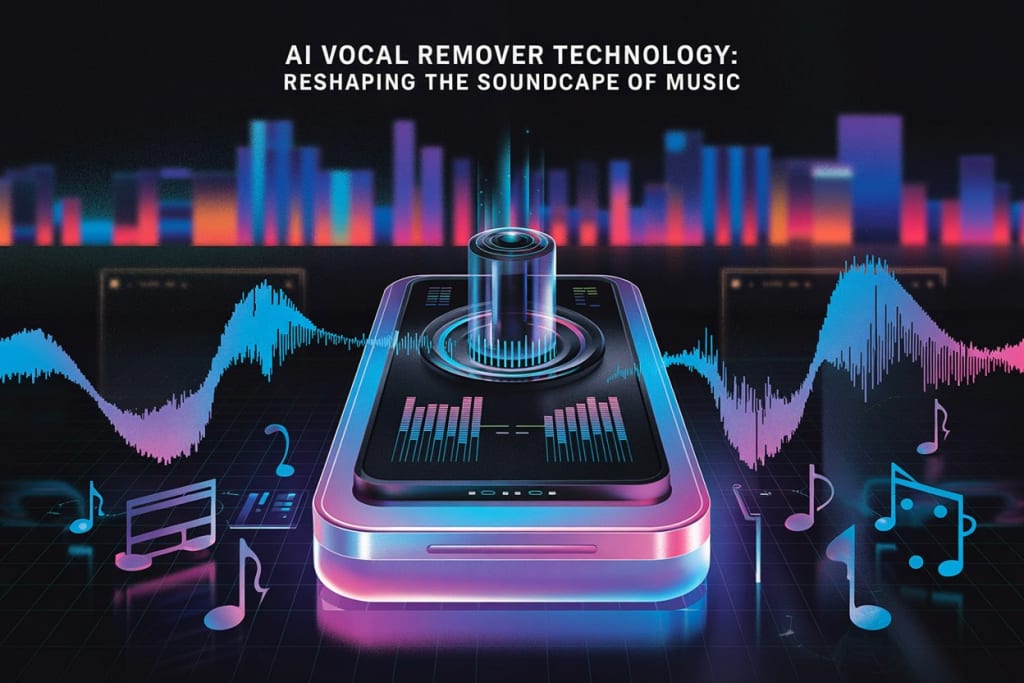
Artificial intelligence (AI) has infiltrated every segment of the creative universe — from visual arts to writing, and now more than ever, into the realm of audio. One of the most exciting and useful innovations to be born from this crossover is AI Vocal Remover Technology. Specially designed to separate vocals from the instrumentals in music tracks, this particular tool is changing the way that musicians, producers and even everyday users engage with sound.
We will explore how this technology works, its applications, benefits, and the possibilities it brings for the music industry and beyond.
What Is AI Vocal Remover Technology? 🎧
AI vocal remover technology, in a nutshell, is the software driven by machine learning algorithms that can extract or remove vocals from your mixed audio track. This enables users to pull out raw instrumentals (for karaoke or remix) or clean vocal stems (to be used in mashups, remixes and vocals editing)
Unlike basic techniques, such as phase cancellation or EQ filtering — which tend to leave muddy leftovers or diminish the overall sound — AI-backed systems “learn” how vocals sound by studying thousands of songs. They then use that knowledge to properly isolate elements in a track, often quite well.

⚙️ How Does It Work?
At the core of AI vocal removal lies a collection of advanced deep learning models, usually trained on extensive datasets filled with multitrack music recordings. These models are crafted to:
- Analyze the frequency spectrum of a song
- Identify unique temporal and harmonic patterns that are characteristic of vocals
- Recognize instruments and separate them from other audio elements
Many vocal removers rely on advanced neural networks, such as Convolutional Neural Networks (CNNs) or U-Net architectures, to analyze audio spectrograms. These models work by pinpointing which sections of the spectrogram correspond to vocals and which ones are for instruments, allowing them to split the audio into separate files—commonly known as "stems." The whole process can be completed in just a few seconds, but it really depends on how complex the track is and the strength of the algorithm being used.
🎼 Use Cases: Why It Matters
The ways we can use AI vocal removal are not only varied but also really exciting:
🎤 Karaoke and Personal Entertainment
One of the most popular applications is karaoke. Users can easily upload their favorite tracks to an AI vocal remover and get an instrumental version in an instant, making it perfect for belting out tunes at home or during a fun gathering with friends.
🎧 Music Production and Remixing
Producers and DJs can tap into isolated vocals to whip up remixes, mashups, or bootlegs, all without having to rely on original stems from record labels. This really expands the creative horizons for artists, no matter their experience level.
📚 Education and Practice
Musicians picking up a new instrument can easily isolate backing tracks, allowing them to practice without any distractions. Meanwhile, vocalists can hone in on their parts, giving them the focus they need. Music teachers can also benefit by using tracks with the vocals removed, making their lessons even more effective.
🧼 Audio Restoration
When it comes to restoring audio in films and archives, AI plays a crucial role in enhancing old recordings by eliminating unwanted sounds and separating voiceovers from distracting background noise.
🔍 Top Tools and Platforms
A number of platforms have stepped up as the frontrunners in this area:
LALAL.AI – Renowned for its clean output and ability to handle batch processing.
Moises.ai – Provides real-time editing and is mobile-friendly.
Spleeter by Deezer – An open-source option that’s a hit among tech enthusiasts.
Vocal Remover.org – A browser-based tool that’s super easy for casual users.
Adobe Podcast AI – Enhances vocal quality during podcast post-production.
These tools typically allow for stem extraction, not just for vocals, but also for drums, bass, piano, and much more.
⚠️ Limitations and Challenges
AI vocal remover technology is undeniably impressive, but it’s not without its quirks. The effectiveness of this tech really hinges on the quality and intricacy of the original audio. For instance, tracks that are heavy on reverb, effects, or have multiple vocal layers might still end up with some “ghost” artifacts or odd distortions. Plus, if you push the processing too far, you might end up with a sound that feels robotic or just plain unnatural.
That said, the good news is that ongoing updates and improvements to the models are gradually tackling these challenges.
🔮 What’s Next?
As we look to the future, it’s clear that AI vocal removal will become a standard feature in digital audio workstations (DAWs), streaming services, and even during live shows. Here’s what we can expect:
- Real-time separation of vocals and instruments
- Complete control over stems for remixing in music apps
- Mobile-friendly solutions that deliver high-quality processing
- Enhanced accessibility for music creation
This shift towards more accessible music tools will empower a whole new wave of creators—enabling anyone with a smartphone to remix a hit song or jam along with a professional-quality backing track.
🎬 Final Thoughts
AI vocal remover technology isn’t just a fun gadget—it’s a game changer in the way we interact with music. Whether you’re a seasoned music producer, a karaoke lover, or just someone diving into sound design, this tool turns once-challenging tasks into something quick, easy, and available to everyone. As this technology keeps evolving, the only thing holding you back is your imagination.
About the Creator
Keep reading
More stories from Abdul AL Noman and writers in Education and other communities.
Creating a Higher Education Legacy in Monterey
Not Known for Colleges Picturesque Monterey, California is not known as a college town. Instead, its recent fame was that of being the old stomping grounds for John Steinbeck and the current location of a world-class marine aquarium.
By Dean Traylor6 days ago in Education
Winning Tactics for Building Wealth in Real Estate Investment
Before making any real estate purchase, the most critical step is thorough research. Understanding the local market is more than just browsing listings—it's about identifying economic drivers, population growth, rental demand, and future development plans. By analyzing these trends, investors can identify the areas with the greatest potential for long-term growth and profitability. It’s essential to know which property types are in demand and which tenants or buyers are actively looking for in that specific region.
By Michael O'Sullivan Hampton2 days ago in Education




Comments (1)
Did an amazing work.