
Agile vs Waterfall: Which Methodology Will Lead Your Startup to Success?
Agile vs Waterfall

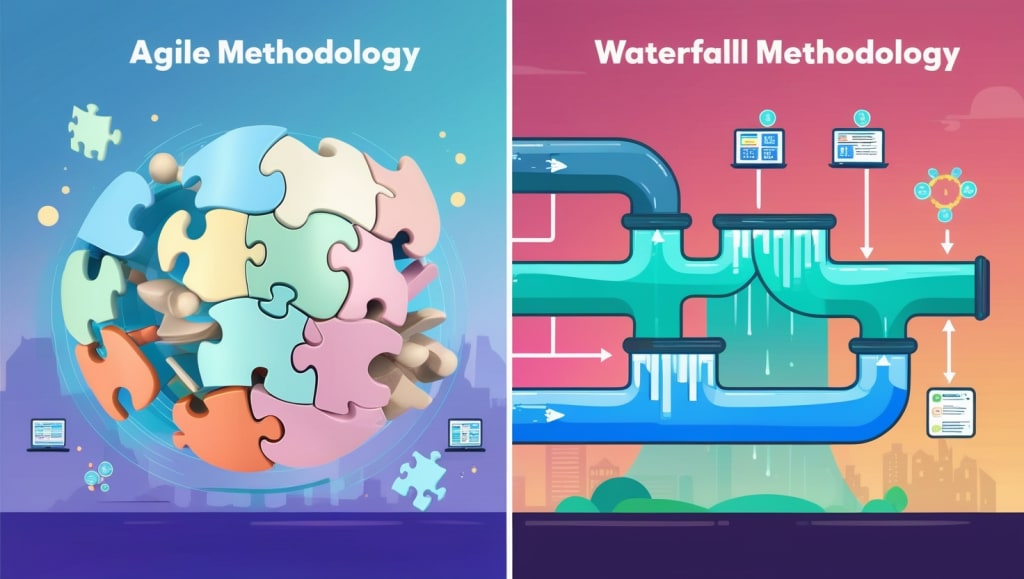
Imagine you’re a startup founder at a crossroads. Your product idea is strong, and your team is eager, but there’s a looming question that could make or break your launch: How should we build this thing? This is the tech world’s version of picking a path in the woods—Agile or Waterfall?
Choosing the right project management methodology isn’t just about logistics—it’s a strategic decision. It impacts your speed to market, how you handle change, team dynamics, and customer satisfaction. Agile and Waterfall represent two very different philosophies for developing products, and the choice between them can define your startup's trajectory.
So, which one’s the golden ticket to startup success? Let’s break it down.
What is Agile Methodology?
Agile development is more than just a buzzword—it’s a mindset born from the frustrations of rigid, traditional development. Introduced in the early 2000s, Agile prioritizes flexibility, collaboration, and continuous feedback over meticulous planning and fixed processes.
Instead of locking into a full blueprint upfront, Agile encourages iterative development. Work happens in short bursts called sprints, where teams build, test, and adjust based on user and stakeholder feedback. This approach is perfect for dynamic environments where requirements evolve rapidly.
Popular Agile frameworks include:
- Scrum
- Kanban
- Lean
What is the Waterfall Methodology?
Waterfall is the traditional, structured approach to project management. It follows a linear, sequential process where each phase must be completed before moving to the next. This includes:
- Requirements Gathering
- System Design
- Implementation
- Testing
- Deployment
- Maintenance
Think of the Waterfall approach as constructing a building—you wouldn’t start pouring concrete without finalized blueprints. Waterfall is best suited for projects where requirements are stable and clearly defined and where precision, compliance, and documentation are paramount.
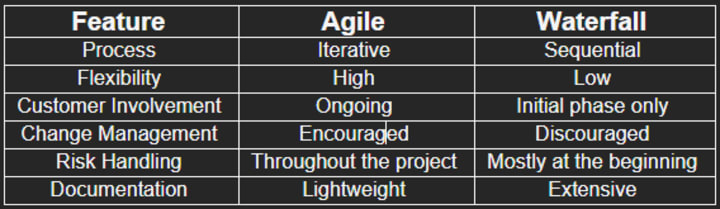
Agile vs. Waterfall: Core Differences
Why Startups Gravitate Toward Agile
Startups thrive in uncertainty. They’re racing to validate ideas, enter markets, and get early traction. Agile is tailor-made for this environment:
- Quick Feedback Loops – Release MVPs fast and learn what users actually want.
- Flexibility to Pivot – Make changes on the fly without reworking the entire project.
- Collaborative Culture – Cross-functional teams thrive on constant communication.
Reduced Risk – Issues surface early and are resolved incrementally.
When Waterfall Might Be the Right Fit
Despite Agile’s appeal, Waterfall still has strategic advantages for building a mobile app—especially for compliance-heavy, fixed-scope projects. Consider these situations:
- Developing a medical app with regulatory approvals.
- Building hardware products where prototyping is expensive.
- Creating financial tools with strict audit requirements.
Cost, Team, and Customer Implications

Cost and Resources
Agile offers faster Software development and iterative improvements, often leading to earlier market entry. However, without scope discipline, it can spiral into increased costs. Waterfall, while potentially slower to launch, ensures cost predictability and resource planning.
Team Dynamics
Agile thrives in collaborative, flat-structured teams that value autonomy and quick decisions. Waterfall, by contrast, suits hierarchical structures, where clarity in roles, milestones, and documentation is essential.
Customer Involvement
Agile keeps customers engaged throughout. Frequent check-ins and feedback loops ensure alignment. Waterfall, with its limited touchpoints, may risk delivering something that no longer matches the client’s needs by the time it launches.
Risk Management and Scalability
Agile spreads risk out by testing early and often. When things go wrong, they’re caught quickly. Waterfall bets on getting things right from the start, effective when you can predict everything upfront, risky when you can’t.
Scalability also favors Agile. Frameworks like SAFe or LeSS allow Agile practices to grow alongside your team, making it ideal for fast-scaling tech startups. Waterfall can scale too—but slowly and with more coordination challenges.
What About a Hybrid Approach?
Some startups are blending both models in what’s often called “Wagile”. This hybrid model combines Waterfall’s planning discipline with Agile’s iterative execution.
For example:
- Use Waterfall for initial compliance documentation and architectural planning.
- Use Agile sprints for feature development and UI testing.
Hybrid models work well when you need structure but still want to adapt and innovate quickly.
How to Choose: A Quick Checklist
Choose Agile if:
- You need to reach the market fast.
- Requirements are likely to change.
- Your team is collaborative and self-driven.
- You’re building SaaS, web, or mobile products.
Choose Waterfall if:
- Your scope is fixed and well-documented.
- You’re in a regulated industry.
- You need clear documentation for stakeholders.
- Your team prefers structured workflows.
Why Startups Gravitate Toward Agile
Startups thrive in uncertainty. They’re racing to validate ideas, enter markets, and get early traction. Agile is tailor-made for this environment:
Quick Feedback Loops – Release MVPs fast and learn what users actually want.
Flexibility to Pivot – Make changes on the fly without reworking the entire project.
Collaborative Culture – Cross-functional teams thrive on constant communication.
Reduced Risk – Issues surface early and are resolved incrementally.
Khired Networks is a reliable MVP development company offering bespoke software solutions using an Agile approach, helping startups accelerate development, respond to market changes, and build scalable digital products.
Conclusion
Choosing between Agile and Waterfall isn’t about picking a winner—it’s about aligning your mobile app development services approach with your startup’s vision, structure, and growth ambitions. Rather than forcing your team into a rigid model, focus on what supports your product goals, team strengths, and customer needs. In many cases, blending both approaches can offer the flexibility of Agile with the foresight of Waterfall.
Success lies not just in how you build—but in how well your methodology supports change, encourages collaboration, and drives value.
About the Creator
Steve Smith
Steve is a professional digital marketer and currently working as an SEO Expert in the Khired Networks which is a saas development company.
Keep reading
More stories from Steve Smith and writers in Education and other communities.
From Despair to Hope: How Animal Rescue Efforts Rebuild Broken Lives
Animal rescue efforts stand as a powerful response to suffering that often goes unseen. Across towns, cities, and rural areas, animals face neglect, abandonment, injury, and fear every day. Many are left without food, shelter, or medical care. Others are harmed by abuse or natural disasters. Without help, their future is uncertain. Through patience, care, and action, animal rescue efforts transform despair into hope and give animals the chance to heal and live safely.
By Brenda McGrane5 days ago in Education
How to Gain Real Work Experience in Wealth Management
Breaking into wealth management can feel confusing at first. Many roles ask for experience, but it is not always clear how to get it. The good news is that real wealth management work experience comes from action, not just titles. With the right approach, you can build skills, credibility, and confidence before landing a full-time role.
By John Lennox Cummings4 days ago in Education
So You Decided To Become a Nurse Practitioner:
So you decided to become an "Advanced Practice" nurse. Congratulations!... is what I would say if this was a good idea. Grad school? In this economy? What were you thinking? Likely it was something along the lines of either 1) “I've seen these other chucklefucks do it— Why can't I?” or even 2) “I've got a nice career, I should shake it up. I miss feeling like I have no clue what I'm doing.”
By Sandor Szabo2 days ago in Fiction


Comments
There are no comments for this story
Be the first to respond and start the conversation.