
A Nutty Note: A Short Overview on Plantar Fasciitis
I suggest a tub of peanuts for this read


Wow, I miss college already. Yes, it’s only been a few months, but I miss the nights I would study with a box of Planters Peanuts next to me. And, yes, I walked around campus with an entire canister of Planters Peanuts in my bag. I love Planters!
Peanuts are packed with protein and a fun salted snack (I prefer the salted peanuts); these little nuts keep me energized and on my feet! However, it is improbable that Planters Peanuts have single-handedly prevented me from getting Planter… sorry, plantar fasciitis; in fact, plantar fasciitis is quite unrelated to Planters - besides the fact that plantar and Planters sound similar - but I’ve better understood the condition through my lovely peanuts.
I’m not an expert gardener, but I know that peanuts grow underground and sprout from the soil.
Suppose we remember that these Planters peanuts originate from underground. In this case, it may make it a little easier to remember that “plantar” refers to the bottom of an individual’s foot - the plantar region is “underground!” Like peanuts spring up from below the ground, the plantar region is the sole of the feet and is touching the ground! Get it… peanuts from the soil… the sole of your feet… plantar…Planters… It’s kinda poetic!
But what about fasciitis? What does that mean?
Fasciitis can be further broken down into “fascia” and “itis.”
The “fascia” is a giant interconnected web covering organs, muscles, and structures throughout the body. In a sense, the “fascia” is a layer that provides wrapping to hold and move said parts within the body (Johns Hopkins Medicine, n.d.). The fascia is made so that it is one continuous network; while the heart and an arm muscle can have their own fascia wrapping, the whole web of fascia blends together to allow for communication between parts of the body (Cleveland Clinic, 2022). Yes, everything is wrapped by fascia. Our brain? Yes. Our skin? Yes. Our blood vessels? Yes! All our bones? Yes!! No, I won’t list every part of the body, but the key is that fascia wraps EVERYTHING in our body (Bordoni et al., 2020). Notably, the fascia has an elastic characteristic - it stretches as a person moves to provide structure, support, and flexibility (Marks, 2023). So, typically, the plantar fascia works behind-the-scenes, offering arch support and providing shock absorption when we run or walk, helping cushion our bones and muscles from taking all the impact all the time - essential for avoiding injury (Buchanan and Kushner, 2024)!
But…. we are talking about fasciitis, not just the fascia. You may have heard of other “-itis” words - conjunctivitis, tonsillitis, arthritis, and/or bronchitis - these are all inflammations: “-itis” means it is inflamed, stressed, or irritated. It is not a good thing.
Plantar fasciitis means that the fascia, the interconnected web at the bottom of the foot, has become inflamed. While this inflammation can occur anywhere in the plantar region, it is most common in the heel region (Mayo Clinic, 2025).
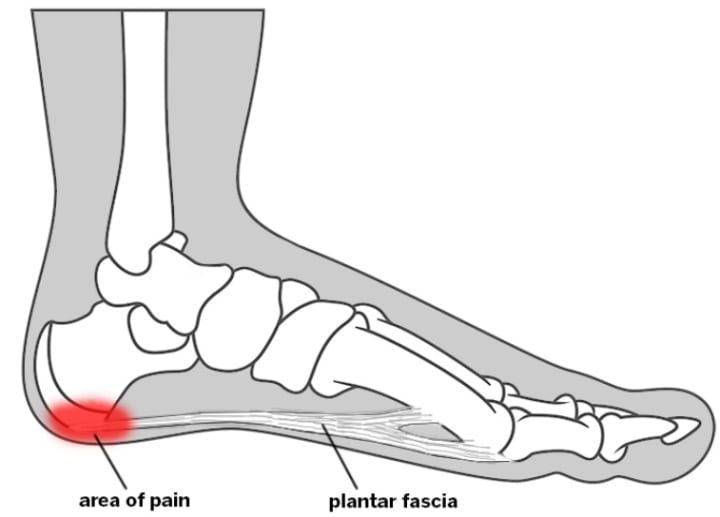
What causes inflammation?
Unfortunately, if the fascia is damaged or overused, there is a high probability that the plantar fascia will be inflamed. When we exercise, run, or walk, we are constantly exerting pressure on our fascia.
While our fascia is meant to absorb shock, sometimes, the pressure can become overbearing.
If you recall, the fascia is elastic - it’s like stretching a thick rubber band! In a way, you can think of the plantar fascia as a thick rubber band that layers the bottom of your foot. Take a rubber band and keep stretching or pulling it, even though you think it's at its limit. Eventually, too much rubber band tugging will cause it to have microtears - tiny rips - which lead the whole band to finally snap. The snapped rubber band is fasciitis, leading to irritation and inflammation. So yes, our fascia can normally keep up with our daily movements, but if it becomes overused or overstretched (rubber band has snapped), then we will have plantar fasciitis (Health, 2022).
Sadly, there are numerous risk factors and activities that can contribute to this inflammation and thus increase the likelihood of developing plantar fasciitis. Two key factors I want to focus on are arch shape and muscle tightness.
Arch Shape:
Between the Golden Gate Bridge and the arch of the McDonald’s M, it’s pretty easy to tell that the McDonald’s M arch is high-arching and the Golden Gate Bridge is low-arching. Are they both beautiful engineering constructs? Absolutely! Like the arches and bridges of the world, we all have different foot arches, which come with their own architecture. In fact, we have Golden Gate feet and McDonald’s feet! … except they aren’t called that - it’s just one way I can remember that we have high and low arches. The “Golden Gate feet” are known as flat feet; individuals with flat feet have low arches. As for people with “McDonald's feet,” their feet are “hollow” and known as high-arching. Both types can be concerning in regards to plantar fasciitis.
When we walk, jog, or run, we have a gait - a natural footing and way of movement. Not everybody takes steps in the same way, and that is perfectly okay! Specifically, two important movements are pronation and supination, which are kind of like checks and balances to stabilize our gait (Donatelli, 1985). While this topic has many levels, I want to give the larger idea: pronation (of the feet) is the tendency of the feet to lean/roll inward, while supination (of the feet) is the tendency of the feet to lean/roll outward (New York’s Best Orthopedic Surgeons [NYBJ], 2018).
I know these words may be difficult to remember, but I think of the word pronate/pronation as “pour IN” or “pouring IN” to know the foot is leaning INward. As for supinate/supination, I think of “scooping OUT” or “soup OUT.”
Normally, supination and pronation do not create problems, but overpronation and oversupination do. Our feet have to be like Goldilocks - not too supinated, not too pronated, but just right! However, this may be hard to prevent when people have low- or high-arched feet.
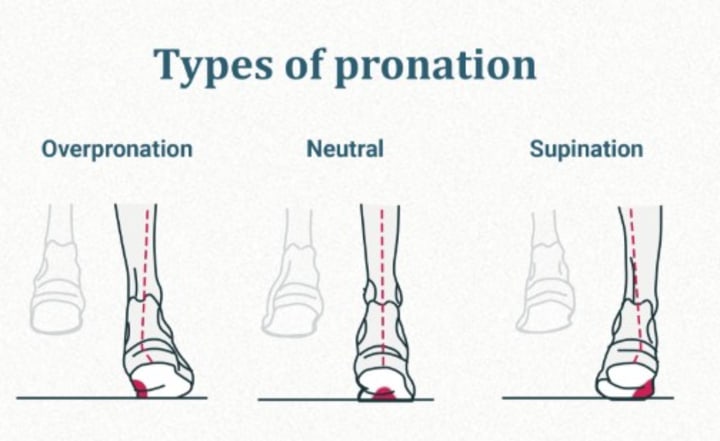
Low Arch: When a person has low arches, there is a tendency for the feet to overpronate; overpronation will stretch the plantar fascia more than it is capable of (NYBJ, 2018). The strain from overpronation accrues, and when the fascia can no longer continue acting as a shock absorber for low-arch footing, plantar fasciitis will develop. It’s fun to remember (over)PROnation happens with LOW arched feet - it rhymes! Low, Pro. Pro, Low.
High Arch: You’re like a ballerina - always on your toes and heels of your feet! I do not mean literally, but in a way… it’s kinda true! Since there is a steep “bridge,” all the pressure and weight will be distributed on the ball and heel of the foot (Elsalamony, 2020). The ball of your foot is like the “front end” of your foot, right below your toes, while the heel is the back of your foot.
Just like how individuals with low arches have plantar fascia strain, plantar fascia in individuals who have high-arched feet also experiences too much tension and pressure. However, high arches tend to result in oversupination (Elsalamony, 2020).
The key point is this: having a high or low arch increases the chance that our body weight and force will be improperly distributed as we take steps. Over time, the plantar fascia will rip apart from this awkward footing. Okay, I’ll admit – maybe “rip apart” sounds a little gruesome. I’m sorry!
Muscle Tightness:
Don’t worry—we won’t be ripping apart muscles here. So, what are we talking about in this case? When we talk about muscle tightness concerning plantar fasciitis, we are primarily referring to one muscle: the gastrocnemius (YaleMedicine, n.d.). I totally understand if the word is one you have never heard of. Just remember that the gastrocnemius (pronounced gas-trok-knee-me-us) is one of the two main muscles in both your calves, which are found in your legs.
When this muscle becomes tight, we have restricted movement; it’s just like a water bottle cap put on too tightly - it’s so hard to move it! Due to the tightness, when we try to move our calves, the part of our body which “propels” our legs, we will have a harder time flexing our feet upwards (ankle/toes bending upwards).
Why specifically pointing upwards?
It would be wrong to ignore that the gastrocnemius affects our flexibility of pointing downwards as well. However, tightness mainly impacts pointing upwards.
And honestly, it helps to play around with the word “gastrocnemius” - gastrocnemius, gastroKNEEmeus, gastroHEELi us. I don’t remember all my nursery rhymes, but I am so glad I learned how to rhyme - it helps me learn a lot!
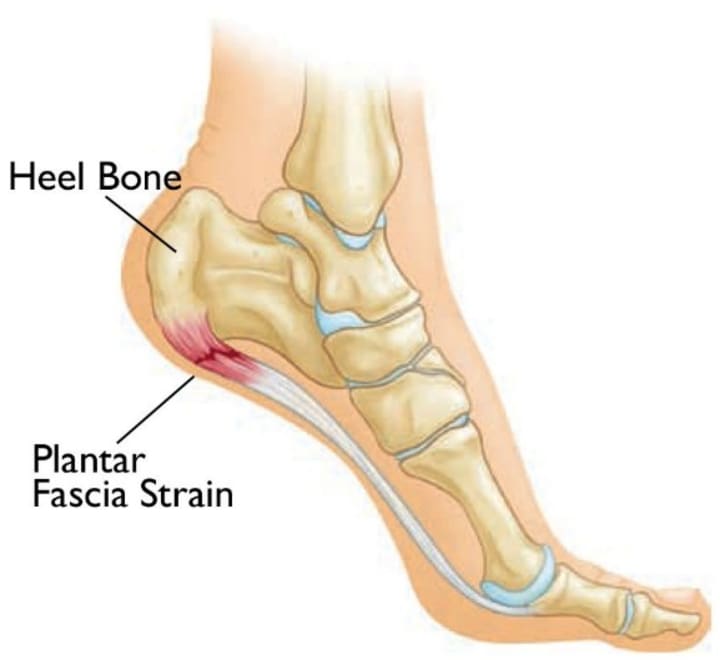
I wanted to point out the “-kneemeus” and “-heelius” rhyme scheme because the gastrocnemius connects from the knee down to the heel (Cleveland Clinic, “Calf Muscle: Anatomy, Function and Common Conditions”). When walking or running, our knees bend and extend straight to provide that “push-off” to lead to the next step. When our legs are fully straight, there is already a natural tightness. Adding another layer of stiffness makes the push-off harder. Therefore, each step comes with strain since the ankle has difficulty bending up and … yep… the heels can feel like they are being slammed down; the mobility is cut short, making it so the steps are not taken as smoothly. Over time, that heel-banging impact can lead to plantar fasciitis (YaleMedicine, n.d.).
Oh, wait–did I mention smooth? Like Skippy’s smooth peanut butter? There can’t be a Skippy’s Fasciitis… oh wait, smooth would just mean a happy, healthy plantar fascia. Oh, gosh, I’m going nuts–quite literally!
About the Creator
Keep reading
More stories from Sanskar Shah and writers in Education and other communities.
Frappés to Facts: A Quick Introduction on Type I and Type II Diabetes
As I sat in my car drinking my large McDonald's Mocha Frappé, I had nothing better to do than see how much sugar there was; frankly, I should not have looked - there were over 70 grams of added sugar. Looking at the shake like a disappointed dad, I did nothing but continue loving it. All 70+ grams of sugar were consumed. In justification, I convinced myself that I needed the entire frappé to function - it’s like how I fully filled up my car with gas. Same difference. And, so, as I drove home, I led with the mentality that I was a car that needed a full tank.
By Sanskar Shah10 months ago in Education
TUS NUA - ch 49
TUS NUA – ch 49 New Beginnings – Mia and Midnight (*)(*)(*) As Mia spoke on the phone to Ali’s sister, Ellen, Finola slipped quietly away and walked to the stream behind Tus Nua. Carefully, she put a block on her family so no one could know what she was about to do.
By Margaret Brennan5 days ago in Fiction




Comments
There are no comments for this story
Be the first to respond and start the conversation.