
A Journey Through the Roof of the World"
The Road to Pamir

Chapter 1: The Decision
It all started with a photograph. A winding road surrounded by towering snow-capped peaks, with a solitary yak grazing in the distance. The caption read, "The Pamir Highway: One of the World's Highest Roads." I didn’t think twice. I closed my laptop, booked a one-way ticket to Dushanbe, Tajikistan, and told my boss I was taking my first ever solo trip.
I wasn't a seasoned traveler. My past vacations were short and predictable: beach resorts and European cities. This was different. I was about to journey through the ancient Silk Road, across high-altitude deserts, forgotten villages, and mountain passes that kissed the sky. The Pamir Mountains had called my name.
Chapter 2: Dushanbe to Khorog
Dushanbe, the capital of Tajikistan, greeted me with sun, Soviet-style buildings, and smiles from strangers. The language barrier was tough, but pointing and Google Translate worked wonders. After one night, I caught a shared 4x4 Jeep bound for Khorog, a city tucked deep into the Pamirs.
The road twisted like a serpent, and the higher we climbed, the more surreal it became. We followed the Panj River, which separates Tajikistan from Afghanistan. I could see Afghan villages across the water, children waving as we passed. The river raged between us, but life mirrored ours on the other side: same stone houses, same dusty roads, same sky.
It took 16 hours to reach Khorog. My legs were cramped, but my heart was wide open. I had never felt so far from everything and yet so alive.
Chapter 3: Into the High Desert
Khorog was a peaceful little town surrounded by rugged cliffs. I rested there a day, drank green tea in teahouses, and wandered local markets. Then I continued east toward the Wakhan Valley and the real heart of the Pamirs.
My new driver, an ex-soldier named Rahmat, spoke broken English and had stories carved into his weathered face. As we bumped along gravel roads, he told me about Soviet days, border conflicts, and harsh winters that isolated villages for months.
We passed hot springs, Buddhist stupas, and ancient fortresses. We stayed in homestays with local families who offered us bread, yak milk, and mountain hospitality. At night, we slept under heavy quilts while the wind howled outside.
One morning, I woke before sunrise in Langar, a remote village near the Afghan border. I climbed a hill behind the homestay and watched the first light spill over the Hindu Kush mountains. The silence was sacred.
Chapter 4: The Highest Pass
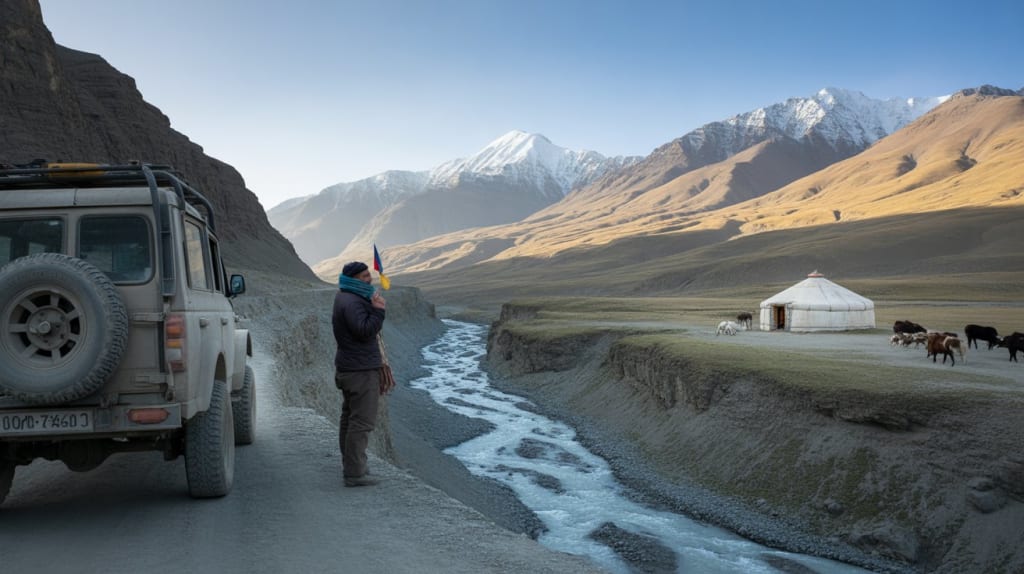
The road climbed steadily as we entered the Murghab Plateau, an eerie high-altitude desert that felt like Mars. Elevation: 4,000 meters. Air: thin. Landscape: endless. Herds of yaks wandered freely. Children rode donkeys across vast plains. Life here was simple, elemental.
We approached Ak-Baital Pass, the highest point of the Pamir Highway at 4,655 meters. My head pounded from the altitude, and my breath came in gasps. But the view was unreal. Snowy peaks reached up like frozen flames, and below us stretched the road I'd traveled, like a silver ribbon.
Rahmat took a photo of me holding a small flag: "You made it," he said. I smiled through chattering teeth. I'd never been prouder of myself.
Chapter 5: A Surprise in the Desert
In Murghab, the largest town in Eastern Tajikistan, I met a group of Kyrgyz nomads selling handmade wool rugs. One woman invited me to visit her yurt camp for tea. I accepted, and Rahmat took me up a nearby hill where several white yurts stood beneath the stars.
Inside, it was warm and filled with laughter. We sat on carpets, drank salty milk tea, and ate plov (rice and meat). They sang songs I didn’t understand, but I clapped along anyway. A little girl gave me a bracelet she had woven herself.
That night, I slept in a yurt for the first time, warmed by a small coal stove and humbled by the kindness of strangers.
Chapter 6: Lake Karakul and the Way Home
Our final stop was Lake Karakul, a jewel at the edge of the world. The lake's turquoise water glistened under a bright sun, surrounded by wind-blown rocks and snow-frosted mountains. At over 3,900 meters, it was the highest lake I had ever seen.
There were no trees, no birds, no people in sight. Just me, the lake, and the wind.
I sat there for hours, thinking about how far I had come—not just in kilometers, but in courage. A few weeks earlier, I had been afraid to travel alone. Now I was here, at the top of the world.
When we finally crossed the border into Kyrgyzstan and reached Osh, the journey was over. But something inside me had changed. I was no longer a tourist. I had become a traveler.
Epilogue: Why the Pamirs Changed Me
Travel isn't just about seeing places. It's about unlearning fear, learning humility, and discovering parts of yourself that only rise to the surface when you're lost, cold, or overwhelmed by beauty.
The Pamir Highway didn’t just show me breathtaking landscapes. It showed me resilience—in the people, in the mountains, and in myself.
I left a piece of my heart in those highlands. But I brought back something greater: a story I will tell for the rest of my life.
About the Creator
Farzad
I write A best history story for read it see and read my story in injoy it .
Navigating Economic Uncertainty with Strategic Property Investment
Economic uncertainty has become a constant presence in today’s financial landscape. From inflation and rising interest rates to global conflicts and supply chain disruptions, investors are increasingly concerned about protecting their assets and ensuring long-term financial security. Amid this volatility, real estate remains one of the most dependable investment vehicles. Its tangible nature, consistent income potential, and historical resilience make it a powerful tool for weathering financial storms.
By Accrue Real Estateabout 9 hours ago in Education
Scaling a Business by Doing Less, Not More
Many business owners believe growth comes from adding more. More services, more markets, more tools, and more staff. While this sounds logical, it often leads to confusion and burnout. Scaling a business becomes easier and more sustainable when leaders choose to do less, but do it better.
By Darrell Hulsey7 days ago in Education


Comments
There are no comments for this story
Be the first to respond and start the conversation.