
Sapiens: A Brief History of Humankind
Human evolution, culture, civilization, and power

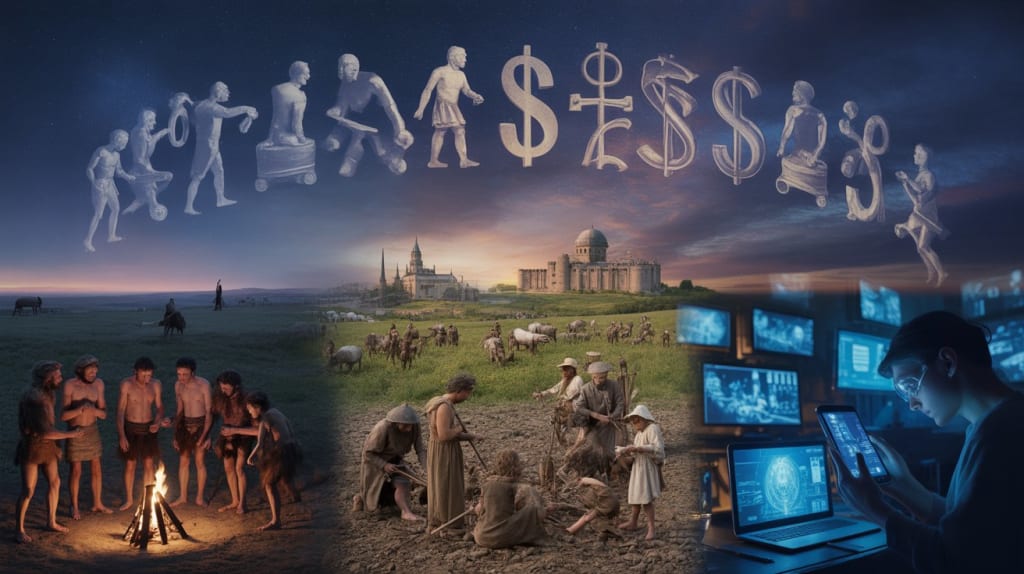
Book Review: Sapiens – A Brief History of Humankind by Yuval Noah Harari
Genre: History / Anthropology / Non-fictionPublished: 2011Pages: 443Language: English
Introduction
"Sapiens: A Brief History of Humankind" by Yuval Noah Harari is an extraordinary exploration of human history, offering deep insights into how Homo sapiens rose to become the planet's dominant species. Harari, a historian and philosopher, blends history, biology, economics, and sociology into a narrative that is both engaging and thought-provoking. First published in Hebrew in 2011 and later translated into dozens of languages, "Sapiens" has since become a global bestseller.
In this review, we will dive into the key themes, major arguments, strengths, and criticisms of the book. This 1200-word review will serve as a detailed analysis for readers who wish to understand not just what the book says, but why it matters.
The Structure and Central Themes
"Sapiens" is divided into four main parts, each corresponding to a major era in human development:
The Cognitive Revolution (circa 70,000 years ago)
The Agricultural Revolution (circa 12,000 years ago)
The Unification of Humankind (the last few thousand years)
The Scientific Revolution (beginning around 500 years ago)
Harari's central thesis is that Homo sapiens became dominant not through brute strength or individual intelligence, but through our unique ability to create and believe in shared myths. These shared myths allowed for large-scale cooperation, forming the foundation for everything from religion to empires to capitalism.
The Cognitive Revolution
The first section explores how our ancestors went from insignificant primates to rulers of the earth. Harari credits the "Cognitive Revolution" as the moment when Homo sapiens developed the capacity for complex language and imagination.
This capacity allowed humans to cooperate in larger groups than any other species, not just based on trust or familiarity, but on shared beliefs. Harari uses the example of religion, money, and even corporations as imaginary constructs that people collectively agree to follow. He states, "There are no gods, no nations, no money, and no human rights, except in the common imagination of human beings."
This perspective, while controversial to some, highlights the power of storytelling in shaping human societies.
The Agricultural Revolution
In the second part, Harari challenges the commonly held belief that the Agricultural Revolution was a great leap forward. Instead, he argues that it was a "trap" that led to harder lives, less nutritional diversity, more disease, and social hierarchies.
Farming allowed humans to settle and grow in number, but it also introduced new problems: land ownership, social inequality, and warfare. Harari provocatively suggests that wheat domesticated humans, not the other way around. "We did not domesticate wheat. It domesticated us," he writes, highlighting how crops shaped human behavior and society.
This counterintuitive argument is one of the book's most memorable and challenges the narrative that progress is always positive.
The Unification of Humankind
The third section examines how humanity moved from scattered tribes to vast empires and global civilizations. Harari identifies three unifying forces: money, empires, and religion. Each of these concepts helped unify diverse groups of people under shared systems.
Money, particularly, is highlighted as the most successful and universal system of mutual trust ever devised. Harari describes it as "the most universal and most efficient system of mutual trust ever devised."
Empires, despite their violent and oppressive nature, also contributed to the spread of culture, language, and technology. Harari is not romantic about this, acknowledging the destruction they caused, but he points out that many modern ideas—like law, governance, and global trade—have roots in imperial systems.
Religion is treated both as a social glue and a political tool. From polytheism to monotheism and humanist ideologies, Harari argues that religion evolved to serve the needs of increasingly complex societies.
The Scientific Revolution
The final part of the book deals with the rapid changes brought about by the Scientific Revolution. Harari argues that this era, beginning around 1500 AD, was the most transformative in human history.
The pursuit of knowledge, powered by imperial expansion and capitalism, led to technological breakthroughs, industrialization, and eventually modern science. Harari explores how this revolution changed humanity's relationship with nature, power, and even itself.
This section includes discussions on capitalism, imperialism, consumerism, and the future of artificial intelligence and bioengineering. Harari warns that Homo sapiens may be on the verge of becoming "Homo Deus" (god-like humans) with the power to engineer life itself.
Writing Style and Accessibility
One of Harari's greatest strengths is his writing style. He manages to tackle complex subjects with clarity and wit. Whether discussing ancient hunter-gatherers or modern-day stock markets, his tone remains engaging and accessible.
He uses analogies, anecdotes, and rhetorical questions to provoke thought. For instance, he compares modern-day consumerism to religious rituals, questioning whether we are truly free or merely following new kinds of myths.
However, this simplicity sometimes draws criticism. Some scholars argue that Harari oversimplifies historical complexities or makes broad generalizations without enough scholarly depth. While the book is not intended as a dense academic text, readers looking for footnotes and detailed references may find it lacking.
Criticism and Controversy
"Sapiens" has received both high praise and sharp criticism. Many applaud it for its ambition, narrative power, and thought-provoking ideas. It has been endorsed by figures like Barack Obama, Bill Gates, and Mark Zuckerberg.
Critics, however, point out that Harari is not a specialist in all the areas he covers. Some anthropologists and historians argue that his take on certain periods or concepts—such as the Agricultural Revolution or religion—can be speculative or overly cynical.
Yet even critics admit that the book's value lies in its ability to stimulate conversation and encourage readers to question long-held beliefs.
Why It Matters
In a world increasingly driven by division, technology, and ideological conflict, "Sapiens" provides a much-needed big-picture view. Harari reminds us that most of what we accept as "truth" is often a shared story. Understanding this can lead to greater empathy, critical thinking, and openness to change.
The book is especially relevant today as we face global challenges such as climate change, political extremism, and technological disruption. Harari doesn't offer easy answers, but he asks the right questions.
Conclusion
"Sapiens: A Brief History of Humankind" is an essential read for anyone interested in understanding how we got here and where we might be headed. It's not just a book about history—it's a book about human nature, society, and the power of ideas.
Yuval Noah Harari succeeds in doing what few historians attempt: he tells the story of all of us. And in doing so, he forces us to rethink what it means to be human.
Final Verdict: 5/5 stars. Bold, insightful, and necessary reading for the 21st century.
About the Creator
Farzad
I write A best history story for read it see and read my story in injoy it .
The Impact of Virtual Reality on Healthcare Innovation and Medical Practice
Virtual reality is steadily transforming the healthcare industry by offering immersive digital environments that support medical education, treatment planning, and patient care. Unlike traditional tools, VR allows healthcare professionals to interact with highly detailed simulations that replicate real medical situations. These interactive experiences provide opportunities for learning and preparation that were previously difficult to achieve through conventional training methods.
By Alex Kipman4 days ago in Education
Why the Sun Will Become a Red Giant: The Future of Our Solar System Explained
Every morning, the Sun rises as it has for billions of years, bathing Earth in light and warmth. To us, it feels permanent and unchanging. Yet in the vast timeline of the universe, the Sun is only halfway through its life.
By shahkar jalal2 days ago in Education



Comments
There are no comments for this story
Be the first to respond and start the conversation.