
A Dozen More Idioms to Finish the Year
How many of these do you use?

I love idioms and use them all the time. I must get it from my mother. I grew up listening to her use her favourite idioms, which I have written about before:
It is not only the idioms and their use that capture my attention, but also how they arose.
Here are a dozen more idioms and their origins. Many are derived from early pieces of poetry. Some of the lines you write may become future idioms.
How many of these have you heard of, or do you use?
1. "Beer and skittles"
This originated in 19th-century England. It represented carefree fun and leisure. It mixed the popular pub activity of drinking beer with the bowling-like game of skittles.
It is usually used in the negative sense: "life isn't all beer and skittles.” Charles Dickens and Thomas Hughes demonstrated that life entails both responsibilities and pleasures.
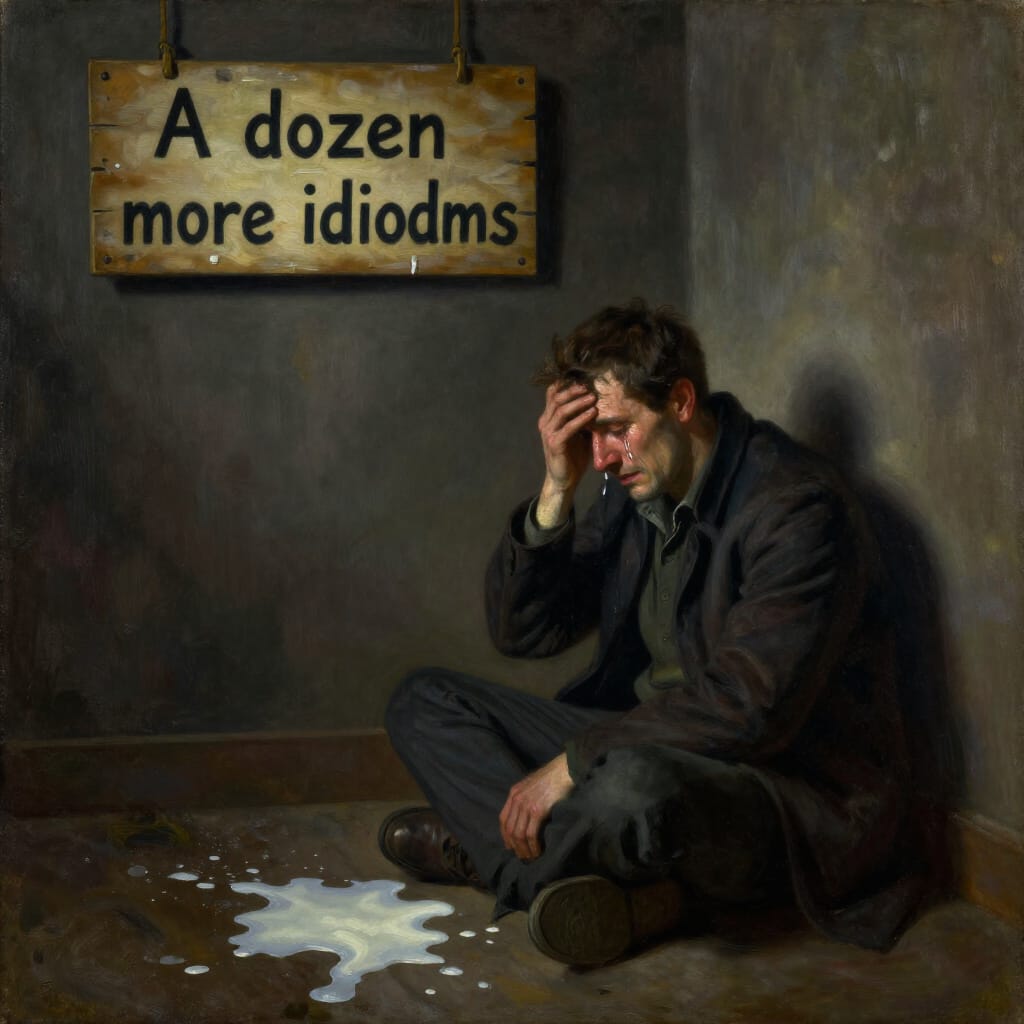
2. “Don’t cry over spilled milk."
I wish I had a dollar for every time my mother said that. She would always remind me of this when I complained about something that had happened. It's pretty common. It means there is no point in getting upset over something that has happened and cannot be changed. It’s a reminder not to dwell on what has happened, but rather to focus on a solution and move forward.
Its origin dates to the 1659 collection of proverbs, which stated, “No weeping for shed milk.”
3. “As easy as pie.”
Is an idiom that means something is not overly challenging to do. The phrase is usually linked to the fact that pies are typically simple take make. It’s more likely linked to the simple pleasure of eating pies in 19th-century America. The first citation was actually made in Australia (the land of the meat pie) in the 1220s.
On a side note, if you have never had a good old Australian “dog’s eye” with "dead horse,” you do not know what you are missing.
4. “Biting off more than you can chew.”
This means taking on more than you can handle, resulting in difficulty or failure to complete a task. It connects to old Chinese proverbs. However, it became popular as an English idiom in 19th-century America. Around this time, chewing tobacco was a popular habit. People say someone has bitten off more than they can chew when tobacco makes them sick.
5. “Don’t count your chickens before they hatch."
This idiom tells us to stay focused and not assume something before it has happened. It derives from "The Milkmaid and Her Pail," one of Aesop's Fables. In the fable, a milkmaid dreamed of making cream and butter from her milk. She hoped to sell them to buy eggs. When the eggs hatched, she imagined having a chicken farm. With the money, she could buy dresses to impress the boys. She became so absorbed in her dreams that she spilled the milk and lost it all.
that advises against anticipating success before it is certain. Stay curious and grounded until you reach your goals.
6. “Don’t judge a book by its cover."
One of the most common idioms advises against judging something before we understand it. It urges us to see beyond looks and first impressions. Instead, we should focus on what’s inside and a person's personality.
It dates to Roman times when the poet Juvenal wrote, “Never judge from appearances.”
7. “All is fair in love and war."
This suggests that in some cases, anything is allowed, even if it's unethical or immoral. The idiom particularly drew attention to love and war. We know anything is fair in war, but what about love? Do you agree that anything goes when it comes to love, that anything goes to get the desired outcome?
Although its origins are unclear, it is believed to date back to 16th-century English poetry.
8. “Ignorance is bliss."
This idiom suggests that not knowing the whole truth can be better. It helps avoid unnecessary stress and worry. Think about the innocence of a child playing with matches, not knowing what could happen.
English poet Thomas Gray's 1742 poem, An Ode on a Distant Prospect of Eton College. The line, "Where ignorance is bliss, 'tis folly to be wise," shows their happiness. They don’t know the sorrows and responsibilities of adulthood.
9. "Good things come to those who wait."
The inference is that patience and perseverance are essential for success. Being patient and waiting for the right moment can lead to great opportunities.
The main idea is from the French proverb, "Tout vient à point à qui sait attendre." This means, "Everything comes in time to those who can wait." The phrase gained fame in the 1980s when Heinz used it in a ketchup ad.
10. “It takes two to tango."
This idiom underscores that tango requires two dancers. In a fight, a negotiation, or any teamwork, there are always two sides and two people involved.
There was a popular song from 1952 called “Takes Two to Tango.” Ex-US President Ronald Reagan also famously used it. Its origin dates to the early 1900s. Hoosier Yackerman loved to dance, but hated people. He danced the tango to perfection on his own. When he entered a dance competition, the judge told him he did not win because “It Takes Two to Tango (boom boom!).”
11. “Actions speak louder than words."
Actions matter more than words. This shows that words can be empty without corresponding actions.
It dates to John 3:18 in the Bible, which says, "Let us not love with words or tongue, but with actions and in truth."
The famous monk St. Francis of Assisi also used the term in the 1200s, as did Abraham Lincoln in a 1856 speech.
12. “Better late than never."
There had to be at least one that came from Latin. This idiom comes from an ancient Latin proverb, "potiusque sero quam nunquam." Geoffrey Chaucer popularised it in the Canterbury Tales. It’s better to do something late than not do it at all. This idea applies to work, personal projects, and relationships.
How many of these did you know, or do you frequently use?
Till next time,
Calvin
About the Creator
Calvin London
I write fiction, non-fiction and poetry about all things weird and wonderful, past and present. Life is full of different things to spark your imagination. All you have to do is embrace it - join me on my journey.
Reader insights
Outstanding
Excellent work. Looking forward to reading more!
Top insights
Compelling and original writing
Creative use of language & vocab
Easy to read and follow
Well-structured & engaging content
Expert insights and opinions
Arguments were carefully researched and presented
Eye opening
Niche topic & fresh perspectives
Heartfelt and relatable
The story invoked strong personal emotions
Masterful proofreading
Zero grammar & spelling mistakes
On-point and relevant
Writing reflected the title & theme
Keep reading
More stories from Calvin London and writers in Education and other communities.
Common Lies on Resumes and How Employers Find Them Out
Your CV should tell the tale of your work life. This is the paper that tells a possible employer who you are before you even go to an interview. Some people who are applying feel like they have to lie or even make things up because of the pressure. It might seem like a good idea to correct a few things that aren't quite perfect, but employers are getting better at finding them.
By Novelty Diploma5 days ago in Education
AI in Education Market to Reach USD 73.7 Billion by 2033
Market Overview Artificial Intelligence in education refers to the use of machine learning, natural language processing, and intelligent analytics to support teaching, learning, and educational administration. AI technologies are increasingly integrated into learning platforms, digital classrooms, tutoring systems, and assessment tools. These technologies enable automated grading, personalized learning paths, and real time feedback for students and educators. As educational institutions continue to adopt digital infrastructure, the role of AI systems in improving learning outcomes has become increasingly important.
By Roberto Crum7 days ago in Education
The Politics of Playing Dress-Up
Well, to start off I'd like to say a happy world book day to all who celebrate. I know I haven't really posted anything on my socials about it but I'm not a jubilant kind of person. I lay low most of the time. Let's start off with a popular anecdote from the vaults...
By Annie Kapur6 days ago in Geeks


Comments (5)
I use “Don’t count your chickens before they hatch" a lot. It was great to see where some of these idioms come from.
I can see clearly from your image that it means "don't cry over spilled milk." The irony is that I actually spilled milk on my blanket just recently! I did not cry per se, but I certainly got angry. It might be one and the same because when the anger lingered, I felt like I wanted to cry. I really enjoyed learning about the "beer and skittles" idiom. I definitely cannot disagree that life is a mix of both responsibilities and pleasures. This is my cue to go pour myself a glass of wine! I died laughing at "biting off more than you can chew". I feel so called out because I cannot count how many times I have found myself in that situation. I am actually at the start of a massive project right now, and let's just say it would have been better if I were already halfway done. The universe is definitely trying to tell me something with that fifth idiom about counting chickens.
Great! Thank you.💕💗 I have heard all except beer and skittles, and I didn't know more than you can chew had to do with chewing snuff. I have used a few, and people older than me would use them when I was growing up, much more than I hear them now.😉💕💗
I so love these 🦋♦️🦋 Happy New Year 💙♦️♦️
Thanks for all these , and I do use a lot of them